No More Yielding but a Dream

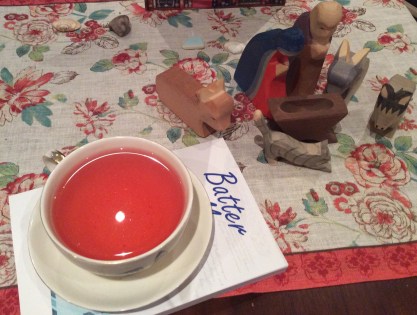
We’re hoarding today’s tea, a chocolate almond affair, because it’s that rarity in this calendar -a black tea. It’s absurd to drink it tomorrow at breakfast but on the other hand, we have to sing tomorrow morning, so we can’t resort to Twinings or anything that requires milk. Consequently, we’re revisiting a tea alarmingly named ‘Bear Track.’ It’s full of hibiscus, beetroot and we think raspberry, and so is a colourful spot on this dreicht Scots day.

So was the pantomime this evening. We went with our academic daughter for the sake of British tradition and can now safely boast having partaken in one. Well, we’ve seen one. We didn’t do much in the way of active participation. It was good fun though, full of colour and magic, and well worth seeing the once.

In the spirit of the evening  here’s not a poem, but Puck’s epilogue to A Midsummer Night’s Dream.

If we shadows have offended,
 Think but this, and all is mended—
 That you have but slumbered here
 While these visions did appear.
 And this weak and idle theme,
 No more yielding but a dream,
 Gentles, do not reprehend.
 If you pardon, we will mend.
 And, as I am an honest Puck,
 If we have unearnèd luck
 Now to ’scape the serpent’s tongue,
 We will make amends ere long.
 Else the Puck a liar call.
 So good night unto you all.
 Give me your hands if we be friends,
 And Robin shall restore amends.
(A Midsummer Night’s Dream, V.i)

The Tourist’s Alphabet

In going to Glasgow today we spent rather a disproportionate amount of our time on trains. Admittedly, we spent less by 3 hours than we would have done had we gone on a bus, but we still have tremendous sympathy with the writer of ‘The Tourist’s Alphabet.’ Train journeys through the years really haven’t changed all that much. Especially when the Scouts are all rammed into the carriage bound for Dalmany, There’s a chattering drunk on one side, a somnolent one on the other (doomed, it turned out, to miss the Kirkcaldy stop in spite of the cumulative efforts of ourselves and others to the contrary), no room to stand much less for a trolley (see above about the Scout contingent) and the train is bent on stopping at every God-forsaken place between Edinburgh and Dundee. And for good measure they’re showing off Edinburgh Gateway, the new station, too. Punch, of course is much wittier about the whole fraught episode, so without further ado, ‘The Tourist’s Alphabet.’

The Tourist’s Alphabet

(By Mr Punch’s Railway Book)

A is the affable guard whom you square:
B is the “Bradshaw” which leads you to swear:
C is the corner you fight to obtain:
D is the draught of which others complain:
E are the enemies made for the day:
F is the frown that you wear all the way:
G is the guilt that you feel going third:
H is the humbug by which you’re deterred:
I is the insult you’ll get down the line:
J is the junction where you’ll try to dine:
K is the kettle of tea three weeks old:
L are the lemon drops better unsold:
M is the maiden who says there’s no meat:
N is the nothing you thus get to eat:
O is the oath that you use – and do right:
P is the paper to which you don’t write:
Q are the qualms to directors unknown:
R is the row which you’ll find all your own:
S is the smash that is “nobody’s fault:”
T is the truth, that will come to a halt:
U is the pointsman – who’s up the whole night:
V is the verdict that says it’s “all right.”
W stands for wheels flying off curves:
X for express that half shatters your nerves:
Y for the yoke from your neck that you fling,
And Z for your zest as you cut the whole thing!

N.B. Punch obviously had no recourse to Strawberry Rhubarb Parfait tea as an antidote to the woes of travel. It tastes mildly of pink and we feel a bit like we’re drinking strawberry fool, but as a restorative it does come highly recommended by us.

An August Midnight

Among the scents we actively recoil from in drinks, coconut is one of them, or so it emerged this morning when we opened the tin with this day’s tea. We’ve never liked  coconut but we can sometimes bear it in things if it isn’t the main ingredient. This isn’t true of tea, possibly because no drink on earth should smell of suncream. In this particular instance, we’re immensely grateful that the tea doesn’t taste as it smells, but that might be because we were afraid of leaving it to steep. We’ve never really been curious to find out what suncream tastes like, you understand.

All told though, and if you can get past -or indeed have no issue with -the smell of coconut, it’s a nice tea, smooth, creamy and reminiscent of those flavoured custard creams sold briefly by Lidl (the coconut variety, naturally). We used to buy them in the summer and eat them out in the garden. With that in mind, here’s a poem we’ve long associated with summer writings and the act of creation -though we now suspect that for years we misunderstood the title. No matter, the day’s almost run out here in Scotland, and goodness knows Miss Marschallin-cat would be grievously offended if we didn’t consider her august company.


An August Midnight

Thomas Hardy

I

A shaded lamp and a waving blind,
And the beat of a clock from a distant floor:
On this scene enter–winged, horned, and spined –
A longlegs, a moth, and a dumbledore;
While ‘mid my page there idly stands
A sleepy fly, that rubs its hands . . .

II

Thus meet we five, in this still place,
At this point of time, at this point in space.
– My guests parade my new-penned ink,
Or bang at the lamp-glass, whirl, and sink.
“God’s humblest, they!” I muse. Yet why?
They know Earth-secrets that know not I.

City of the Scarlet Gown

We unveiled Irish Breakfast Tea this morning, and there really isn’t anything we can say about that except to express our profuse gratitude at finally opening something that will wake us up over breakfast. We love the variety of leaf teas this Advent Calendar displays but we’re desperately short of black tea and we’ve put off buying it expressly because we’re confronted by a calendar full of the stuff.

Thus, sufficiently awake and free of cotton-wool for brains when we looked up from hunting for Christmas cards -minimal luck, the selection was worse than sparse so late in the month -it was to help show St. Andrews off to visitors. Even on grey December days it’s easy to boast about. We had been traipsing through the Castle and were wending towards the cathedral in three o’clock twilight, and the sky was the loveliest wash of orange and grey whenit came home to us again how lucky we’ve been these last seven years. Part of it is the lifestyle of the people, and part of it’s the smallness of the town, and not a little of this is because of the sea and the fact that its in our blood even though we, like Coleridge hale from the city and cloisters dim. But there’s something more than that, an inarticulable something that we can’t seem to express. We alighted at Leuchars station one May -just to visit -and knew in our bones we’d come home. Andrew Lang says this best, so we’ll let him have the last word.

Almae Matres 

Andrew Lang

ST. ANDREWS by the northern sea,
    A haunted town it is to me!
A little city, worn and gray,
  The gray North Ocean girds it round;
And o’er the rocks, and up the bay,
  The long sea-rollers surge and sound;
And still the thin and biting spray
    Drives down the melancholy street,
And still endure, and still decay,
   Towers that the salt winds vainly beat.
Ghost-like and shadowy they stand
Dim mirrored in the wet sea-sand.
St Leonard’s chapel! long ago
   We loitered idly where the tall
Fresh budded mountain ashes blow
  Within thy desecrated wall:
The tough roots rent the tomb below,
  The April birds sang clamorous,
We did not dream, we could not know,
    How hardly fate would deal with us!
O broken minster, looking forth
    Beyond the bay, above the town!
O winter of the kindly north,
  O college of the scarlet gown,
And shining sands beside the sea,
   And stretch of links beyond the sand,
Once more I watch you, and to me
   It is as if I touched his hand!
And therefore art thou yet more dear,
   O little city, gray and sere,
Though shrunken from thine ancient pride
   And lonely by thy lonely sea,
Than these fair halls on Isis’ side,
  Where Youth an hour came back to me!
A land of waters green and clear,
   Of willows and of poplars tall,
And, in the spring-time of the year,
  The white may breaking over all,
And Pleasure quick to come at call.
   And summer rides by marsh and wold,
And autumn with her crimson pall
 About the towers of Magdalen rolled;
And strange enchantments from the past,
    And memories of the friends of old,
And strong Tradition, binding fast
   The ‘flying terms’ with bands of gold, —
All these hath Oxford: all are dear,
   But dearer far the little town,
The drifting surf, the wintry year,
   The college of the scarlet gown,
   St. Andrews by the northern sea,
      That is a haunted town to me!
Batter My Heart

Tonight, after a day spent attempting to get organised for Christmas (when and how did it get to be December 13?) we’re drinking Caramel Roibos tea. It’s smooth, rich and roughly the way we imagine liquid gold to taste. Win fact this is our second pot; we made the first with breakfast. It’s not really a breakfast tea though, and we don’t just mean that it only half diminished the feeling our brain was over-stuffed with cotton wool, or even that we felt extravagant drinking it (though we did). It’s a tea meant to be savoured though, drunk slowly and unaccompanied by anything that might interfere with the flavour of the tea.

It’s St. Lucy’s Day today, and by rights I should offer you John Donne’s thoughts on that occasion. In Scotland though, that particular poem is really best read on the shortest day of the year, and that’s still a little way away, so we’re guarding it jealously. Instead, have another of his and a favourite of ours, ‘Batter My Heart. And because it happens that it’s been strikingly adapted by John Adams into an aria, we’re going to give you that too; it captures the raw urgency of the speaker and deserves to be better known.

Here then, as sung by Gerald Finley, is ‘Batter My Heart’ from Doctor Atomic and Donne’s Holy Sonnet.


Holy Sonnets; Batter My Heart, Three-Person’d God

John Donne

Batter my heart, three-person’d God, for you
As yet but knock, breathe, shine, and seek to mend;
That I may rise and stand, o’erthrow me, and bend
Your force to break, blow, burn, and make me new.
I, like an usurp’d town to another due,
Labor to admit you, but oh, to no end;
Reason, your viceroy in me, me should defend,
But is captiv’d, and proves weak or untrue.
Yet dearly I love you, and would be lov’d fain,
But am betroth’d unto your enemy;
Divorce me, untie or break that knot again,
Take me to you, imprison me, for I,
Except you enthrall me, never shall be free,
Nor ever chaste, except you ravish me.


Hot Chocolate Tea and Mist like Incense

In the course of sampling a tea labeled ‘Hot Chocolate’ we’ve put our finger on why we take exception to chocolate in tea; it is disconcerting to drink something that smells of one thing and tastes of another. Hot Chocolate tea in particular is neither fish nor fowl. It has black tea notes, so is long in the mouth like any weighty black tea, but it smells of chocolate. It doesn’t actually taste of chocolate though, more of cinnamon and vanilla, maybe of sugar too. Most disconcertingly that undefinable thing, ‘milk essence’ is back, which leaves the whole thing tasting vaguely creamy. Now it may be that adding milk to ‘Hot Chocolate’ tea would help it, some teas work that way. Equally, milk might crush the spices and the vanilla, which opinion we tend towards. Either way, if we have this for breakfast tomorrow (and we could,as  it’s very definitely a black tea whatever else it is), we’re going to feel excessively decadent -Signora Neroni comes to mind, or possibly a misguided E. M. Forster heroine.

By rights we should give you another Scots poem this evening, just to prove that this piece of green and pleasant land has in fact produced poets who understand both metre and rhyme. We were going to too, and then we went rootling around on the internet for a scrap of something that had come up in a sermon months ago and were so delighted that our haphazard googling yielded results that you’re getting that instead. It’s neither May, nor Ascensiontide, nor even a Thursday, but that doesn’t diminish the loveliness of the poem. Besides, it’s Gaudete Sunday today, the Advent Sunday when we can relax liturgical disciplines a bit. If the priests can wear rose, we think we can disregard the calendar and look backwards to Ascension in the name of good writing. We’ll chalk up on a roster somewhere though that we owe you one piece of good Scottish poetry.

Ascension Thursday

Saunders Lewis (translated from the Welsh)

What is happening this May morning on the hillside?

See there, the gold of the broom and the laburnum

And the bright surplice of the thorn’s shoulder

And the intent emerald of the grass and the still calves;

See the candelabra of the chestnut tree alight

The bushes kneel and the mute beech, like a nun,

The cuckoo’s two notes above the bright hush of the stream

And the form of the mist that curls from the censer of the

meadows.

Come out, you men, from the council houses

Before the rabbits run, come with the weasel to see

The elevation of the unblemished host from the earth,

The Father kiss the Son in the white dew.

Green Tea and the Silvery Tay

There are some things that will always work well in tea. Cornflowers are one, and fruit -nearly all of it -seems to be another. We were reminded of this tonight, coming back from the university carol service to a pot of what the calendar simply calls ‘passionfruit green tea.’

The great blessing of fruit in tea is that while it increases in flavour, it never oversteeps, even if the tea does. Hence we could leave the leaves of Orange Oolong in the pot for as long as we liked, and it never went bitter. That’s not strictly true of green tea, but we had had the kind of day that left us disinclined to savour our tea over-long, so that was a non-issue.

Standing in the queue for the carol service this evening, we were told all about a poem penned to St Andrews that isn’t the famous Andrew Lang one.It was written by Robert Crawford for the installation of the new principal and we had grand plans to share it, but seemingly it can’t be found for all the tea in China, so here instead is a poem by another Scottish poet, William Topaz McGonagall. He’s best known for ‘The Bridge of the Silvery Tay’ -at least, for the first four lines. Less well known is that the Tay Bridge Disaster goes on ad at quite some length. The thing about McGonagall’s poetry -well one of many things -is that there are patterns to it, so in former years the Poetry and Cake Society used to play Guess the Rhyme at it’s Christmas party. We gave up on the (in)famous Tay Bridge poem because after a while we all knew it too well.

It wasn’t the only poem he wrote on the subject of the Tay though, and as Tayside isn’t so many miles as the crow flies from us, here’s ‘A Descriptive Poem of the Silvery Tay.’ We’re very sorry. If it’s any consolation, you could always play Guess the Rhyme.

A Descriptive Poem of the Silvery Tay

William Topaz McGonagall

Beautiful silvery Tay,
With your landscapes, so lovely and gay,
Along each side of your waters, to Perth all the way;
No other river in the world has got scenery more fine,
Only I am told the beautiful Rhine,
Near to Wormit Bay, it seems very fine,
Where the Railway Bridge is towering above its waters sublime,
And the beautiful ship Mars,
With her Juvenile Tars,
Both lively and gay,
Does carelessly lie
By night and by day,
In the beautiful Bay
Of the silvery Tay.
Beautiful, beautiful! silvery Tay,
Thy scenery is enchanting on a fine summer day,
Near by Balmerino it is beautiful to behold,
When the trees are in full bloom and the cornfields seems like gold –
And nature’s face seems gay,
And the lambkins they do play,
And the humming bee is on the wing,
It is enough to make one sing,
While they carelessly do stray,
Along the beautiful banks of the silvery Tay,
Beautiful silvery Tay, rolling smoothly on your way,
Near by Newport, as clear as the day,
Thy scenery around is charming I’ll be bound…
And would make the heart of any one feel light and gay on a fine summer day,
To view the beautiful scenery along the banks of the silvery Tay.

In a Bath Teashop

Have you ever heard it say that the better the tea-leaf the better the tea? Forever Nuts is a herbal tea that takes this idea to it’s logical conclusion; the constituent parts of it are so big as to actually be awkward to extract from the sample tin onto a teaspoon. That’s its greatest fault though -if you don’t mind drinking tea that is pink.

tea
Lest there was any doubt that it really was pink tea.

It doesn’t taste of pink, you understand, there’s beetroot in it and that dyes it pink. Mind you, it doesn’t taste of beetroot either. In fact it tastes mostly of apple, cinnamon, almonds and what we’re tolerably sure is another nut that the ingredients neglected to specify. It being another of our previous attempts to replace the Crumble Tea, when it cropped up in the calendar today it was a bit like stumbling over an old friend.

It’s especially welcome after a day spent drinking Twinings  breakfast tea. (We did warn you we could be snobbish about tea.) It’s not that there’s anything wrong with Twinings; if we have to have a bag tea their our default when we can’t get Red Rose, and we can’t at the moment, because we’re in Scotland. It’s just that if you live on nothing but leaf tea -and good leaf tea at that -for long enough, it’s a wrench going back. Well we think so. The fact that we never learned to take Twinings Breakfast Tea without milk probably doesn’t help either.

If at this point you’re wondering how teabags ever came to feature today, given that we’re clearly fussy on the point of tea, we spent a large portion of today from sunset onwards in tearooms visiting with people. If that sounds like on of those quirks of time worthy of Austen -when a morning lasted until you sat down to your afternoon meal -it’s only because this is Scotland and twilight falls at 3. If anything we were observing tea precipitately. Tea of course, was most quotidian, but as proof it needn’t be that way, here is a poem by John Benjamin. We preface this by saying that whenever we read ‘In a Bath Teashop’ we think of Bath wet-cobbled and rainy. It’s not that it rained the whole time we visited -it didn’t – it’s that nothing elevates a bath tearoom so much as ducking into one to escape a sudden gout of rain when without an umbrella.

In a Bath Teashop

John Betjeman

Let us not speak, for the love we bear one another—
Let us hold hands and look.”
She such a very ordinary little woman;
He such a thumping crook;
But both, for a moment, little lower than the angels
In the teashop’s ingle-nook.

Tea With My Aunts

This evening choir ran short, since no one had a list of the hymns and the anthem was both straightforward and familiar. To that end we returned home, made a cup of today’s Advent tea and listened to a podcast cheerfully dissect a favourite TV show -just to make sure we weren’t the only people on earth for whom that constituted a hobby. The tea was a white tea, ginger and pear, and although we associate pears with sunnier weather, the ginger rendered it suitably wintery. We’ve never encountered a white tea we disliked, and this was no exception. Being lighter to start with, they seem to adapt more readily to being flavoured, than say, green tea.

We also finally got around to sampling a bit of the St Nicolas Day tea, which purported to taste of apple cider. In fact it does, but possibly the sweetest apple cider we’ve ever had. That could have done with having a green tea underneath to cut the sweetness. We say that not out of any kind of expertise, but because the Advent Calendar issuer once kept us in what we called Crumble Tea and they called Mom’s Apple Pie, and it was the cousin to this cider-inspired infusion. Green tea, cinnamon and something apple-tasting, and it was apple crumble in a cup. Ideal for a winter night. We keep sampling its tea inheritors, and though some have come close, nothing is nearly as good -but then, none of them was also a green tea.

After that dictate on how people who know how to make tea should be making tea, have a poem in which everything is in it’s proper place.

Tea With My Aunts 

John Arlott

Tea with my aunts at half-past four,

Tea in a world without a war;

The widow-queen is still alive

In Grampa’s house at Albert Drive,

And firm the monkey-puzzle tree

He planted at the Jubilee.

A frilly, fragile cup of tea

Unsafely balanced on my knee,

Aunt Anna mellows as I take

Another slice of home-made cake,

She rustles in her stiff grey gown

And takes her endless knitting down.

A chastely ringed and blue veined hand,

A weak white neck in velvet band,

With modest touch aunt Susan plays

The tranquil ‘Sheep May Safely Graze’

Of Bach, the tune she used to play

On Sunday evenings years away,

To whiskered men of gentle sort

Who paid her strained and stately court.

The Landseer cattle in the hall,

The massey antlers on the wall,

The monumental two-year clock,

A faith in class as firm as rock,

And all the house are just the same

As on the day the family came,

Firm barred against the new and strange

And devil-prompted thoughts of change.

The gilt-edged shares will never drop,

But yearly yield a steady crop

To feed a world of certain grace,

Where servants knew their proper place.

The bombs that broke the windows here

Have not destroyed the atmosphere.

Why the Flood Came

Today we revisited the coffee cake tea of two days ago. But at some point in the afternoon we paused in our writing -some of it creative, much of it for UCAS -and made a pot of what the Calendar calls ‘nutty and spice.’ It seems to be equal parts nuts and spices, and emerging from that semi-somnolent place writing induces, it was just what we needed. It tastes of crisp autumn weather, never a bad thing this time of year because often by the time we make afternoon tea the sun has set and it’s easy to forget that so lately as November the sun set in the afternoon.

We’re cheating a bit this evening, because UCAS exhausted our creative energy sometime around the third pot of tea. As we approach that terrifying rush for Christmas, here’s a piece of liturgical humour from the Advent church newsletter that we thoroughly appreciated on reading;

Why the Flood Came 

Originally from the parish magazine of All Saints’, Worlingham

And the Lord said unto Noah; ‘where is the Ark which I have commanded thee to build?’

And Noah said unto the Lord; ‘Verily I have had three carpenters off ill. The gopher wood supplier hath let me down -yea even though the gopher wood hath been on order for nigh twelve months. The damp course specialist hath not turned up. What can I do, O Lord? ‘

And the Lord said unto Noah; ‘I want that ark finished after seen days and seven nights.’ And the Lord said unto Noah; ‘it will be so.’

And it was no so.

And the Lord said unto Noah, ‘What seemeth to be the trouble this time?’

And Noah said unto the Lord; ‘ Mine subcontractor hath gone bankrupt. The pitch which Thou commandest me to put on the outside and the inside of the ark hath not arrived. The plumber hath gone on strike.’

Nora rent his garments and said; ‘The glazier departeth on holiday to Majorca -yea even though I offered him double time. Shem, my son who helpeth me on the ark side of the business, hath formed a pop group with his brothers Ham and Japheth. Lord, I am undone. The gopher wood is definitely in the warehouse. Verily and the gopher wood supplier waiteth only upon his servant to find the invoices before he delivereth the gopher wood to me.

And the Lord grew angry and said unto Noah; ‘what about the animals? Of the fowls after thier kind, and every creeping thing of the earth after his kind, two of every sort have I ordered to come to thee to keep alive. Where, for example, are the giraffes? And where are the clean beasts, the male and female, to keep their seed alive upon the face of the earth?’

And Noah said; ‘the van cometh on Tuesday and yea, it will be so.’

And the Lord said to Noah,;  ‘How about the unicorns?’

And Noah wrung his hands and wept, saying; ‘Lord, they are a discontinued line. Thou canst not get unicorns for love nor money.’

And God said; ‘Where are the monkeys and the bears and the hippopotami and the elephants, and the zebras and the hartebeests, two of each kind, and of the fowls of the air by sevens and the male and female?’

And Noah said unto the Lord; ‘They have been delivered to the wrong address but should arrive on Friday, all save the fowls of the air by sevens, for it hath just been told unto me that fowls of the air are sold only in half dozens.

And Noah kissed the earth and said; ‘Lord, Thou knowest in Thy wisdom what it is like with delivery dates.’

And the Lord in his wisdom said; ‘Noah, my son, I knowest -why else dost tho think that I have caused a flood to descend upon the earth?’