
Returning to Stars Hollow

gilmore-girls

Having avidly rewatched Seasons 1-7 of Gilmore Girls in anticipation of the revival episodes, we sat down and binge watched all four of the new episodes (with plenty of tea and biscuits on hand, of course). Despite the time constraints of a much shorter series, Gilmore Girls: A Year In The Life managed to hit a lot of the right notes and walked a fine line between catching the viewer up and moving the story forward nine years. ‘Winter’ got us back into the Gilmore Girls rhythm very quickly and by the middle of the first episode, it felt like we had never left Lorelai and Rory’s world. We thought that we would share a few of our thoughts on a character-by-character basis. Needless to say, there are spoilers for anyone who has not watched all four episodes yet.

Lorelai.

Where else to start but with Lorelai (Lauren Graham)… Overall, A Year in the Life resolves Lorelai’s storyline well. Without feeling untrue to her character, we see her arc quite naturally over the four episodes towards reconciliation with Emily and openness with Luke. The Wild scenes where Lorelai leaves Stars Hollow on a voyage of self-discovery showcase Lauren Graham’s versatility and emotional depth as an actress whilst also demonstrating Lorelai’s growth as a character. In one of the most poignant scenes of the whole revival (perhaps the scene of the revival), Lorelai’s emotional phone call to her mother provides much needed catharsis as they grieve and remember Richard. The trip in turn gives Lorelai a clearer perspective on her relationship with Luke and in a lovely counterpoint to the beginning of the series, Lorelai ends happily settled down whilst Emily is the character striking out on her own.

Rory.

 Rory’s (Alexis Bledel) character has perhaps the most problematic arc of the three Gilmore girls. A Year in the Life perhaps struggles in this respect with being ten years after the end of the original series. Much of Rory’s angst feels far more suited to a 20-something Rory than a 30-something Rory (indeed those famous final four words take on a very different perspective in this context, but more on that later…) Rory’s character also seems to suffer the greatest rupture between where we left her at the end of Season 7 and where her story picks up again. Rory’s relationship with Logan is most symptomatic of this. It is never explained how they transitioned from his “all or nothing” ultimatum at the end of Season 7 to a “What happens in Vegas stays in Vegas” agreement in A Year in the Life (although this is perhaps explicable in light of the return of the Sherman-Palladinos). This development does not fit naturally with how either character left us. It feels unnatural for Rory to be happy being the “Other Woman” given her previous experiences with Dean and Lindsay while Logan’s reconciliation with his family and willingness to acquiesce to marrying Odette is also unexplained.

Emily.

 A Year in the Life is perhaps at its strongest when it comes to resituating Emily (Kelly Bishop) as a character in light of the death of her husband Richard (Edward Herrmann). We see her progress through all the phases of grief (including the unimaginable sight of Emily Gilmore in jeans!) Her storyline also offers a valuable chance for Lorelai and Emily to grow closer. The therapy scenes in particular offer an insight into just how complex their relationship is after so many years of miscommunication. Underneath that tension, A Year in the Life offers a sustained look at how the relationship has evolved since the end of Season 7. By the end of ‘Fall’, mother and daughter have reached a better understanding and seem set on a much better path for the future. In arranging to see each other, Lorelai and Emily have progressed to a point where this agreement is mutual rather than forced.

Emily’s character also achieves a satisfying sense of direction and self-worth beyond the DAR and her position as the matriarch of the family. In many respects, this newfound independence brings plot points to fruition that were planted during Emily’s separation from Richard in Season 5. One of the most notable examples of this is the show’s use of her history degree at the whaling museum in Nantucket.

Honourable character mentions.

 Kirk and Michel make happy (and entertaining returns) but the return of the fabulous/terrifying Paris Geller (Liza Weil) is one of the most welcome and successful subplots of A Year in the Life. Paris continues to be a force of nature and fluctuates between acerbity and deep-seated vulnerability. The scenes in her return to Chilton display this perfectly when she veers wildly from terrifying school children and karate kicking bathroom doors in stilettos one moment to fragility and insecurity the next. We only wish she could have appeared in more episodes!

A few gripes.

 As wonderful as it is to have Amy Sherman-Palladino and Daniel Palladino back in the Gilmore Girls driving seat, the revival suffers in some respects from having two different writers and from the episode distribution that they were given. ‘Spring’ and ‘Summer’ (DP) are hugely different in narrative style from ‘Winter’ and ‘Fall’ (ASP) and many storylines get lost between them or end up being resolved preternaturally quickly. An example that particularly grated was the storyline in ‘Winter’ regarding Luke and Lorelai considering having children. It did not feel resolved by the end of ‘Winter’ and then was never referenced again.

A Year in the Life also suffered from the natural difficulties of only having a four-episode run and the respective availabilities of returning actors and actresses. Sookie’s (Melissa McCarthy) absence was never more keenly felt than when she failed to appear at Lorelai’s wedding (despite making her only appearance of the revival, alongside dozens of wedding cakes, earlier in the same episode). The short episode run also seemed to lead to expansions and contractions of time and geography that make no logical sense. Rory jumps between London and Stars Hollow seemingly instantaneously (we wonder if the Huntzbergers have indeed invented teleportation in addition to owning all the newspapers on the planet). In a similar vein, Emily is shown in Nantucket the night before Lorelai’s Stars Hollow wedding and would have to travel at lightning speed to attend her daughter’s wedding the following day. This inconsistent sense of time also affects the transitions between episodes for the viewer. It is unclear whether each episode continues directly on from the preceding one or whether weeks or even months have passed in between.

Where A Year in the Life does do well is connecting the show’s longer past with its present through audio and visual flashbacks. One of the most emotional scenes of the revival combines scenes of Friday dinners’ past to great effect as Rory sits down to write her family’s story.

The final words.

The final four words have suffered somewhat from being reified by fans in the intervening period between the end of Season 7 and the revival. Whilst somewhat frustrating upon initial viewing, on reflection there is a pleasing symmetry in how Rory’s storyline is concluded as she mirrors the Lorelai that we met at the beginning of the original series. Many storylines come full circle from the original series in A Year in the Life and set the scene for characters to begin new phases in their lives. Ending on such a note of possibility and uncertainty leaves us feeling that we have indeed seen a year in the life of the Gilmore girls and that their world will continue to change even without us there to witness it.
Put the Kettle On

After all our frustration with coffee-flavoured tea, we were apprehensive to discover today’s tea was meant to taste of coffee cake. It turns out that this was needless; it’s only a well-spiced black tea with lots of cinnamon, which is an institution we can endorse. Especially because great swathes of today were spent on an imperfectly heated 23 Bus Service to Stirling.

Happily too, this means we can reinstate the ritual of having leaf tea at breakfast. In the absence of a good black tea, we’ve defaulted to Twinings teabags, because it doesn’t matter how big the leaves or high the grade, green tea is insufficient to wake us up in the morning. And yes, we freely acknowledge that we’re a bit snobbish about our tea. We like to think of it as ritual though, because after all, what could be more ritualistic than tea? Here’s a poem from Ten Poems about Tea that recognises this all too well.

Alternative Anthem

John Agard

Put the kettle on
Put the kettle on
Is the British answer
to Armageddon

Never mind taxes rise
Never mind trains are late
One thing you can be sure of
and that’s the kettle, mate.

It’s not whether you lose
It’s not whether you win
It’s whether or not
you’ve plugged the kettle in.

May the kettle ever hiss
May the kettle ever steam
It is the engine
that drives our nation’s dream.

Long live the kettle
that rules over us
May it be limescale free
and may it never rust.

Sing it on the beaches
Sing it from the housetops
The sun may set on empire
but the kettle never stops.

Strawberries and Austen

This evening’s Advent tea sample assures us it is serenity in a tin, which assertion we’re disinclined to question, since after all the chaos that is a High Anglican Advent Service, we welcome the concept. It’s not just the choreography at Mass either. We’re supposed to be moving back to Canada, Marschallin-cat and all, and are presently making arrangements. Also we’re applying via UCAS for teacher training, but no two universities use the same application window, and they still make more sense than the Canadian courses we’ve looked at. Serenity in tins or otherwise is readily welcomed.

This particular cupful tastes and smells of strawberries. There’s reship in there too, but it seems mostly to colour the tea, not flavour it. Consequently we’re sitting here drinking tea and thinking of Emma and Highbury where strawberries meant ‘English verdure, English culture English comfort seen under a sun bright, without being oppressive.’  Except that the light’s gone and we’re in Scotland.

With her in mind though as we drink our strawberry tea, here’s a poem by Jane Austen, who we’ve credited with many things previously, but never verse.

Happy the Lab’rer

Jane Austen

Happy the lab’rer in his Sunday clothes!
In light-drab coat, smart waistcoat, well-darn’d hose,
Andhat upon his head, to church he goes;
As oft, with conscious pride, he downward throws
A glance upon the ample cabbage rose
That, stuck in button-hole, regales his nose,
He envies not the gayest London beaux.
In church he takes his seat among the rows,
Pays to the place the reverence he owes,
Likes best the prayers whose meaning least he knows,
Lists to the sermon in a softening doze,
And rouses joyous at the welcome close.

Kneel with the Listening Earth

We’re drinking something called Genmaicha tonight, and it’s evidence of a flavoured tea that works. It’s flavoured with popped rice, and if that sounds odd, it doesn’t taste it. It offers a subtle, almost nutty taste to the tea, which means it bears up well against mince pies.

We defend the mince pies, by the by, on the basis that tonight was the Nine Lessons and Carols service. In the days that we were still in the choir, we were always offered them in the reception afterwards as a thank-you, and accordingly it came to mark the point at which mince pies became acceptable Advent fare. Clearly the habit has stuck. Also, we had guests this evening and wanted to offer them a suitable sweet.

We’re still humming the music from the Nine Lessons and thinking of Advent this evening, so we thought we’d cheat a bit and borrow a poem we’ve posted before that anticipates the season.

After Trinity 

John Mead Faulkner

We have done with dogma and divinity,
Easter and Whitsun past,
The long, long Sundays after Trinity
Are here with us at last;
The passionless Sundays after Trinity,
Neither feast-day nor fast.

Christmas comes with plenty,
Lent spreads out its pall,
But these are five and twenty,
The longest Sundays of all;
The placid Sundays after Trinity,
Wheat-harvest, fruit-harvest, Fall.

Spring with its burst is over,
Summer has had its day,
The scented grasses and clover
Are cut, and dried into hay;
The singing-birds are silent,
And the swallows flown away.

Post pugnam pausa fiet;
Lord, we have made our choice;
In the stillness of autumn quiet,
We have heard the still, small voice.
We have sung Oh where shall Wisdom?
Thick paper, folio, Boyce.

Let it not all be sadness,
Nor omnia vanitas,
Stir up a little gladness
To lighten the Tibi cras;
Send us that little summer,
That comes with Martinmas.

When still the cloudlet dapples
The windless cobalt blue,
And the scent of gathered apples
Fills all the store-rooms through,
The gossamer silvers the bramble,
The lawns are gemmed with dew.

An end of tombstone Latinity,
Stir up sober mirth,
Twenty-fifth after Trinity,
Kneel with the listening earth
Behind the Advent trumpets
They are singing Emmanuel’s birth.

Snow Day

We opened the Advent Calendar this morning to a tea called Snow Day. It professes to be full of peppermint leaves, white chocolate, cocoa and something called cream flavouring. (No, we don’t know what that is. We’re sort of afraid to ask.) At a glance then it is trying to taste of mint hot chocolate. At the risk of sounding snobbish, while we love tea, and we love hot chocolate, we don’t necessarily like them together. Luckily for us, Snow Day actually tastes of peppermint creams, which is a curious choice for a tea since there are only so many peppermint creams a person can eat in a sitting, and it turns out that that threshold is reached before the end of a second cup of tea. It’s not a bad green tea though, provided you like mint lots. This happens to be true of us.

Here’s a poem for today by Thomas Hardy, whose poetry is too often forgotten in favour of his novels. It gets the feel of a British winter to the bone, and just to be novel, in a year of things that have sometimes seemed overwhelming and bleak, it’s hopeful.

The Darkling Thrush

Thomas Hardy

I leant upon a coppice gate
      When Frost was spectre-grey,
And Winter’s dregs made desolate
      The weakening eye of day.
The tangled bine-stems scored the sky
      Like strings of broken lyres,
And all mankind that haunted nigh
      Had sought their household fires.
The land’s sharp features seemed to be
      The Century’s corpse outleant,
His crypt the cloudy canopy,
      The wind his death-lament.
The ancient pulse of germ and birth
      Was shrunken hard and dry,
And every spirit upon earth
      Seemed fervourless as I.
At once a voice arose among
      The bleak twigs overhead
In a full-hearted evensong
      Of joy illimited;
An aged thrush, frail, gaunt, and small,
      In blast-beruffled plume,
Had chosen thus to fling his soul
      Upon the growing gloom.
So little cause for carolings
      Of such ecstatic sound
Was written on terrestrial things
      Afar or nigh around,
That I could think there trembled through
      His happy good-night air
Some blessed Hope, whereof he knew
      And I was unaware.

Asperges Me, Advent and Tea

It’s Advent I, the start of the liturgical New Year, and about this time last year we wrote about what that entailed from the choir stalls. One of the questions that arose at the time was the root of the Asperges -the liturgical  rite that justifies the priest in dousing all of us with water for reasons of penitence. Broadly speaking.

We still can’t say anything very definite about how that came about, though we think it might be an echo of the baptismal liturgy. We did discover though -and accordingly thought it might interest others to learn -that the Asperges lies at the root of our word ‘aspersions.’ It turns out that ‘to cast aspersions’ means not only ‘a false or damaging accusation,’ or even ‘the act of slandering or libeling’ but also -and this was new to us -‘to sprinkle with water.’ Who’d have guessed?

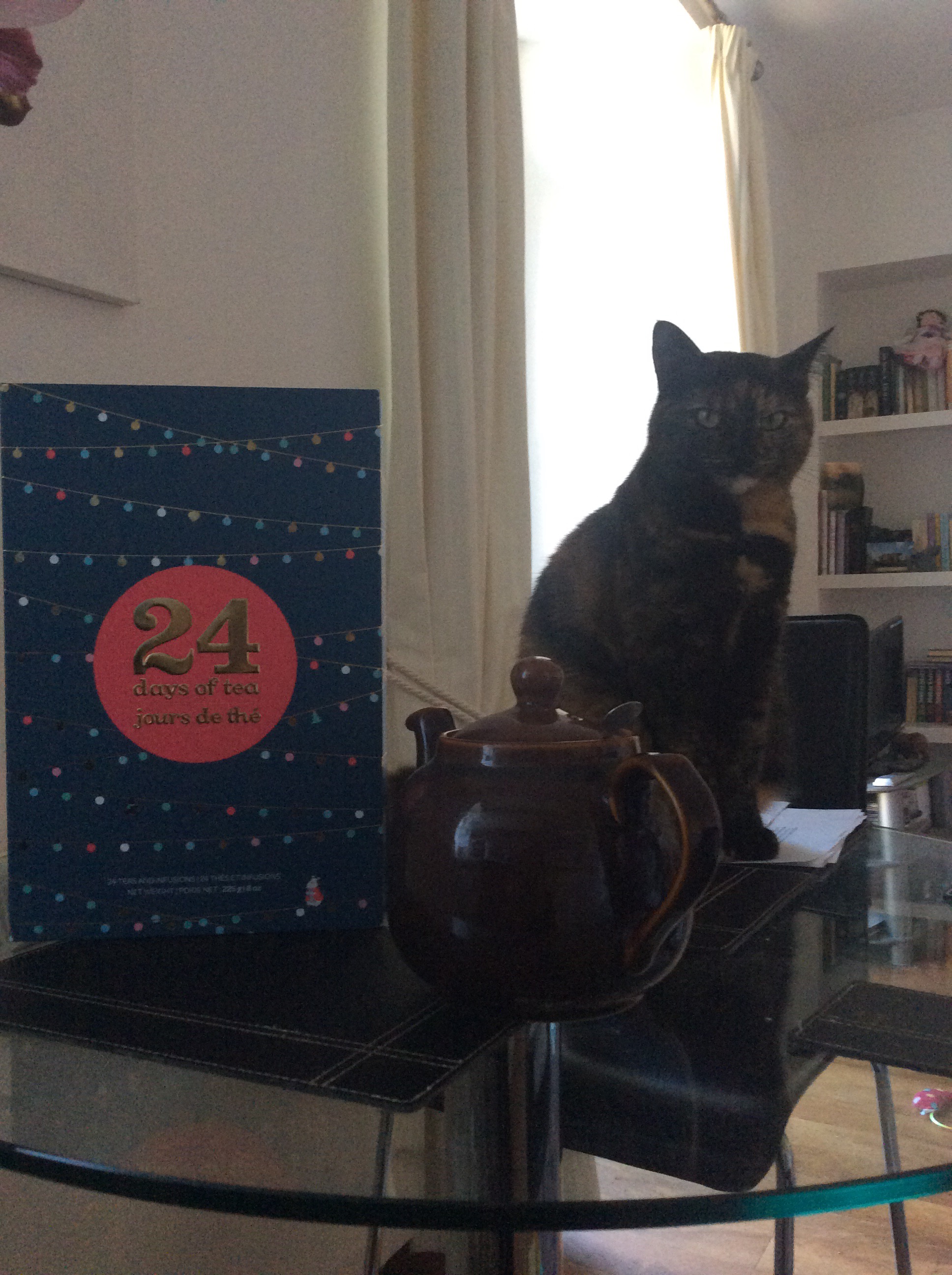
We do all this though, the water and the litanies, because in part, Advent is about renewal. It’s apocalyptic too, and comfortably gloomy, even penitential as evidenced by the Asperges. But ideally there’s also something expectant that underpins it as we look ahead to Christmas, something we were reminded of when all unlooked for an Advent Calendar dispensing tea arrived on our doorstep. Even the stand-offish Miss Marschallin-cat liked it. At least, she designed to sit with it, no small thing in her world.

Nothing is so wholesome and restorative as tea, not to us. Which is why as we watched the sun setting at 4 o’clock the other day, we looked across at that tea calendar and resolved to reinvigorate the Poetry and Cake Society, where tea and good poetry met, even if we can only manage this electronically, and even if it only lasts through Advent. It will be our effort to sustain light squibs and that too-emily forgotten hopefulness of Advent this year.

Now though we have to bolt. There is a summons to sing unmanageable Palestrina for an Advent Carol Service this evening and that means a rehearsal. We’ll be back soon with thoughts on tea and poetry.

(Re)Introducing the 87th Precinct

The last time we mentioned mystery novels, it was with a view to looking at Golden Age and hard-boiled writing. There’s another side to that coin though, one we neglected to look at and that is the police procedural.

There are two series that worked to introduce us to this kind of writing. One was Colin Dexter’s Inspector Morse, to whom we owe a serious debt in the shape of our knowledge of the cryptic crossword. It’s worth noting that Book Morse isn’t nearly so civilised as Televised Morse. He loves opera, certainly, and he can solve a Times crossword in 10 minutes, but he’s as likely to read The Sun as he is the news portion of The Times, and is much more inconsistently gentlemanly than his televised equivalent. Perhaps the greatest thing about these books, second only to the mystery, is the friendship between Lewis and Morse. It’s a temperamental, imperfect, stiffly articulated thing, but is summed up with touching succinctness by Strange; ‘he didn’t give a damn what anyone else thought, but he cared about your opinion, Lewis.’

The other though, the one we want to talk about, is Ed McBain’s undeservedly obscure 87th Precinct series. Described by the author as a ‘conglomerate hero,’ Steve Carella and the other precinct detectives seized a long history of policemen outwitted by amateur detectives  and turned it on its head, arriving on the page a collection of capable, competent men and women who knew their job and did it well. We see them not only catching murderers, but organising line-ups, analysing fingerprints, following clues, in other words doing all the things we expect of the police in a mystery -or would if they weren’t routinely made out to be antagonistic towards our detective champion of choice.

Perhaps the most interesting aspect of the 87th Precinct though is the counterpoint it offers to the hardboiled detective story. Among the many tropes of that genre is the isolation of the private eye. Because the law is often antagonistic to the detective preserving it, s/he is forced to work alone. But in the police procedural, especially under the eye of McBain, we are offered an alternative. The 87th Precinct aren’t nuclear family, but they are a kind of family, something hinted at as early as Cop Hater, the debut book of the series. Without exception it is the reliance of the men of the 87th Precinct on one another that sees the mystery solved, managing somehow to unite all the best aspects of Golden Age writing, its warmth and community, with more realistic detective cases. It isn’t the visceral reality offered by McBain’s contemporary writers, but then, if we had any taste for visceral corpses and gruesome murders we’d never have thrived on those Golden Age stories in the first place.

Short, with clear, crisp prose, we’ve never been sorry that our Crime Fiction course brought McBain and his books to our attention. We do wonder though why they aren’t better-known and more widely loved.

Why the Death of Roger Ackroyd Matters

American Murder Mystery detective: I’m going to solve this murder because it’s horrible and dramatic and linked to me through my tragic backstory.

English Murder Mystery detective: I’m going to solve this murder because I don’t want to be late to tea.

A while ago we stumbled across the above quote on the internet. It made us laugh, and then it made us think, because we’re not sure it does justice to either classification of mystery.

The English murder mystery traditionally comes from a place of optimism. In it the world is inherently good, as are the people in it. When the detective is invoked it is because a Wrong has been committed that puts that goodness in jeopardy. It becomes the duty of Poirot, Campion, Wimsey, et al to restore that goodness, to preserve civilization. For that reason we often fail to see the corpse, or if we do, it is tidily presented. Not only that, the murder weapons we see in the early English mystery are often exotic, curio knives, pistols that date to the Boer war, sacrificial daggers and ancient artifacts.

Alison Light has argued that this is a reaction in Golden Age fiction especially, against the War. Readers needed the fantasy of clean, contained justice, not realistic renderings of corpses and their deaths. To a certain extent we suppose we must still need it, otherwise why be outraged when those ten Detection Club laws are broken? Why be startled by the violent death, the masses of fictive blood in Have His Carcass? Why care, as Edmund Wilson once famously asked, who killed Roger Ackroyd, and why be absolutely indignant when that particular solution is presented? Is it because in a civilized, well-ordered world, these things have no place?

We think it might be, and thinking on it, we recant; the loss of tea is a part of the English murder mystery since to delay it is to infringe upon civilization, and to lose the veneer of civility is to let the world fall, and that must not happen.

Often though, in American detective fiction, this is exactly what has happened. If the classic English mystery is cozy, the American is what writers of crime fiction call hardboiled. The detective is flawed, undeniably, but if s/he is flawed, so is their world. Where English mysteries begin from a place of optimism, the American begins from one of disillusionment. Here the world is fallen, the people imperfect. We see the corpses and more than that they are messy. There is violence and there are guns, people are battered and bruised; there is also blood, brains, severed limbs, and where in the English mystery these things would shock, here they feel inevitable. The world is an uncivilized one, tea will be late, and the detective is obliged to work outside the limits of the law to preserve it.

Never because of personal history though. While they undeniably have histories, when Sam Spade, Phillip Marlowe, and Vic Warshawski (to name but a few) fight devastating odds it is not in the name of their own private demons but because they must. Not to do so is to let a world they have sworn to protect fall to the Bay City Cops, the thugs, the mafia, is to sacrifice whatever innate goodness is left in the world. Their fight is to not to preserve, but to restore civilization and that fallen grace. Inevitably, it can’t be done all in one stint, so they go on fighting, never quite winning, but never wholly losing either. If the solution is not proclaimed with a triumphal yell, if the ends when tied together are frayed, it is because the victory in hardboiled fiction, like its corpses, is messy and its world a murky, changeable place in need of salvation.

Even here we’ve simplified it. We’ve not touched on the police procedural, which is a cat of another colour and exists at least in part to refute the isolated, defeatist world of the hardboiled gumshoe. Another time. For now it’s enough to have approximately sifted what it is that drives the mechanism of the hardboiled plot, why we love it, and why they fight.

Review; The Chilbury Ladies’ Choir

We’ve been meaning for some time to comment on Jennifer Ryan’s The Chilbury Ladies’ Choir. It arrived unexpectedly in August from a friend who clearly understands our taste in reading. An epistolatory novel revolving around the village in the year 19141, we opened it expecting something in the style of Miss Read.

img_0693
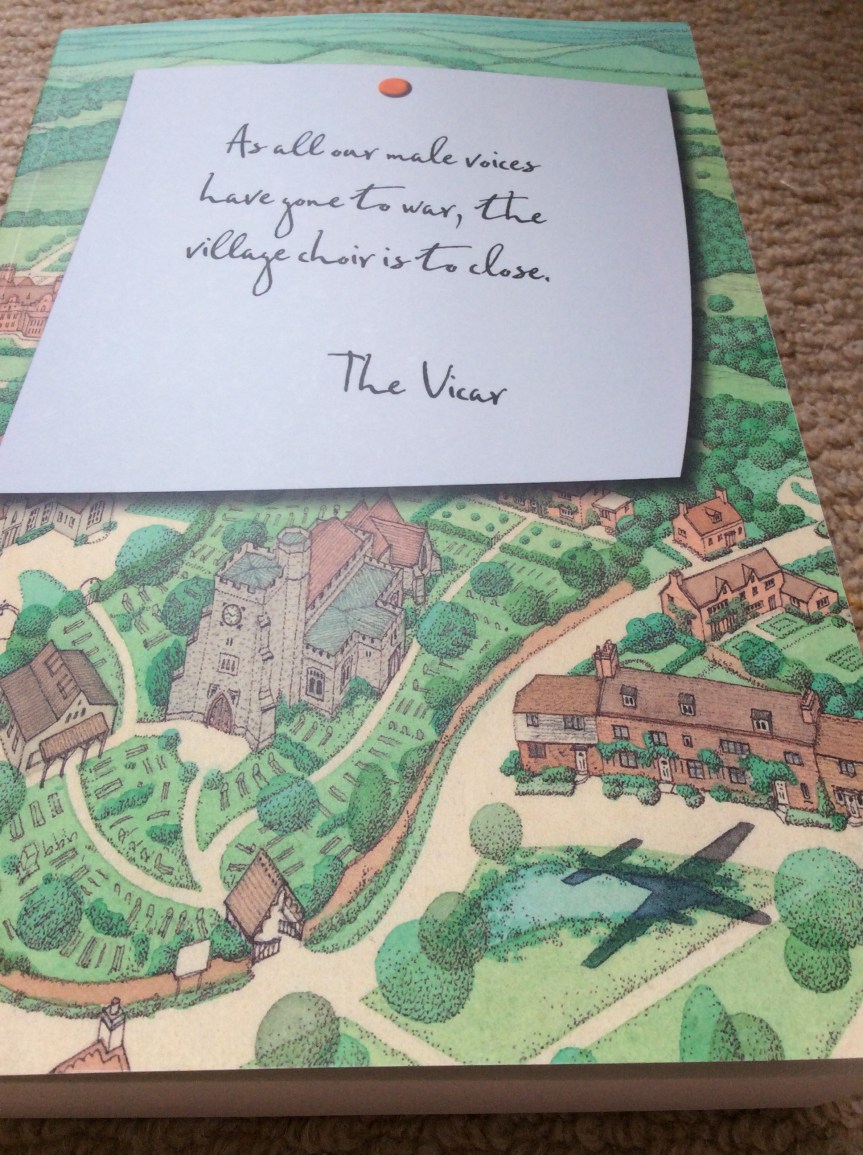
The Chilbury Ladies Choir; it even looks like a Miss Read book with all those variegated greens and the village map.

For the most part it was. The plots were all transparent enough that we could guess the outcomes, and quotidian enough to sit comfortably next to the world of Thrush Green (we never did learn to love Faiarcre). Now and then though it defied expectations. The end of the first act saw it veer sharply into realism, and while that should have jarred with the soap-bubble existence of the Chibury women, it didn’t because the author knew how to pay off on consequences and grow her characters.

It does fall down in plausibility every now and again. We know that much of the story owes to various real-life experiences reported to the author, and don’t doubt these things did happen; on the page though, some of them strain credulity. As we’ve said before, reality is no defence for fiction. Sometimes the mechanics in place to sustain a plot simply overburden a story, and occasionally we saw that happen here. For our part we could have done with more from little Sylvie and less about the swapped babies (though we hasten to add that Clara Palfry was a wonderful creation but.

None of that should detract from the narrative craft on display Ryan handles a broad cast with deftness and balance, rounding out all of them just enough to leave the impression that we have got to know all of these characters equally. Each volta or turn brings with it unlooked for depths, with the result that even when predictions about plots and characters are met there are still ideas to be explored and deeps unplumbed yet.

Perhaps most satisfying was Ryan’s refusal to give into the fairytale ending when it presented itself. It would have been the easy and obvious choice with a book so comfortably readable as The Chilbury Ladies Choir, but at no stage does Ryan take it. Instead we get enough hopefulness and enough mundanity to ground the story of the Chilbury Ladies Choir solidly in a world recognisably our own. The result is an optimistic story with a warm heart, that makes for light but satisfying reading.

The paucity of tenors and basses it turns out is a problem that echoes through the ages, and while here there is undeniable poignancy in the SSA status of the choir, we can’t help finding that more than a little gratifying, especially when it makes for such a good narrative. And it’s nice to know we at All Saints’ are in good company. After all, even choirs are only human.


Vibrations in the Memory

‘You have to sing ‘Summer Holiday’ and ‘Draw on My Leg’,’ said the young boy we were babysitting on Saturday.

He made this declaration with the total certainty unique to nursery-age children that because he knew these songs, so would we. In fact, to the shock and horror of various British friends, we knew neither, not even, as we repeatedly asserted, ‘Summer Holiday. We have since heard both of them, but on Saturday evening confronted with a barrage of questions ranging from ‘why don’t you know them’ to ‘why didn’t you sing them in nursery?’ we did begin to think about music we’d sung in school at that age.

Brahms famous weigenlied stands out at once because that was our wiegenlied if you like, our lullaby, the song the music-box played and that we devoted years to discovering the lyrics to because our grandmother could remember no more than lullaby and goodnight/with roses bedight.

‘Allouette’ is there too, and ‘My Darling Clementine,’ though we can’t remember where we sang them. We know that for many years we loved to sing -albeit mostly flatly -‘Over the Rainbow,’ and now think it must have been this song, with its octave leap and falling sixth that seeded our love of Rusalka’s ‘Song to the Moon.’

When we think about our early-years music experience though, almost all of it owes to The Sneezepickle Songbook, a creation lovingly rendered by an irreplaceable music teacher who radiated enthusiasm for both her subject and her children in waves. It’s her fault that we sing the wrong words whenever ‘Early One Morning‘  strikes up on the radio; to us it will forever be about a bluebird heralding the spring, and nothing to do with heartbroken young women.

‘How does Robin Build its Nest?’ was another of her creations, and we think it was Mrs Sneezepickle who gave us ‘Fat Robin Redbreast.’ (She was a bird-lover, can you tell?)

We can’t remember more specifics, and to enumerate them might well prove redundant, because what Mrs. Sneezepickle and her songbook with its cover of hunter Stewart Tartan really gave us was our love of music. It doesn’t matter that our singing will never be more than amateurish. We’re not looking to make a career of it, or even a study like Iona and Peter Opie, amalgamating children’s games across the country for future reference. We only want to sing, even if it’s only ‘Summer Holiday’ to a sleepy 3-year old of a Saturday evening.   We’ve tried to explain why before, but think Madeleine L’Engle might say it best;

The kind of unself-consciousness I’m thinking about becomes clearer to me when I turn to a different discipline: for instance, that of playing a Bach fugue at the piano, precisely because I will never be a good enough pianist to play a Bach fugue as it should be played.But when I am actually sitting at the piano, all there is for me is the music. I am wholly in it, unless I fumble so badly that I perforce become self-conscious. Mostly, no matter how inadequate my playing, the music is all that matters: I am outside time, outside self, in play, in joy.