It’s well and truly summer here, and we can tell by the size of the choir. We’re not a large choir in term-time, but we’ve halved in size since the students went home. When we came into the choir room on Sunday, the precocious alto looked at us, did the maths and said, ‘we are officially the Trinity Choir.’
‘Yes,’ we said, ‘in every sense of the word.’
The sometimes-tenor then entered and completed our set. In light of this we’ve been driven to that poem we’ve been threatening to write for months. It comes from a place of great affection, and sympathy for diminished choirs the world over, because after all, three’s a choir -isn’t it?
Six Little Choristers
M.C.Steep
Six little choristers, sit cantores side,
One collided with the organ, leaving only five.
Five little choristers censed by the thurifer,
Asphyxiation by incense reduced them to four.
Four little choristers waiting in the vestry,
One fell out of procession and then there were three.
Three little choristers uncertain what to do,
One fled from sentimental motets then there were two
Two little choristers led Solemn Evensong,
One thought it much too catholic, and then there was one.
One gloomy chorister with conductor does conspire,
To halt music for the summer as one is not a choir.
We know there’s a lot of choreography to keep straight at our church, and we realise that some things get dropped when we spring everything at once on a visiting clergy person, as the other evening. In an effort to be helpful then, have a poem explaining our ethos. It’s apt, and perhaps the littlest bit tongue-in-cheek
What’s The Use?
by S.J. Forrest
transcribed by Father James Siemens, AF
‘Oh just the usual thing you know; the BCP all through,
Just pure and unadulterated 1662;
A minimum of wise interpolations from the Missal,
The Kyrie in Greek, the proper Collects and Epistles,
The Secret and the Canon and the Dominus Vobiscum,
(Three aves and a salve at the end would amiss come);
To the “militant” and “trudle” there is little need to cling,
But apart from these exceptions, just the ordinary thing.’
‘Oh, just the usual thing you know; we’re C of E of course,
But beautify the service from a mediaeval source,
With various processions, and in case you shouldn’t know,
There are tunicled assistants who will tell you where to go;
And should you in bewilderment liturgically falter,
Just make a little circumambulation of the altar.
The blessing, like a bishop, you majestically sing;
But apart from these exceptions, just the ordinary thing.’
‘Oh, just the usual thing you know; but very up to date,
Our basis is the liturgy of 1928,
With lots of local colouring and topical appeal,
And much high-hearted happiness, to make the service real;
Our thoughts on high to sun and sky, to trees and birds and brooks,
Our altar nearly hidden in a library of books;
The Nunc Dimittis, finally “God Save The Queen” we sing;
But, apart from these exceptions, just the ordinary thing.’
‘Oh, just the usual thing you know, we trust that you’ll be able
To mingle with the reredos and stand behind the Table;
(For clergymen who celebrate and face the congregation,
Must pass a stringent glamour-test before their ordination!)
Patristic ceremonial; economy of gesture,
Though balanced by a certain superfluity of vesture;
With lots of flanking presbyters all gathered in a ring,
But, apart from these exceptions, just the ordinary thing.’
Such is Everard Bone’s description of Ordinary Time in Excellent Women. As Trinity Sunday slips away and we look to that gaping expanse of 26 Sundays, we’re inclined to agree. The vestments are green, the vide aquam disappears, we sing St Patrick’s Breastplate and generally it sticks like a well-beloved liturgical ear worm and we confuse the neighbours by drifting around singing it.
The problem, of course, is hardly the green. It’s that everything drifts for a bit.Think of the flatness that comes so inevitably after a holiday, and that’s what Ordinary time is to us. We’ve had holidays in spades of late. The whole protracted Eastertide with its frills and ornamentations, Pentecost with its tongues of fire and rich reds on the altar.
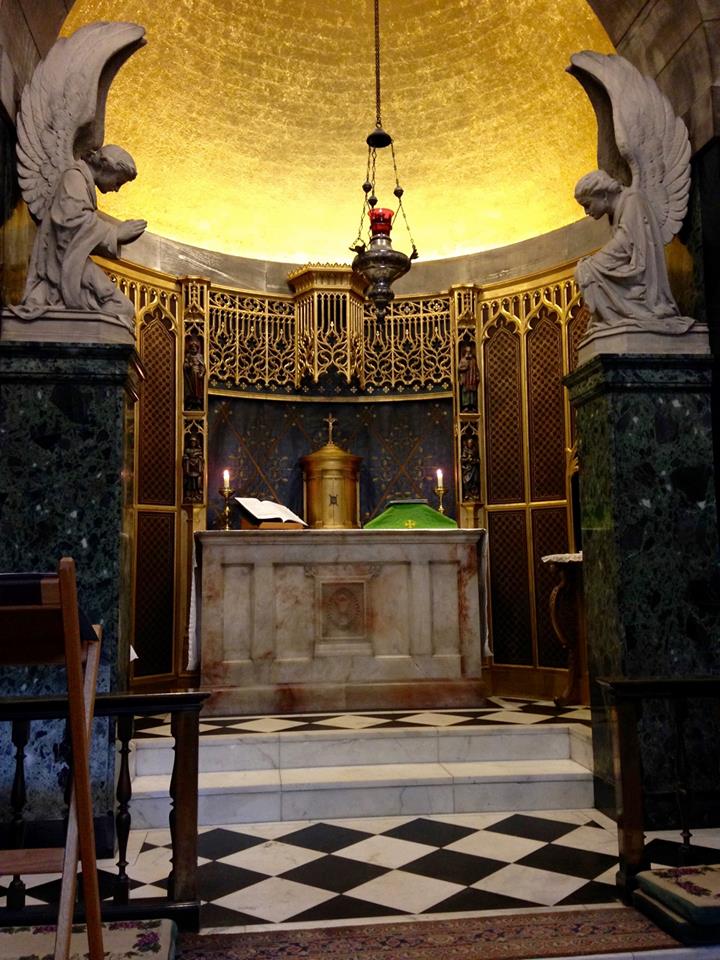
That was last Sunday, and we think its understandable why we’re sorry to see the red go, though the side-chapel even now holds its own rather well.
The nice thing about the spikiness of this church though –and we say that from a place of deep affection –is that we find a way to fill that time. There’s evensongs and saints’ days and lots of smaller scale occasions to make much of. Besides, we haven’t had Corpus Christi yet, and the new rector is resolved that we welcome Ordinary Time in with real pomp and circumstance. This will, inevitably involve a Benediction, and we’ll all say a prayer in the choir vestry beforehand that this time it comes out right, but we’ll enjoy it to.
We’re also anticipating, it turns out, a stoup for holy water and votive candles. Proof that we don’t always bolt in the other direction when confronted with change. We were in fact ridiculously pleased by this development, much to the bemusement of our choral scholar. We can’t help it; we’re cut from the same cloth as the rector, resolutely and unapologetically high church, and possibly we belong in a Barbara Pym novel.
We’re saying too a crossed-fingers sort of prayer that Sumsion in F stays the Mass setting until Christ the King Sunday. It’s good, singable, and might just make those 26 Ordinary Sundays a bit less flat and endless.
For my readers from away, or indeed those here who have never caught the habit of catching the goings on in Ambridge of an evening, we’re been listening over the last two years to a storyline aimed at addressing coercive control on the programme. It’s riveting but also increasingly unbearable listening.
Here’s a question for fellow writers; is there ever a point at which you sacrifice narrative to spare your reader? We can’t imagine doing this, and in fact never have, but we’ve also never spent two years shaping the kind of nerve fraying plot we’ve had on The Archers lately.
We want to say first that the emergence of this question has nought to do with the quality of the writing. Narratively it’s brilliant. The story-craft is laudable, as is the acting. But increasingly the listening community has been heard to say it feels emotionally gas-lit itself by the long-running story arc, and the longer it runs the more we’re beginning to see their argument. When it finally reached narrative climax –or possible a Dark Moment but definitely some key anchor scene –we were left genuinely cold and covered in goose-flesh, quietly shivering while we took in what had happened. We kept on being caught like that for a whole week, almost as if we were in shock, and goodness knows it took long enough for the cold to wear off afterwards. Consequently we’re curious, when do you sacrifice story for your audience, and should you?
It seems heresy to say there’s a point at which it’s acceptable to sacrifice story intent and even now we’re not sure that’s ever the answer. What we do think though is that we didn’t need this story in such excruciating detail.
There’s an old maxim that says that if treated intelligently we read intelligently. If you hint at gas-lighting and domestic violence, we’ll follow that through. Goodness knows, we all did that anyway back in the early days when Rob declined to eat a tuna bake. All up and down the country we shouted at the radio and prophesied this man’s awfulness and said ‘leave now, Helen. For God’s sake, go.’
That was enough. Someone somewhere, back when things came to crisis, did the maths and said that what we’d had was roughly a Helen and Rob storyline every other day for two years. That’s something like three episodes a week. What was needed, we think, for the sake of our collective sanity, was perhaps an episode every two weeks, maybe once a week. The scriptwriters could have still turned those screws and dimmed the gas lights while saying they were doing nothing of the kind; we’d have put it together.
And dare we say it, that might have been more effective. There is nothing so potent as the void of imagination. What we don’t know for certain we fill in. We’d have all come up with something slightly different to account for what was happening at Blossom Hill Cottage, and we feel confident in asserting it would have been pretty uniformly grim and awful. More importantly, it wouldn’t have overbalanced the focus of the programme, as has arguably happened.
That’s the real problem; it’s not that the story is shockingly realistic. We’ve done realism before. We even have a taste for doom –Thomas Hardy is one of those author’s whose works we’d salvage in the event of flood –it’s the imbalance. We’re all off-kilter, caught up in this claustrophobic drama of coercive control and manipulation, and we have nothing of the same weight and substance to counteract it. We’re only just now beginning to get back some of the levity we’ve missed but because we’re so far skewed to the side of gloom at the moment, it’s mostly leaving us with emotional whip-lash. We needed, and should have had this light-heartedness months ago, preferably at the same calibre as the coercive control story to save our nerves completely unravelling.
It’s a brilliant story. Incredible good has come out of it, and it absolutely needed and deserved the focus it was given. It’s well told. None of that’s the trouble. We’re worn out. It’s as simple as that.
Today we had grand plans to finally tackle the lawn, an admission that would horrify great-grandmother Grace and her Presbyterian strictures on how to observe a Sunday, but which also a chore badly needs doing if the garden is ever going to look neat. As chores go this is the one we hate most of all; ours isn’t a big garden but it feels it when you start on the grass.
We got as far as shutting the Marschallin-cat away into the front of the house and connecting the menace that is the electric mower, and then as if by divine signal, it refused to start. We spent about an hour fussing and fiddling with it. We boast a fair amount of expertise at mending anything that needs a needle, but electronics are far and away out of the realms of our understanding. We couldn’t even coax the screws into loosening to have a look at the electrical mechanism. Not, you understand that we’d have known what to do with it if we’d succeeded, or even much fancied prodding about at a lot of wires without an idea as to what we were doing. We didn’t. We just thought we ought to try for the form of the thing.
In the end we went on an excursion to find out where the recycling centre was, and subsequently engaged a taxi to take us and the mower there, as it has obviously chosen the 7th Sunday in Eastertide to give up the ghost and missed the memo telling it this was supposed to have happened on Good Friday -if it had to happen at all – for the sake of liturgical appropriateness.
We have since contacted the powers-that-be to replace the electronic monstrosity, as we only rent the flat, and that should be shortly sorted. Other than that though, all we’ve achieved is the disposal of a machine we were never much attached to and irritating Miss Marschallin-cat, who is resentful that she didn’t get an excursion out into the garden after all. It’s days like this, when the sun is out and the grass long that I’m regretful we live on a road to busy for her to go exploring.
For our part we’ve settled for writing a bit and listening to Ian and Sylvia. Great-grandmother Grace would still be unimpressed though; Sundays according to her are for scripture and possibly (also inexplicably) Go Fish and pick-up sticks, or so we’re told. We make far better Scottish Episcoplains though than we do Presbyterians, and we don’t think they’d mind.
We can’t quite believe we’ve reached Good Shepherd Sunday already. At least we would have if this were a Sunday that figured in the Scottish Episcopal calendar. As far as we can gather it doesn’t, beyond the thematically relevant acclamation and a sudden influx of hymns on the same, and alas, none of them Crimond.
We have special affection for Crimond because for 14 years that was our school hymn and we sang it on a Monday morning. We still default to the descant on the even-numbered verses, a residual effect of being a soprano in the school choir. We can still sing it too –and we’re absurdly proud of this –without a hymnal. Crimond though is one of those settings that seems to be innately Presbyterian. Certainly we were assured when learning our school’s history that that was what drew Ms. Margaret Syme to the hymn all those years ago.
In the broader sense it doesn’t really matter. We’ve laid down roots here, a love of many of our church’s prevalent hymns among these. We don’t particularly need the N.E.H. for ‘Faithful Shepherd, Feed Me,’ or ‘The King of Love My Shepherd Is’ if it comes to that. But none of these is part of our history like Crimond. None of them reduces us to that child who was mesmerised by an off-centre overhead projection of a paraphrased psalm 23 and who learned to sing for love of it.
It’s for no better reason than this that we find we miss Canada this fourth Sunday in Eastertide. Specifically we miss Rosedale Presbyterian with its spectacular choir and 10 Elm Avenue, where for so many years we sang the top line to a much-neglected piece of hymnody.
We’ll leave you with the closest arrangement we can find to the one we remember loving.
On Thursday we went down to Edinburgh for Rusalka. In the event we’ve not said, this is we venture, our favourite of all opera ever. For skilfully rendered story and devastatingly good music it’s unmatched.
When Scottish Opera announced Rusalka for this season we determined to go. We’ve not seen it live since the COC took it on 7 (?) years ago, and we wanted to. Nothing conveys the vulnerability, the messiness, the sheer effort of singing like a live performance. But outings like this run the risk of ending with us spending the third act nervously watching the clock and calculating the distance back to Waverly Station to catch the 23:08 back to Leuchars. We love our grey town by the sea, but it’s not exactly easy to reach if you can’t drive.
We’re glad we made the effort though. We never noticed the time, and we did catch the train, but this was more than that. Rusalka is, as it says on its title page, a lyrical fairytale at it’s heart, and this production had taken the idea and run with it. All the women, from Rusalka to the witch Jezibaba were given dresses that tapered and flared like fishtails. The men were all in woodsy greens and browns. It was lovely to look at, lovely to listen to, and best of all this was a production that brought interesting and new interpretations to its characters.
Jezibaba especially stood out in this respect. Every previous iteration of the opera we’ve seen has rendered her cartoonish, warts, rags, stoop and all. It wasn’t only that Scottish Opera gave us an elegant woman who acted as well as she sang. There was a depth we’ve never seen in the part before. Straight-shouldered and graceful, Jezibaba was still terrifying when call upon. There was also great tenderness in her music. This was a woman who looked at the abandoned Rusalka and saw in her something of herself and seeing it, offered her empowerment the best way she understood it. More than that though, we believed it of her, not only because the musical cues, the darkening of Rusalka’s leitmotif, it’s adoption of aspects of Jezibaba’s reinforced it, but because the performance sold the interpretation. Blood vengeance was part of her, certainly, but not the only part. And there was something far more chilling about the woman who could move from cradling Rusalka like a child to wielding a knife with menace than there was in that cartoonish witch we so often think of.
Vodnik the water gnome was memorable too, and we don’t say that lightly. Years of singing and we still find ourselves in alien territory when we hear basses. It’s not that we dislike them, it’s that it’s a different kind of listening. We’re comfortable with high notes, we sing them often, so we listen with understanding to the soprano, and gravitate towards those high lines because we can appreciate them. We can spot when a tempo’s unsympathetically slow and necessitating extra breaths, we know when a high note has landed, and while we know we could never do half so well, we can understand the hurdles to be got over and the nuances in the singing.
We can’t say that about the lower registers of the voice, which is why whenever we hear an especially good singer traverse those places -as happened the other evening – we can only listen with a certain amount of awe. We think of low notes and we think of falling (with a fair amount of control) down a well. It never sounds like that. This sounded like it rose up out of the floor, out of the space beneath the floor, possibly from somewhere dark and rich and warm deep in the earth itself. Think about what red velvet cake might sound like if it could sing. The really impressive thing though, is that a voice like that came out of a man submerged in the scenery. It turns out that if you literally make your water gnome, well, a water-gnome, complete with tail, free movement is sacrificed somewhat. It made it all the more effective when he did break free of the set. Power radiated off of him in waves, and we’ve never seen anything like that. It was awful in that old, archaic sense of the word, full of awe and wonderment.
It wouldn’t be Rusalka though without a mention of the Song to the Moon. We could rave about it forever –it’s our favourite aria if we have to choose –but we won’t. We can’t say anything meaningful that hasn’t been already. Suffice it to say it sounded like liquid gold, that those harps felt like coming home.
We’ll leave you with those harps. They say it best after all. And while this isn’t the performance we heard, it’s still a favourite.
We love this time of year, we really do. Starting with Palm Sunday, this is the time when our church pulls out all the stops, becomes unapolegetically over-the-top and High Church and ushers in Holy Week with open arms.
All of that began today with a service that bar none had more happening than any service we’ve attended before. In the first place there were the palms. Great life-sized ones that the choir carries in and then have to juggle alongside the hymnal as they process. It’s awkward, especially if, as today the procession goes outside and the world sends out a reminder that this is a seaside place in the shape of wildly turning hymnal pages. To be a fully-functioning chorister of a High Scottish Episcopal Church, it is necessary to have at least 5 hands. Yes, we calculated this.
We came in from processing, found somewhere to set the palms down, but only after we’d concluded the processional hymn, the ‘prophetic hymn’ (we mistakenly supposed this to be the introit prior to reading the order of service) and introit hymn. These were sung back to back. Also to be a chorister at our church, you need to be able to survive an hour and a half of near continuous singing.
We got a reprieve in the psalm and then came the dramatic canting of the Gospel. Dramatic Canting is, we’ve decided, the official term. There were soloists, we were the angry mob before Pilate, there were neumes (think of those strange square notes on that 4-line staff) and we were canting. Mind, we didn’t sound a bit like an angry mob because all of us were choristers throughly and none of us (except perhaps one of the altos) has been trained in the kind of singing that enables a high line of chant to sound brutal and visceral rather than seraphic. But the performance came off. The congregation was rapt.
This isn’t to say it all went smoothly. That never happens. Today our overworked conductor got so confused that he threw out the Sursum Corda and put the Sanctus in twice. As it happened, we appreciated the aberration because shortly before the Eucharistic liturgy began we realised no one had told us what Mass setting it was. Hint; not the one in the back of the hymnal. The sometimes-tenor dutifully fetched the music from the choir room, but only for half the choir. So we spent an anxious moment wondering if this was a setting we needed music for. Hence the gratitude for the accidental first Sanctus, which assured us we could in fact, sing off-book.
All of this is only the beginning. As of Maundy Thursday we are going to have to sing 5 services in 4 days. There will probably be more canting, there will certainly be more processions, and we guarantee that today’s extra Sanctus won’t be the only thing to go wrong. It’s going to be glorious. We love being a part of that overarching narrative that we strive to communicate in Holy Week. We know full well too, courtesy of a Presbyterian upbringing no one here would believe we’d had, that we would never get to the triumphalism of Easter were it not for the drear and gloom of Lent. We will revel then, as always, in that emotional nadir of the Tridium, it’s Good Friday Theology, and enjoy singing our way through it. We’re still too Presbyterian to look beyond that presently, but we’re too High Anglican by now not to allow ourselves to be confident of what will follow.
Recently, in the course of doing a spot critical reading on a television programme we follow, we stumbled across an article stressing the potency of names and the nature of what it called ‘word magic.’ The idea was that names were invested with power and how they were used mattered. To apply a diminutive was to detract from the power of the name, while adding to that of the person who coined the diminutive. Withholding or sharing a name became significant, altering a balance of power. It was a fascinating piece of the world’s mythology and it didn’t sound as spectacular as it might have because we had been drawing our own conclusions about names in a very different context.
Tuesdays have now, for some time, found us volunteering at our local Roman Catholic Primary School. As a rule we give our time to the primary 2 class, taking reading groups and helping with maths. The result of this is that after many months we have mostly put names to faces –quite the accomplishment given our lack of visual memory –and the result of this is that by and large we’re credited with a certain amount of authority. Even the Pears, most anarchic of reading groups, acknowledges that we are in control because when they act out of turn we can call upon them by name –something for which we are profoundly grateful.
This morning though, on returning from break, we were redirected to assist in Primary 4. We had no objection at all to doing this, but it did dawn on us as we caught the remnants of their carpet time, how shockingly alike these children looked viewed from behind. The girls all had their hair in plaits, the boys all wore theirs cropped short, and inevitably they were in uniform. Also, we realised as we took the Peaches out into the hall for a reading session, we had absolutely no idea what their names were.
Logically, these were older than the children we tend to work with and, therefore, more responsible, and there is without fail always one child who hovers at our elbow preaching the gospel of ‘teacher says…’ We still could have done with names though, because we have never yet met a group of children who when faced with a teacher not their usual one, don’t act up at least a little, just to see if they can, and these were no exception. And while we did have the names on their reading journals, we had no idea who belonged to which journal, with the result that they were much harder to reign in than they should have been. Another week or three and it won’t matter; we’ll get used to this set of names and match them to personalities and no doubt develop a system that makes them listen to us. We’ve done it before. But we can’t help wishing that introductions were done a bit more effectively on the occasions when we move in to help with a new class.
Bad things would seem happen in Brighton, or so Austen and Graham Greene have given us to understand. These last few weeks The Archers -a radio drama set in the fictive Midlands village of Ambridge –has been attempting to more firmly impress this idea on us, only this time we find we don’t care. Why not? It’s all to do with plot, or rather the lack of one.
It was brought to our attention recently that there is a curious divide when it comes to storylines in Ambridge wherein a plot is either character-driven or story motivated. At its writerly best though, the programme understands fundamentally that character is story, and this is why we do not care what happened in Brighton.
All credit is due to the writers, they have done a lot to move us from disinterest to what is almost interest in Rex and Toby Fairbrother, who are at the centre of the non-plot that is the drama in Brighton. We still have to pause to distinguish them, and appreciate it when their neighbours decide to treat us as if we have developed amnesia by addressing them by name, but when Rex and Toby aren’t talking marketing gibberish about pasteurised eggs we do find them moderately engaging. At least, we’re invested in Rex because he has been allowed to break from his role of The Good Brother enough to betray a vulnerability that works to round out his character. Toby remains a source of perpetual irritation. (This, by the by, is how we have come to tell them apart. We aren’t convinced they aren’t voiced by the same actor.) It’s a shame really that Rex isn’t the one sorting out crises in Brighton. Then we might almost be engaged with the story.
More crucially –and character dimensionality notwithstanding – we don’t know what happened in Brighton. It’s being held off screen as it were, presumably to generate tension and so interest for the listeners, but that only works if the character motivation behind the Brighton-related crisis that needs resolution is apparent, which it isn’t. We have no sense of why Rex and Toby bolted from Brighton, no sense of why Toby lately returned thence and even less sense of why they have come to Ambridge to farm geese and pasture-fed hens. Without these things it’s difficult to care much about Toby’s history, much less generate tension. What we do have is half a character in the shape of Toby who insists on intruding unresolved back-story into the conversation at odd moments. Much like listening to an unresolved chord this is unfulfilling.
For the Brighton story to work effectively for us, we need either to round out the nuisance that is Toby Fairbrother, or we need what happened in Brighton to be spelled out in English that is not cluttered by marketing babble. Until one –or ideally both –of these things happen, we will remain indifferent to all things Fairbrother, geese, hens, clumsy attempts at flirtations, the lot.

 Chorister at Home