Scent of Almonds

Today has involved, among other things, the internet’s insistence that it couldn’t establish a secure connection to the blog, a singing lesson, and the augmenting of the Christmas Cake. We’re fairly sure the last one went wrong, somewhere between skewering the cake and soaking it in orange juice as per the instructions. Turn upside-down, they read. Add Orange Juice, they said .So we did these things, and righted the cake, because it said to do that too. And then we thought about it, and wondered how, gravity being what it is, a perforated cake was going to absorb orange juice sitting right-side-up and wrapped in clingfilm and tinfoil. The marzipan was on by then too – also as per the instructions – and we’re pretty sure that none of the above sequence is good for marzipan. We’re certain, after a sample of the stuff, that we prefer making it from scratch. It’s nothing against store-bought, but it always tastes sweeter than the home-made stuff. And not quite like almond. On the other hand, we were all saved eyeing marzipan out of obscure kitchen corners into the next millennia, so that was good.

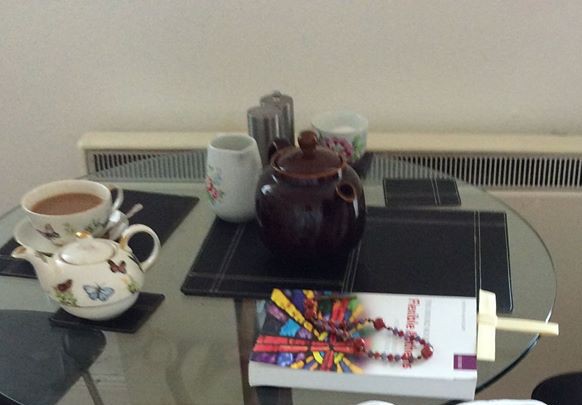
Almonds resurfaced in the tea. It smelled of sweet almonds, which is good, because anything else would send a sane literary critic running the other direction and worrying about cyanide. Just us? It may be entirely possible we’ve read one murder mystery too many. Anyway, it’s a green tea that tastes of roasted almonds a combination that works well. It’s long in the mouth and stands being steeped for long periods of time.

Things being what they are, we ought to have a poem on hand about almonds or Christmas cakes, or something for consistency. In fairness, we did look. The absolute dearth of literate has us convinced that all anyone ever took away from marzipan was a blizzard of icing-sugar. Blizzard being, naturally, the collective noun for amassed icing sugar. Probably any poet whose baked the stuff is still coaxing it out of the crevices of counters and finding residual powder behind the toaster. Good to know we’re in good company on that one.

Instead, here’s a poem about the new year. Precipitate, possibly, but then, Advent is our liturgical new year, so it’s not entirely without relevance.

Year’s End

Richard Wilbur

Now winter downs the dying of the year,
And night is all a settlement of snow;
From the soft street the rooms of houses show
A gathered light, a shapen atmosphere,
Like frozen-over lakes whose ice is thin
And still allows some stirring down within.
I’ve known the wind by water banks to shake
The late leaves down, which frozen where they fell
And held in ice as dancers in a spell
Fluttered all winter long into a lake;
Graved on the dark in gestures of descent,
They seemed their own most perfect monument.
There was perfection in the death of ferns
Which laid their fragile cheeks against the stone
A million years. Great mammoths overthrown
Composedly have made their long sojourns,
Like palaces of patience, in the gray
And changeless lands of ice. And at Pompeii
The little dog lay curled and did not rise
But slept the deeper as the ashes rose
And found the people incomplete, and froze
The random hands, the loose unready eyes
Of men expecting yet another sun
To do the shapely thing they had not done.
These sudden ends of time must give us pause.
We fray into the future, rarely wrought
Save in the tapestries of afterthought.
More time, more time. Barrages of applause
Come muffled from a buried radio.
The New-year bells are wrangling with the snow.

Advent III: the Jocundity of Dachshunds

As if in proof to yesterday’s declaration that it’s not spices in tea, really, we swear on a bible, that we take objection to, today’s selection was called Gingerbread. Straight and to the point. It’s a robins packed chock full of ginger, and it smells and tastes like gingerbread in a cup. So much so that we investigated the ingredients for traces of molasses. We found none. Low on caffeine and richly flavoured, it’s a perfect evening tea. This is how you do spiced teas properly.

In other news, it’s Advent III, the Sunday when the rose vestments come out and we relax whatever Advent discipline we have going. We always think that if ever there was a day we could let the blog slip, it’s this one. But we enjoy the blog, and Gaudete Sunday happens to be our favourite. Even if we still haven’t sung Hills of the North Rejoice this season.

In perpetual embodiment of jubilation though, are the Dachshunds of Dawlish. We owe them a poem, not least because Miss Marschallin has had two this season to their none. But also, no one does unbridled joy like a Dachshund leaping around your knees. We don’t even have to do anything for it. If we look vaguely in the direction of the kitchen from three o’clock onwards, they leap in jocund fashion at the prospect of food. If you go into the kitchen any time after half three, they run in giddy circles. Open the gate to the family room and they race to see who can crush the sofa cushions fastest. It’s like being perpetually bombarded with optimism, and it’s contagious. So here’s a poem to the Dachshunds, with love and affection. We really are sorry we insisted on bathing them earlier today.

img_3077

Lost and Found

Ron Padgett

Man has lost his gods.
If he loses his dignity,
it’s all over.

I said that.

What did I mean?
First, that the belief
in divinity has almost
disappeared.

By dignity
I meant mutual
self-respect, the sense
that we have some right
to be here and that
there is value in it.
(Values are where
the gods went
when they died.)

My dog Susie doesn’t seem
to have any values, but she does
have Pat and me, gods
she gets to play with and bark at.

The Dachshunds have many values, if you’re curious. Fabulous Orange Ball is high on the list. It’s narrowly outranked by Food. Sun is crucial, and warm. We’re sort of in disgrace until the warm weather comes. But they bark anyway, because apparently part of being perpetually optimistic about the universe involves making a joyful noise unto the Lord at every possible occasion.

On which note, we’ll end with Hills of the North, just so someone sings it this year. The important thing to note here is that there are two sets of lyrics, and ours are right. Well, we think so. The people who sing the other ones probably disagree. Both are quite good in their own way though.

Currying Feline Favour: How it Isn’t Done

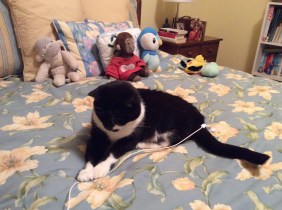
There’s nothing quite like waking up to a cat being pointedly ill on the bedspread. This after we had deported her the previous evening from the master bedroom, where she was improving upon someone’s good, grey coat.

It was like this. We were sitting down to tea, when a summons came up the stairs with the terrifying words, ‘You must see what the cat is doing. She isn’t moving.’  It’s not as if, come Advent and Christmas we harbour a perpetual fear that the Marschallin-Cat will asphyxiate, choke, strangle or otherwise do away with herself by means of tinsel, poinsettia, or Christmas bauble, so these were well chosen words. Allowing for the fact that we do, in fact, anticipate all and any of these things at a given holiday moment. Left to our own devices there would be no ornaments within striking distance of the Magnificent Paws, and no lights. We’ve won a victory against the poinsettias, and tinsel is, happily, not a Canadian fixture.

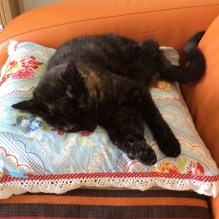
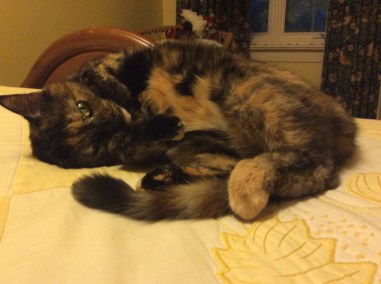
Anyway, off we went, only to find Miss Marschallin was very much moving. Flip-flopping, in fact, side-to-side. Stretching luxuriantly across the grey wool coat, exposing her underbelly to anyone who happened to be passing. Miss Marschallin never exposes her underbelly to passers-by. We only get to stroke it on extra-special occasions when she’s half-asleep with unbridled contentment. Anyway, the owner of the grey coat got within a foot of that particularly vulnerable spot, put a hand out, and thought better of it. They further declined to go to bed via the other side of the bed, which was vacant, because really, why adjust one’s life to a cat.

What can we say? They haven’t lived with cats long. Miss Marschallin’s predecessor was only with us eleven years and loved a good tummy rub. Chalk and cheese, these two felines. All the while, there was the Marschallin-cat beautifying that grey coat with her lovely ginger fur. There is nothing not improved by ginger fur. Also, this way the coat’s owner could now do a credible impression of some fur-clad ’40s movie star. Heddy Lamar, Garbo, maybe. We don’t know.

img_0015-1  img_0022-1

img_2917
A Chronology of Cats

Neither of them was budging, so in the end there was nothing for it but to swoop Miss Marschallin up into her very particular hold and transport her elsewhere. You could practically hear the indignation radiating from her. And really, we don’t blame her. To be taken away from a comfy place to sleep for no better reason than the fact of one’s being portable and the sleeping place of choice being someone else’s property…well, it doesn’t bear thinking about.

Which, we’re tolerably sure, is how we came to be the loving recipient of this morning’s pointed gift. It’s not as if there were wooden floors going spare, or anything. Here’s a poem for you by way of apology to Her Nibs, Filed-Marschallin, Empress and Queen of Dawlish.  We first found it in the Opies’ Oxford Book of Children’s Verse. Perusing it as an adult, it’s one of the rarities that isn’t supremely dogmatic and moralistic. But also, whoever wrote it, unlike that coat owner, spoke Cat.

The Mysterious Cat 

Vachal Lindsay

I saw a proud, mysterious cat,
I saw a proud, mysterious cat
Too proud to catch a mouse or rat—
Mew, mew, mew.

But catnip she would eat, and purr,
But catnip she would eat, and purr.
And goldfish she did much prefer—
Mew, mew, mew.

I saw a cat—’twas but a dream,
I saw a cat—’twas but a dream
Who scorned the slave that brought her cream—
Mew, mew, mew.

Unless the slave were dressed in style,
Unless the slave were dressed in style
And knelt before her all the while—
Mew, mew, mew.

Did you ever hear of a thing like that?
Oh, what a proud mysterious cat.
Mew . . . mew . . . mew.

Supposedly it’s a chant for a pantomime. If it is, it makes an abnormal amount of sense for panto material. But not unlike the cat, we wound up disdaining our tea this evening. It’s not that we require anyone to be kneeling beside us while we drink it, stylish or otherwise. It’s that tonight’s tea was undrinkable. It goes by the prosaic name of Ginger Turmeric Tonic, and while undoubtably it’s supposed to be wholesome, it tastes appalling.

Someone – we’re unclear who – had the clever idea to pair the ginger and turmeric with green tea, which goes about as well as you’d expect. The green tea, left to steep, goes bitter. The ginger, meanwhile, has it’s usual sharpness. And But none of this matters because all one can taste over the lot of it is the numeric. And all that while the tea smells shockingly of anise. We stuck it out about a half-a-dozen mouthfuls before calling it a bad job, so can’t really comment on steeping grade, or anything like that. And we’ll freely own that our using numeric six ways from Sunday to make a curry probably doesn’t help.

We don’t think that’s the root problem though, because we’ve quite happily partaken of teas flavoured with cloves, cardamom, and any number of spices that swisher between sweet and savoury in our cooking. We’ve even known them to translate well to tea. This is not one of them. No doubt it’s a rigorously wholesome thing. Good for colds. But for our money, we’re much happier sticking to hot lemon and honey. Maybe a lemsip. Possibly even the odd dose of ginger. The calendar can keep the turmeric.

The Messiah, Music and Metre

We can tell Christmas is hurtling ever closer by the fact that today’s broadcast of The Hallelujah Chorus was followed immediately afterwards by I Know that My Redeemer Liveth, thus tipping the musical hand, had we not already caught on, that this was The Messiah in full. We resisted the urge to protest at the radio that it had just trespassed into Easter and that technically you can no more say ‘Hallelujah’ in Advent than you can in Lent, the liturgical year being ever symmetrical. Instead we made tea and enjoyed the music.

The tea was Chocolate Orange, which does exactly what it says on the tin. It’s a black tea with essence of orange (don’t ask; we’re afraid to) and chocolate. It’s a good combination, or at any rate, we’re less likely to grouse about it than we are about other chocolate-and-tea blends. Though the strength of this one comes largely from extracting the tea infuser after the first cup. While the orange is flavourful, the chocolate and tannins conspire to drown it. It could very quickly become the kind of tea to take paint off a car if left to steep unchecked.

The Messiah on the other hand, was top-heavy, that is, biased towards the soprano, a fact which delighted us. Modern editors being what they are, no two editions can agree on who sings what when, and often include appendices. Thus we have previously sung How Beautiful are the Feet as a chorus, and it’s a good chorus too, if overlooked. We mention it only inasmuch as the all-hands-round approach is itself highly interpretive; the vocal colour a soprano brings to And the Glory of the Lord Shone all Around Them is brighter and lighter than it is in the hands of an alto, or even a tenor. Not necessarily better, but certainly different. And this was a bright, light Messiah. More like sleigh bells, say, than trumpets, and a lovely accompaniment to tea. Perfect, as it were, for rapidly-approaching Christmas.

It turns out we’re hard-pressed to find good poetry on music. It’s a tricky subject, and since describing it well is a bit like trying to catch moonlight, we’re not sure we blame the poets of the age for the omission. Instead, here’s Thomas Hardy on dancing. Taught the fiddle as a young boy, you can practically here the triplets in this piece.

The Night of the Dance

Thomas Hardy

The cold moon hangs to the sky by its horn,
And centres its gaze on me;
The stars, like eyes in reverie,
Their westering as for a while forborne,
Quiz downward curiously.

Old Robert draws the backbrand in,
The green logs steam and spit;
The half-awakened sparrows flit
From the riddled thatch; and owls begin
To whoo from the gable-slit.

Yes; far and nigh things seem to know
Sweet scenes are impending here;
That all is prepared; that the hour is near
For welcomes, fellowships, and flow
Of sally, song, and cheer;

That spigots are pulled and viols strung;
That soon will arise the sound
Of measures trod to tunes renowned;
That She will return in Love’s low tongue
My vows as we wheel around.

For more on Hardy and music, try his Fiddler of the Reels. It’s the kind of short read that will lose you an afternoon, and the descriptions of music are radiant. Just don’t, whatever you do, read it for the characters. Never read Hardy for the characters. That way madness lies.

Sleigh Rides

More pink tea today. This one is called Sleigh Ride, and the ingredients run the gamut from cooked rice and almonds to hibiscus. But when not conjuring irritating Christmassy earworms for us, all it really tastes of is the hibiscus. No surprise, since hibiscus is one of those herbal flavours that rapidly overwhelms everything. And while there’s probably a balance with any tea when it comes to steeping and strength, this one is particularly elusive. Four minutes in and the first cup was hot water, seven and it was only hibiscus.

It’s a flavour we associate with Latvia, probably because our academic daughter had a habit of gifting us hibiscus tea from her home village whenever she returned to town after the holidays. That’s primarily how we know hibiscus tea. It tastes warm and of friendship and is excellent for colds.

img_3074

Sleigh Ride though, the name of the tea, is a bit different. We’ve already alluded to the music it triggers – there was a year when our younger brother was addicted to that particular carol and we heard nothing else for a month. But sleigh rides were also a staple of our holidays. Late spring, British Columbia trips skiing. The days were longer, but only by a little, and one evening out of the fortnight we’d put our names down for a sleigh ride. There were horses, and hot apple cider afterwards, but the best part was the miles and miles of client, snowy landscape. A difficult thing to do justice to in description. But here’s a poem that comes close to success.

A Winter Eden

Robert Frost

A winter garden in an alder swamp,
Where conies now come out to sun and romp,
As near a paradise as it can be
And not melt snow or start a dormant tree.

It lifts existence on a plane of snow
One level higher than the earth below,
One level nearer heaven overhead,
And last year’s berries shining scarlet red.

It lifts a gaunt luxuriating beast
Where he can stretch and hold his highest feat
On some wild apple tree’s young tender bark,
What well may prove the year’s high girdle mark.

So near to paradise all pairing ends:
Here loveless birds now flock as winter friends,
Content with bud-inspecting. They presume
To say which buds are leaf and which are bloom.

A feather-hammer gives a double knock.
This Eden day is done at two o’clock.
An hour of winter day might seem too short
To make it worth life’s while to wake and sport.

Not Even the Rain

Today’s tea, drunk this afternoon, was a black tea that purported to taste of Red Velvet Cake. Accordingly, it was suitably rich, more dessert than breakfast tea. This was more or less as we expected; we still remember, after all, the days when our academic grandmother aspired to bake red velvet cake. The trick, as per her recipe book, was to lean in hard to the richness of the cake. Never to use margarine when it called for butter, or milk instead of cream. It worked for her. The tea was like that too; creamy and full-bodied, unapologetic in its luxuriance.

The same academic grandmother was responsible for the founding of what was then the Poetry and Cake Society. We met, a moveable feast, at a different house each week. Read aloud, drank tea and baked for one another. Nothing so indulgent as red velvet cake, to our memory, though courgette cake was quite thing in the society’s last year or so.

We were thinking of this over tea, it being about the time when Poetry and Cake would hold its Christmas party. We think we’ve told you a bit about some of the games. Guess the Rhyme, for instance, was the favourite. There was another, unnamed, where we had to justify a dislike of one famous poet and a taste for an overlooked one. The less expected the answer, the higher your score. We did terribly. Such are the hazards of narrowly focusing on the Romantics. But we did once confess to a certain amount of disinterest in Cummings. The lack of capitals, you know, irritate us. Far too obvious an answer.

But then, in rewatching The Hour the other evening, we realised that, as with every other rule, this one had an exception. So here, with no more regard for capitalisation than red velvet cake has for calories, is the one bit of Cummings to really win us over.

Somewhere I have never travelled gladly beyond

e.e. cummings

somewhere i have never travelled, gladly beyond
any experience your eyes have their silence:
in your most frail gesture are things which enclose me,
or which i cannot touch because they are too near

your slightest look easily will unclose me
though i have closed myself as fingers,
you open always petal by petal myself as Spring opens
(touching skilfully, mysteriously)her first rose

or if your wish be to close me ,i and
my life will shut very beautifully, suddenly,
as when the heart of this flower imagines
the snow carefully everywhere descending;

nothing which we are to perceive in this world equals
the power of your intense fragility:whose texture
compels me with the colour of its countries,
rendering death and forever with each breathing

(i do not know what it is about you that closes
and opens; only something in me understands
the voice of your eyes is deeper than all roses)
nobody, not even the rain, has such small hands

Snow Days (or Lack Thereof)

Over 14 years of school, we had all of two snow days. This was in Toronto, Ontario, where we walked home in drifts up to our pink knees and it was uphill both ways. So, naturally, we laughed appreciably when, in 2018, we were delayed in the return to Scotland by centimetres of snow. We seem to remember Wales was well and properly snowbound, but London was dusted lightly, and still it ground to a halt. It was eleven before we regained St Andrews, and the first time the British Rail service properly betrayed us. The makings of a great and lasting relationship, that.

We’re thinking about all of this in light of today’s tea, dubbed Snow Day. We’re not sure exactly what those taste like, having, as we say, limited experience, but we didn’t reckon on chocolate and mint. More peppermint than chocolate in this case, too. This is odd only inasmuch as a quick look at the ingredients would suggest this should be the other way round. Still, we’d rather the peppermint, and as an uncaffinated cap to the evening, it does what it says on the tin. We like it fine, you understand, but there have been more interesting teas in this Advent Calendar. To us it tastes like any agreeable mint tea.

But in keeping with the spirit if the thing, here’s a poem by Billy Collins. We knew him first through The Writers’ Almanac, whereon was recited his ‘Reasons I Do Not Keep a Gun in the House.’ It still makes us laugh, but as we now live with the Dachshunds, posting it would probably be disloyal. Instead, here’s a theme and variation on the tea. You can tell us if it’s anything like the reality.

Snow Day

Billy Collins

Today we woke up to a revolution of snow,
its white flag waving over everything,
the landscape vanished,
not a single mouse to punctuate the blankness,
and beyond these windows
the government buildings smothered,
schools and libraries buried, the post office lost
under the noiseless drift,
the paths of trains softly blocked,
the world fallen under this falling.
In a while, I will put on some boots
and step out like someone walking in water,
and the dog will porpoise through the drifts,
and I will shake a laden branch
sending a cold shower down on us both.
But for now I am a willing prisoner in this house,
a sympathizer with the anarchic cause of snow.
I will make a pot of tea
and listen to the plastic radio on the counter,
as glad as anyone to hear the news
that the Kiddie Corner School is closed,
the Ding-Dong School, closed.
the All Aboard Children’s School, closed,
the Hi-Ho Nursery School, closed,
along with—some will be delighted to hear—
the Toadstool School, the Little School,
Little Sparrows Nursery School,
Little Stars Pre-School, Peas-and-Carrots Day School
the Tom Thumb Child Center, all closed,
and—clap your hands—the Peanuts Play School.
So this is where the children hide all day,
These are the nests where they letter and draw,
where they put on their bright miniature jackets,
all darting and climbing and sliding,
all but the few girls whispering by the fence.
And now I am listening hard
in the grandiose silence of the snow,
trying to hear what those three girls are plotting,
what riot is afoot,
which small queen is about to be brought down

Canadian Winter

Winter in Canada. It’s here now, the snow on the ground, and the chill in the air. It was book club this evening, and breakfast with relatives downtown, all of which meant walking across the city in boots. As ever, this time of year, we find ourselves wondering what it is about winter boots that seems to find them without arch support. Or maybe it’s something we do to them. Either way, we’ve been acutely aware of it ever since we took up dancing. Suffice it to say we miss the days of mizzling, Scottish winters. The haar, the rime, and the bleakly grey mornings. At least we could run everywhere in ordinary shoes.

But we’re in Ontario, documenting the creeping start of one if our milder winters. after last year, anything above -20 would feel mild. Still, we have a tradition of magnificent winters, and in the course of nursing tonight’s Nuts and Spices Oolong we’ve stumbled across a poet that felt the need to render them lyrical.

The tea, incidentally, is more spice than nuts. Not surprising, since we’re still fuzzy on how exactly essence of peanut would diffuse into an oolong. We can vouch for the presence of the peanuts though; they’re jolly hard to get into a tea infuser. Muse on the how and why of all that while reading through this description of Ontario winter. It’s nothing like the Scottish Decembers we miss, but it’s spot-on for Canada.

How One Winter Came in the Lake Region

Wilfred Campbell

For weeks and weeks the autumn world stood still,
Clothed in the shadow of a smoky haze;
The fields were dead, the wind had lost its will,
And all the lands were hushed by wood and hill,
In those grey, withered days.
Behind a mist the blear sun rose and set,
At night the moon would nestle in a cloud;
The fisherman, a ghost, did cast his net;
The lake its shores forgot to chafe and fret,
And hushed its caverns loud.
Far in the smoky woods the birds were mute,
Save that from blackened tree a jay would scream,
Or far in swamps the lizard’s lonesome lute
Would pipe in thirst, or by some gnarlèd root
The tree-toad trilled his dream.
From day to day still hushed the season’s mood,
The streams stayed in their runnels shrunk and dry;
Suns rose aghast by wave and shore and wood,
And all the world, with ominous silence, stood
In weird expectancy:
When one strange night the sun like blood went down,
Flooding the heavens in a ruddy hue;
Red grew the lake, the sere fields parched and brown,
Red grew the marshes where the creeks stole down,
But never a wind-breath blew.
That night I felt the winter in my veins,
A joyous tremor of the icy glow;
And woke to hear the north’s wild vibrant strains,
While far and wide, by withered woods and plains,
Fast fell the driving snow

In unrelated trivia, Campbell was an Anglican priest before he was a poet of Canadian winter. We’d never heard of him prior to this evening, and we rather wish now we could talk Advent with him over a cup of oolong. This one is particularly good, nuts or no, and we have a feeling he’d speak our particular liturgical language.

Advent II

This afternoon we opened our Advent door to White Cranberry tea, which was really an infusion. The white turned out to be chocolate, though we only know this from an examination of the ingredients. Pour out too early and it makes for lovely, pinkish cranberry-flavoured tea. Pour out later and its darker pink, tastes more strongly of cranberry, and the chocolate still isn’t in evidence. We don’t mind, not being people who much fancy chocolate in tea. We also happen to have a taste for tart things, so the cranberry flavour agreed with us. For anyone with more of a sweet tooth, we decline to pass judgement.

Instead we lost our half-hour teatime to mulling over Advent, and why exactly we’ve spent the last week or so protesting the renaming of the Advent Calendar. We don’t do it, you understand, out of contrariness. Well, not sheer contrariness anyway. Partly we really are baffled by the idea that Advent is somehow exclusive to church-goers. Doesn’t everyone observing the season, even the ones observing in secular fashion, by counting down the days ’til Christmas?

And yet, for all that, Christmas is only part of the point to us. At the end of the day there’s a flatness to Christmas that we don’t find with other holidays. Easter is triumphant and Lent is majestic and sombre. But Advent, that four-weeks journey of counting down until Christmas, is complex. It’s Little Lent to some people, all grey and solemn. There’s a theological school of thought that says it’s apocalyptic. But it’s also the liturgical New Year. Above all those things though, it’s expectant and hopeful, and giddy with blossoming gladness. It comes into fullness at Christmas, we suppose, but to us the exciting part is really the anticipation. It’s watching for the Christ-Light, or any light, on a grey sunrise, or a three o’clock sunset, or on a monochrome winter day.

Advent to us is full of shifting light as we move ever nearer to Christmas Eve. It’s why, although the candles aren’t the most Anglican of traditions (terribly Lutheran, according to a chap at last week’s Agape) we continue to love them and all they stand for. Who doesn’t need light in the darkness? To know that however grim or bleak the hour, there may yet be something coming to buy the spirit? That’s the gist of Advent to us, the nutshell version. And why it matters so much that we’re doing something more here than the 24 Days of Tea. It’s not just about the tea and the boxes, but about what is coming, and more than that, how we get there.

After all that, here’s a well-loved bit of Yeats. Normal people remember it for it’s closing lines. We remember it for the glorious descriptions of shifting light – perfect for Advent whether you see it in rushing to a half nine choir rehearsal by Scottish sunrise, or from some comfortable Canadian fireside, or indeed, somewhere else entirely.

Aden Reaches for the Cloths of Heaven

William Butler Yeats

Had I the heavens’ embroidered cloths,
Enwrought with golden and silver light,
The blue and the dim and the dark cloths
Of night and light and the half light,
I would spread the cloths under your feet:
But I, being poor, have only my dreams;
I have spread my dreams under your feet;
Tread softly because you tread on my dreams.

Other revelations that came today included the rather eclectic one that Wake, O Wake  is excluded from the Anglican Hymnal of Canada. This dawned on us when listening for the second time in as many weeks to Wachet Auf on the organ, we went in search of the words. We’re not sure why they weren’t there, and we’re convinced we will never parse the logic of this particular hymnody compiler. In compensation, we’re sending you on your way today with the hymn for an ear worm. It’s early in Advent for it, we know, but it’s also lovely, and we’re starting to think there are a shocking number of Canadians who have been cheated of the fun of singing it. This must be rectified.

Nuts in Winter

The calendar that isn’t Advent related would appear to be stuck on an Apple theme. Tonight it was Forever Nuts, a well-balanced herbal blend of apple, raisins, and as the name would hint, nuts. It’s a good tea, one we always keep a stock of. Shockingly pink, as we perennially observe when it bobs up jack-in-the-box fashion behind a door, but warm and autumnal tasting. A lovely shock of colour for grey days and rainy days, dreich spells and snow.

Also perennial is Thomas Hardy, it seems. Inevitably we dip into his poetry at least once through the Advent cycle. And every year we comment on the metre, how musical and playful it is. There are things he does rhythmically that no one else risks doing. Here’s an autumnal poem for an autumnal tea. No nuts -we did lo looking for literary ones – but there’s that feeling of looming endings and waning light that comes with Advent.

The Later Autumn

Thomas Hardy

Gone are the lovers, under the bush
Stretched at their ease;
Gone the bees,
Tangling themselves in your hair as they rush
On the line of your track,
Leg-laden, back
With a dip to their hive
In a prepossessed dive.

Toadsmeat is mangy, frosted, and sere;
Apples in grass
Crunch as we pass
And rot ere the men who make cyder appear.
Couch-fires abound
On fallows around,
And shades far extend
Like lives soon to end.

Spinning leaves join the remains shrunk and brown
Of last year’s display
That lie wasting away,
On whose corpses they earlier as scorners gazed down
From their aery green height:
Now in the same plight
They huddle; while yon
A robin looks on.