Not as We Were

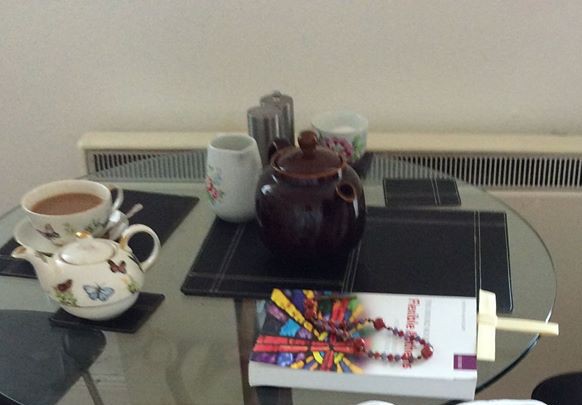
Tonight’s tea is an odd duck, a blend of white, green and jasmine tea with hibiscus for flavour. It’s called Buddha’s Blend, but that’s not the odd thing. It doesn’t taste the way it smells. That is the oddity. We opened the tin and observed to Miss Marschallin-cat that it was reminiscent of a blend we bought once from Wittards, Jubilee blend, a black tea flavoured with mango, mandarin and peach. That’s what Buddha’s Blend smelled of -suddenly we were back in the kitchen of the Grotto, number 68 North Street, spooning specialty Wittards tea into our teapot.

It doesn’t taste of those things though. Well, it wouldn’t, would it, with not a touch of mandarin, peach or even mango among the ingredients. That’s not to say it wasn’t lovely -it was – but it didn’t taste the way it smelled. A disconcerting culinary schism, by the way, if you’ve never experienced it. You might even say it was not as it was -for which reason, we’re giving you Hardy tonight.

Our love of Thomas Hardy’s poetry is well-documented. It might be the most beautiful in the English cannon to us. It conjures the England of coffee-table books as nothing else does, and is exhilaratingly playful in its word choice. Sometimes Hardy will even invent words wholecloth, like ‘norward’ here, or ‘illimited’ of The Darkling Thrush. At least, we’ve never seen anyone else make use of them.

More academically, Hardy, like Emily Dickenson, favours Common Metre -the metre of most hymn tunes. You can, if you’re so minded (this chorister is), set his poetry to everything from Helmsley to Aurelia, and quite a few others besides. It doesn’t work with this poem though. This one’s Dactylic Tetrameter, and if that sounds like a mouthful, suffice it to say you can waltz to this poem, more or less. Music and metre; preoccupations of ours. But here endeth the lesson. For a tea that’s not as it was, here’s a poem that breaks all its own -and Hardy’s -rules.

The Voice

Thomas Hardy

Woman much missed, how you call to me, call to me,
Saying that now you are not as you were
When you had changed from the one who was all to me,
But as at first, when our day was fair.
Can it be you that I hear? Let me view you, then,
Standing as when I drew near to the town
Where you would wait for me: yes, as I knew you then,
Even to the original air-blue gown!
Or is it only the breeze, in its listlessness
Travelling across the wet mead to me here,
You being ever dissolved to wan wistlessness,
Heard no more again far or near?
Thus I; faltering forward,
Leaves around me falling,
Wind oozing thin through the thorn from norward,
And the woman calling.

After Apple Picking

We’re drinking Saigon Chai tonight, just a cup because it’s late and we have, as our Greek lecturer used to say, an appointment with sleep. We’ve always liked Chai, the spice and the savour of it, and this is no exception. Something about it is peculiarly well-suited to winter. It’s a bit like drinking a down blanket, or something, all warmth and comfort.

It comes at the ideal moment; the weather here has turned suddenly wintery, and between the snap of the cold and the dark mornings and evenings, there’s no contesting the season. So as the autumn beats a hasty retreat, here’s a longer poem than we’d usually send up for an Advent submission, but an old favourite -and perfect for that heartbeat transition between seasons. Well, we think so.

After Apple-Picking

Robert Frost

My long two-pointed ladder’s sticking through a tree
Toward heaven still,
And there’s a barrel that I didn’t fill
Beside it, and there may be two or three
Apples I didn’t pick upon some bough.
But I am done with apple-picking now.
Essence of winter sleep is on the night,
The scent of apples: I am drowsing off.
I cannot rub the strangeness from my sight
I got from looking through a pane of glass
I skimmed this morning from the drinking trough
And held against the world of hoary grass.
It melted, and I let it fall and break.
But I was well
Upon my way to sleep before it fell,
And I could tell
What form my dreaming was about to take.
Magnified apples appear and disappear,
Stem end and blossom end,
And every fleck of russet showing clear.
My instep arch not only keeps the ache,
It keeps the pressure of a ladder-round.
I feel the ladder sway as the boughs bend.
And I keep hearing from the cellar bin
The rumbling sound
Of load on load of apples coming in.
For I have had too much
Of apple-picking: I am overtired
Of the great harvest I myself desired.
There were ten thousand thousand fruit to touch,
Cherish in hand, lift down, and not let fall.
For all
That struck the earth,
No matter if not bruised or spiked with stubble,
Went surely to the cider-apple heap
As of no worth.
One can see what will trouble
This sleep of mine, whatever sleep it is.
Were he not gone,
The woodchuck could say whether it’s like his
Long sleep, as I describe its coming on,
Or just some human sleep.


Favourite Things

The calendar yielded an old favourite today -one that, to judge from the website when we went to crib information for you, was brought back specially for the calendar. It’s called Glitter and Gold, and it’s a black tea laced with cinnamon and all sorts. That’s no description, coming from a self-professed tea-lover, but we did the research. It yielded no good result. Suffice it to say we’ve been drinking this tea for years without thinking about the contents much. It’s a Chinese tea, which, Julian Mallory of Excellent Women assures us is ‘always such a treat.’ To us it tastes of Christmas -the cloves, we presume.

Proving we can sometimes be reasonable, here’s an old favourite poem to go hand-in-hand with a favourite tea. It comes from Gaudy Night, and we have a sort of inkling we may have used it on here before. But we love it. ‘Conceited little thing’ -Peter meant in the Donne sense, we think -or not, it’s the poem we turn to when we want to still the world for a spell. (The joys of the boating scene, you understand, we savour for rereads only.) Between the giddy whirl that was yesterday, and the busy, half-mad bustle that is Advent as ordained by the claims of the world, we offer you this bit of literary respite.

That Still Centre

Dorothy Sayers, as found in Gaudy Night
Here, then, at home, by no more storms distrest,
Folding laborious hands we sit, wings furled;
Here in close perfume lies the rose-leaf curled,
Here the sun stands and knows not east nor west,
Here no tide runs; we have come, last and best,
From the wide zone through dizzying circles hurled,
To that still centre where the spinning world
Sleeps on its axis, to the heart of rest.

Lay on thy whips, O Love, that we upright,
Poised on the perilous point, in no lax bed
May sleep, as tension at the verberant core
Of music sleeps; for, if thou spare to smite,
Staggering, we stoop, stooping, fall dumb and dead,
And, dying, so, sleep our sweet sleep no more.

A Round Reel of Poetry: Tea for Accompaniment

It’s elegance meets….well the slightly less elegant tonight, as you’re getting tea and a verse with a dose of tartan. Though next to the ceilidhs we learned on, Scottish Country is the elegant cousin, so it’s not too amiss. Mondays are our dancing evening, and we’re strongly tempted to land you with Mairi’s Wedding, because we’ve not done that one yet here, and it would fit the pattern of our day. You’re not getting it, because it drives us fairly batty, even sung.

Besides, we’re sipping Silver Dragon Pearls tonight, and really, there are limits. Sometimes this Advent Calendar comes through in high style, and a tea this delicate, floral -and yes, high-grade -really deserves dignified accompaniment. Alas, we never claimed to be dignified. And since we’re still thinking in reels and jigs, you’re getting a wee verse about Scottish Country Dancing, no names given. Trust us; it’s much funnier this way.

Black_Watch_-_Campbell_tartan

A New Dance

Part Batt

Guess who’s written a brand new dance,
With a brand new figure in it,
Not easy to learn – but worth a try,
As you’ll hear, if you give me a minute.

It is, of course, a “meanwhile” dance
And sounds, perhaps, complex,
But it’s quite straightforward as long as you know
Your number, your partner, and sex.

Threes and fours on the opposite side –
You’ll find it better that way.
You’ve curtsied and bowed, so now get set
And cross your fingers and pray!

An inverted rondel is how it begins
And then the new figure you’ll see
With simple instructions on sheets 1 and 2
And diagrams 1, 2 and 3.

Two highland settings, a knotted barette,
And end in the form of a square.
Crossing reels, look behind you, and with any luck
You’ll find that your partner is there.

Your partner is there, but ignore him or her,
The pattern now subtly alters –
You grab someone else and all promenade round
Backwards – but only three quarters.

The Mic-Mac Rotary bit comes next,
You loop and you loop again,
A quadruple figure of eight, and then
A five-and-a-half-bar chain.

A two-and-a-half-bar turn ends the dance,
An experience no one should miss.
Wherever, whenever, whatever you’ve danced
You’ve never met something like this!

I hope you enjoy it – I think that you will –
And I do hope you think it’s alright
To give yo this preview of what he might dream
When he’s having a very bad night!

(Previously published in Reel 204)

saltire

After all that, you’re getting Mairi’s Wedding after all. If nothing else, it will give you a flavour of what all those verses are on about. It was also the first Scottish Country Dance we ever had thrown at us, and if you can look at it and tell us even one way in which that makes sense, we’ll bow to your wisdom. Personally, we’re still boggled.

Advent I: This is the Record of John

We’re into Advent proper now, and one of the things we most miss about having a choir is the Advent music. Oh, we love Christmas music as much as anyone, but we love the hopefulness of Advent, the way the atmosphere is pregnant with hope and anticipation, even more. ‘Little Lent,’ we’ve heard it called, and it is, because part of Advent is Apocalyptic. But it’s also ebullient, expectant, and whereas lent has a pall over it, Advent moves from darkness to light. It’s why we’re encouraged by today’s collect to ‘Cast off the works of darkness and put on the armour of light.’

With all that in mind, we thought this year, in the name of variety, we’d give our Advent Sundays on the blog over to posting a favourite Advent anthem, or maybe a hymn we miss. But lest you think we’re too serious about the whole thing, we’re going to include a poem with it -selections from the delightful Church Year in Limericks, a happy discovery of ours made while trying to track down another poetry anthology for work. After all, we must be able now and then to laugh at our doctrine as we would anything else, or risk the heresy of taking it all too seriously.

img_2199

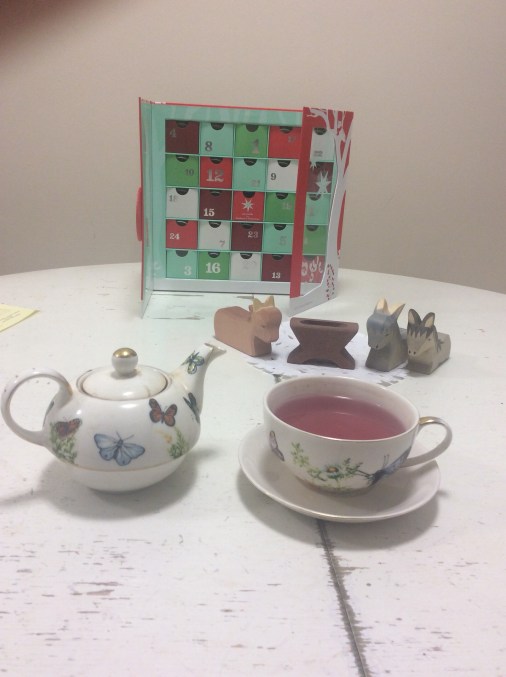
With that in mind, we shan’t grouse about the fact that tonight’s tea (see above) missed the memo that rose is the colour of Advent III, not I. It’s a returning tea to the Advent selection, Strawberry Parfait, and our abiding memory of it is twofold. In the first place, it tastes of pink. In the second, we last drank it after a trying ordeal negotiating our way back from Stirling bus station.

This year it still tastes of pink, and it’s still oddly sweet in a way that recalls a jelly donut. Personally, we keep expecting Truly Scrumptious and company to waltz around the nearest corner and start singing about it. It’s that sort of sweet. Not a bad tea, exactly, but another desert tea -and, oh grievous heresy -not one you’d want to take a biscuit with.  To temper the sweetness, a little, here’s an everlasting Advent favourite of ours, written by Orlando Gibbons and sung here by the Kings College Choir, Cambridge.


And when you’ve revelled in the still small sanctity of that, here’s a bit of levity to close. Who knew what the church calendar was missing was limericks?

Holiday Declarations

From The Church Year in Limericks by Christopher M. Brunelle, © Morning Star Music Publishers 2017

Our cranberries used to be relish
But now it’s our church they embellish
(with popcorn and string)
To welcome the King
Who saves us from fates that are hellish.


You’ll Have Had Your Tea

img_1897

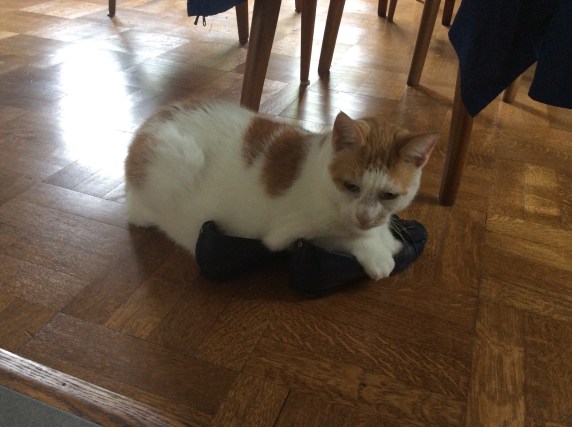
This is Dougie. He had two great missions in life; food and the guarding of shoes. If you wore the shoes, he sometimes attacked your feet for invading them.

He began, when we’d only met him long-distance, as Dougal, because of the ginger in his fur and that old sketch on I’m Sorry, I Haven’t a Clue called Sound Charades, in which two comedians perpetually began their half of the play with cries of:

‘Hamish!’

‘Dougal!’

‘You’ll have had your tea.

‘Oh, no…’

No one had ever had their tea, to hear ‘Hamish’ and ‘Dougal.’ Neither had Dougie, if you believed everything he had to say on the subject of food.

But Dougal was too Scotch a name for the Canadians he lived with, and anyway, don’t cats always have half a dozen names? So he became Dougie, more Canadian for a Canadian cat, but his origin story was apt, because he was perpetually wanting his tea. And shoes to guard. And people to sit on. But no one does comedic sketches about those things. You’ll Have Had Your Tea it was.

Now I’m having my tea, in quite a different sense, and it goes by the dubious name of ‘Chocolate Macaroon.’ I won’t reiterate the spiel about chocolate in tea. But coconut…to anyone else I suspect it’s inoffensive enough. It tastes of suncream to me, probably because that’s what suncream smells of. Also, curiously, it evokes Nice Biscuits, a culinary misnomer if ever there was one. So all told it’s not won me over yet, which is okay. We’re on day two of this Advent calendar and there’s always a couple of dodgy selections. (Coffee tea of last year comes readily to mind.)

Maybe I just feel guilty about the fact that I’m having tea when Mr Dougie can no longer join me and attack my shoes while I sip it. Pancreatic cancer in cats is like that -not the sort of thing you can reverse.

But objectively, if you aren’t averse to coconut, and if you’re not in converse with departed cats, this isn’t a bad tea. Decadent, and not what you’d want to take with your toast at breakfast, but rich and desert-esque. The sort of thing you’d foist on Tommy and Tuppence at one of there Ritz-staying ventures.

In the meantime, here’s a poem, Dougie. Other cats I’ve been known to sing to. Mr Keys got Hansel and Gretel, specifically the ditty about the mouse in the straw, and Her Nibs is partial to Vilja Lied, but you and I weren’t quite on singing terms. I had the temerity to wear my shoes, after all, and you preferred we sit together instead. And who was I to argue with you, world’s most placid cat? So no music for you, but here’s Tennessee Williams, who had he never written a play, would, we feel confident be remembered for his verse.

We Have Not Long to Love

Tennessee Williams

We have not long to love.
Light does not stay.
The tender things are those
we fold away.
Coarse fabrics are the ones
for common wear.
In silence I have watched you
comb your hair.
Intimate the silence,
dim and warm.
I could but did not, reach
to touch your arm.
I could, but do not, break
that which is still.
(Almost the faintest whisper
would be shrill.)
So moments pass as though
they wished to stay.
We have not long to love.
A night. A day….
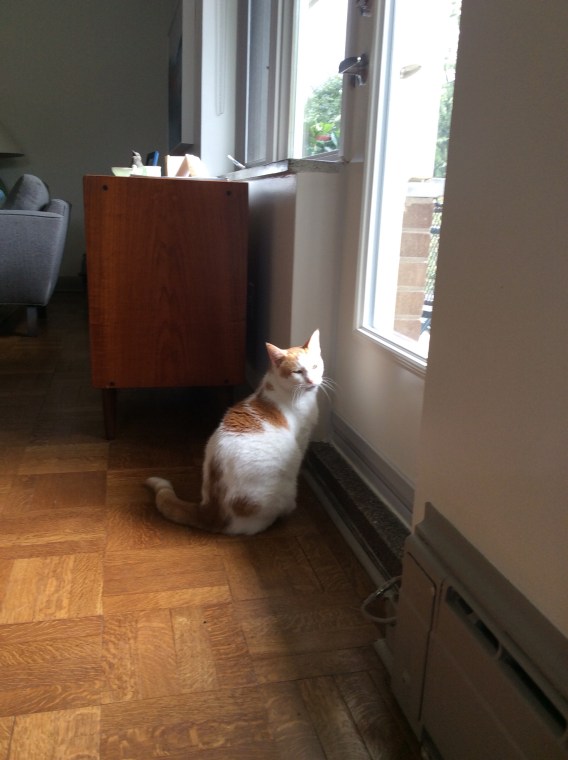
We didn’t have you nearly long enough to love, Dougie. You were supposed to live on the spoils of the land (or at least veterinary selected cat-food) for years to come. There would have been shoes to wrestle and tea to be had, and maybe we’d have eventually got to singing terms. Apparently celestial shoes had greater need of your defence. Do them proud. And until we catch up again, it seems a safe bet to think that as no cat-friendly patch of hereafter would starve you, we can fairly suppose you’ll have had your tea, then.
img_1902

Tea and Not-Quite-Advent

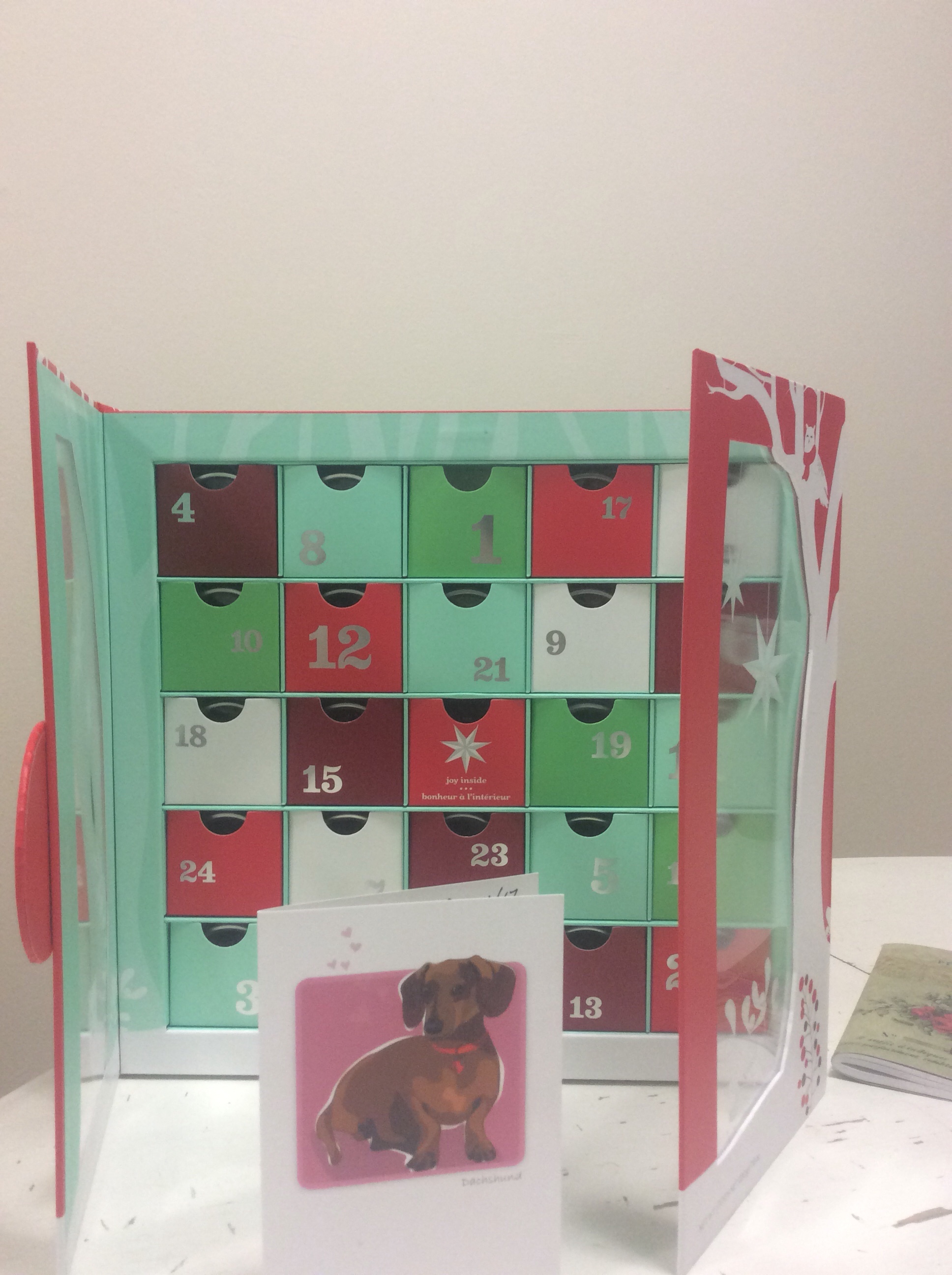
It’s not-quite-Advent, but we’re back anyway, with another tea calendar and more poetry for this December. This one was a gift from the Dachshunds of Dawlish, presumably for removing Her Imperiousness the Marschallin Cat to quarters elsewhere. (She’ll be back in March, we both will, but don’t let on. We’re enjoying the tea!)

Today it’s a blend called Let it Snow, which it most definitely isn’t, and as long as we’re walking to the subway, we’re not complaining. It’s quite cold enough without adding to it. Anyway, it’s a creamy green tea with white chocolate in it, and anyone who forgets our sentiments on tea and chocolate, we like them separate, is the succinct version. But there’s cloves too, and other spices, also custard, which has no business being in tea. Actually, we’re doubtful about custard in anything, we can’t pin that one on the tea. Still, the prices suit it, and all those oddities, chocolate, custard, theybdo add a creaminess to it. The jury’s still out on whether green tea should be creamy though. We’ll get back to you.

Until then, here’s a poem by Carol Ann Duffy. It’s one of those Tea poems we think probably everyone knows, and if we’re honest, we weren’t converted to it’s cause until we heard it read st a wedding reception. He, you understand was a coffee devotee, whereas, she, like us, preached the Gospel of Tea. Do we’ve come to love it for the memory it evokes. Without further ado, here it is.

Tea

Carol Ann Duffy

I like pouring your tea, lifting
the heavy pot, and tipping it up,
so the fragrant liquid streams in your china cup.
Or when you’re away, or at work,
I like to think of your cupped hands as you sip,
as you sip, of the faint half-smile of your lips.
I like the questions – sugar? – milk? –
and the answers I don’t know by heart, yet,
for I see your soul in your eyes, and I forget.
Jasmine, Gunpowder, Assam, Earl Grey, Ceylon,
I love tea’s names. Which tea would you like? I say
but it’s any tea for you, please, any time of day,
as the women harvest the slopes
for the sweetest leaves, on Mount Wu-Yi,
and I am your lover, smitten, straining your tea.

English Toffee and Poetry Fragments

We’re doing the unheard of this evening and brewing tea in a mug. We’ve reconciled this with our conscience by deciding that what we’re really doing is christening a gift of a Christmas mug with a cup of English Toffee tea. Also, we’re too tired to observe the complete sacrament of tea. This is a shame, as English Toffee is clearly a tea that deserves sacramaentalisig. It’s a beautiful balance of Pu’erh tea and toffee flavour -enough to give it a shape but not so much as to trigger our lack of a sweet tooth into protest. Chiefly though it’s existing to revitalise us.

Somewhere on the internet there exists a wonderful rewrite of ‘Ye Watchers and Ye Holy Ones’ to an Easter theme, and it begins, Now Christ is risen from the dead/the Choristers can go to bed… Sadly, no one has yet troubled with a Christmas equivalent, but you can take it on good authority that the sentiment is the same. More so, in fact, since the marathon combination of the Tridium and Easter taps into reserves of energy that Christmas Eve doesn’t begin to plumb. Probably there is an interesting theological nuance to be teased out here, but we don’t feel equal to the task presently.

The Canadian family will vouch for the fact our brains are still somewhere in the choir vestry, probably frozen due to the boiler failure we continue to experience. Forced to explain what a minced pie was (one of the relocated Canadians rather sweetly worried it might not be vegetarian) we managed to garble things about boiled fruit and sugar but didn’t do much better -though we did usefully recollect that Cromwell once banned them.

Here, before we settle into a long day of restorative reading, is one last poem for the last of the Advent teas. There might be more of it, but the version we’re recording comes hand-written from the inside of a Christmas card . We relay it with warm wishes for a Happy Christmastide.

From ‘THe Gude and Goldie Ballats’

(attributed Martin Luther, translated John Wedderburn)

This day to you is born ane child

Of Mary meek and virgin milde,

That blessed bairn being and kind 

Sall you rejoice baith hart and mind.


Christmas Eve and Twelve O’Clock

In what turns out to be grand Christmas tradition, the heating failed this evening at Midnight Mass, so we’re drinking a late cup of tea with just cause. It’s a black tea laced with candy cane and peppermint, and aptly called Santa’s Secret -and it’s exactly what we need. Our hands are still cold. Also, we’ve sung almost continuously for two hours and our voice gave out somewhere after the last top G in ‘Hark the Herald.’ We’ll do it all again tomorrow and gladly, but in the meantime, tea is welcome, especially when it tastes so nice as this one does.

Strictly speaking, we’re now into Christmas day, but as somewhere it’s bound to be evening still, here’s a poem by Thomas Hardy that has it’s roots in an old belief that at midnight on Christmas eve the oxen kneel to observe the Christ. Enjoy it -and Happy Christmas from Scotland!

The Oxen

Thomas Hardy

Christmas Eve, and twelve of the clock.
“Now they are all on their knees,”
An elder said as we sat in a flock
By the embers in hearthside ease.
We pictured the meek mild creatures where
They dwelt in their strawy pen,
Nor did it occur to one of us there
To doubt they were kneeling then.
So fair a fancy few would weave
In these years! Yet, I feel,
If someone said on Christmas Eve,
“Come; see the oxen kneel,
“In the lonely barton by yonder coomb
Our childhood used to know,”
I should go with him in the gloom,
Hoping it might be so.


Myn Lyking

Winter in Scotland and it’s been driech, which in plain English means it’s been raining doggedly since Thursday, when Murphy’s Law being in good working order, the family arrived. We’ve been trying to defend the appeal of a seaside town with sideways wind and twilight at 3 ever since. For our part, we’re combatting the weather this evening by drinking a late pot of Kashmiri Chai. It’s lighter than most chai, with a base in green tea; we discovered this pouring out, when the colour initially suggested the tea was understeeped. In fact it’s meant to be a golden colour. It’s further embellished by cinnamon, nutmeg and marigold flowers. And being chai, it is the ideal antidote to winter, whatever the weather.

We haven’t had much time spare for poetry hunting of late, what with trying to acclimatise three Canadians to Scotland. But last Sunday we were gifted a new carol by the conductor of our choir who told us to open Carols for Choirs to ‘Myn Lyking’ as if everyone knew of it. They should, so here this evening is both the Middle English text for you, and the carol to accompany it.

Myn Lyking 

15th Century (set by R. Terry)

I saw a fair mayden sytten and sing
She lulled a little childe, a sweete Lording.

Lullay mye lyking, my dere sonne, my sweeting.
Lully mydere herte, myn own dere derling.

That same Lord is he that made alle thing,
Of alle lord is his is lord, of alle kynges King.

There was mickle melody at that chylde’s birth
All that were in heav’nly bliss, they made mickle myrth.

Angels bright sang their song to that chyld;
Blyssid be thou, and so be she, so meek and so mild.