Dec. 22

It’s half past five on the 22nd, and already we are so exhausted we could sleep for a week. We have yet to visit one relative, or hang a stocking, and there’s a whole day to go before Christmas Eve. But that’s it. We’re out. We have an appointment with a long winter’s nap. See you next year.

Assuming we don’t, in fact, wander off to sleep to rival the Marschallin Cat and the Buffy Dachshund, it will be purely because we subsist on tea and holiday baking.

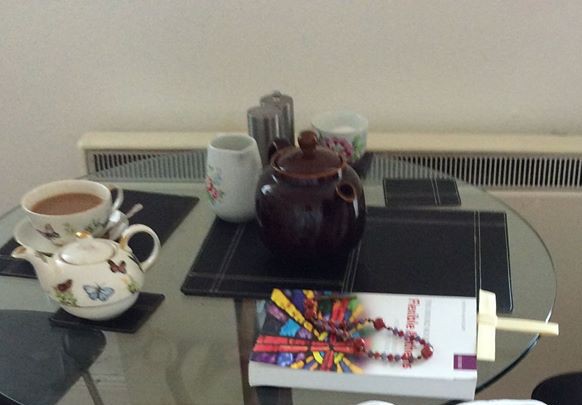
Today it was a green tea, Korean Sejak, that per weird calendar tradition, still lacked capital letters despite featuring a proper noun in the title. It’s a nutty green tea, and it almost had enough caffeine to revive us after driving back and forth to the thriving metropolis of Guelph, Ontario.

(Guelph is not, for those outsider-readers, the alien Dr Who forgot to feature, much as it really should be. It’s a little town in the middle-of-nowhere, Ontario, and when we lived in St Andrews, we met the one other Canadian to know where this place was. He ran student support, and he was a local legend. Malcolm is now one of the Seven Wonders of Guelph. Also on that list; The Floral Clock and The Speed River, which is one of the best misnomers going.)

For most people, driving there-and-back-again is enough for one day, but no. We had to put the marzipan on the Christmas cake, and we had to wrap the gifts, because our family is doing a pre-emptive Christmas Eve tomorrow. This means tomorrow doesn’t exist and somehow our two-day holiday has ballooned into a three-day one.

Query for the universe; Why, knowing all that would be the case, would you stick us with the lurgy to end all lurgies the week of an Advent IV-Christmas Eve hybrid?! Whose clever idea was that, and who did we offend? Asking, so that going forward, we do everything in our power to never offend them the same way ever again.

On the plus side…We can almost breathe through our nose again. Almost. The hacking cough is still around, too. But, you know what? We’re at the stage where we’ll take almost breathing through our nose. Let’s call that a win.

All to say, you’re getting the last of our stockpiled poems tonight. Fair warning; This one famously traumatized a whole generation of Australian English students. The thing is, we sincerely like it. And Advent is supposed to be a penitential season. So…enjoy?

And A Good Friday Was Had By All
Bruce Dawe

You men there, keep those women back
and God Almighty he laid down
on the crossed timber and old Silenus
my offsider looked at me as if to say
nice work for soldiers, your mind’s not your own
once you sign that dotted line Ave Caesar
and all that malarkey Imperator Rex
well this Nazarene
didn’t make it any easier
really-not like the ones
who kick up a fuss so you can
do your block and take it out on them
Silenus
held the spikes steady and I let fly
with the sledge-hammer, not looking
on the downswing trying hard not to hear
over the women’s wailing the bones give way
the iron shocking the dumb wood.

Orders is orders, I said after it was over
nothing personal you understand -we had a
drill-sergeant once thought he was God but he wasn’t
a patch on you

then we hauled on the ropes
and he rose in the hot air
like a diver just leaving the springboard, arms spread
so it seemed
over the whole damned creation
over the big men who must have had it in for him
and the curious ones who’ll watch anything if it’s free
with only the usual women caring anywhere
and a blind man in tears.

Tell you what, we’ll try and spend what’s left of our thoroughly residual brain power sourcing something happier for the penultimate day of Advent. Over a cup of really strong tea, ideally.

Dec. 10

Double digits already?! This happens every Advent, and every Advent we’re confused. Honest to God, the only month that outpaces December is February.

Right, we promised you a rant on Conditor Alme Siderum. Otherwise known as a perfectly inoffensive hymn.

So, what’s it done to offend us? Nothing.

There’s a thing in the order of service called a Sequence Hymn that basically exists to knit the first lesson to the psalm. Lots of churches have them. My old church had one every Sunday and it was always different.

Enter St Thomas’s, Huron St. Where, every Advent, come hell or high water, we have to sing Creator of the Starry Height as a sequencing hymn. Every. Single. Sunday. And then it sods off for Christmas and a great whack of Epipheny. Until Lent comes round and the sequence hymn comes back, and even though Lent is a completely different liturgical bloody season we have to sing this thing again. For six weeks.

As hymns go, there are more offensive ones. It even has a decent tune, except that’s not what we sing. For reasons best known to this church, we sing the plainsong tune, and it goes on for bloody ever. It’s also super unwieldy for anyone who A)can’t read nuems or B) struggles to sing without hefty backup from a choir.

And even if none of that were true, four consecutive Sundays of this thing is A Lot. Five years on, we officially hate this hymn. We are sick to death of singing it, and we don’t understand why the weird penitential season obsession with it our church has.

We actually fell down an ecclesiastical rabbit hole chasing this up once. We thought maybe this was an Anglican Church of Canada quirk and read all the fine print of all the manuals for music directors of said church. It’s not a thing. There are zero rules insisting you drive your congregants insane by using this hymn – and only this hymn! – every time the purple vestments come out.

There is no rhyme or reason, and we’re doubly not coping this Advent, because we may or may not have rebelled during the era of the Covid Live-Stream and picked our own sequence hymns, with zero plainchant sung at a key only a coloratura could pull off. No, seriously. We ended up on High F more than we didn’t and it was fabulous. Jerusalem the Golden never sounded so good. Ditto Lo In The Wilderness A Voice.

But now we’re back to in-person worship and nothing but Creator of the Starry Height, and two Sundays in we just want to murder it. Slowly. With a spoon.

Probably just as well we’re drinking a refreshing peppermint tea tonight, eh? This isn’t for you if you don’t like mint; The clue’s in the name. It tastes very strongly of what it says on the tin. We love mint, so it’s always a winner.

Again, some of the strength comes from tipping the whole packet into the pot. It’s just too hard trying to portion stuff out of those recyclable plastic bags they’ve switched to. You end up with tea leaves on the counter, and that’s a sad waste of tea.

After all that, here’s a poem about stars that doesn’t get old. Maybe because no one’s set it to plainsong…Maybe because that guy Keats was good at his job.

Bright Star
John Keats
Bright star, would I were stedfast as thou art—
 Not in lone splendour hung aloft the night
And watching, with eternal lids apart
Like nature’s patient, sleepless Eremite
The moving waters at their priestlike task
Of pure ablution round earth’s human shores,
Or gazing on the new soft-fallen mask
Of snow upon the mountains and the moors—
No—yet still stedfast, still unchangeable,
Pillow’d upon my fair love’s ripening breast,
To feel for ever its soft fall and swell,
Awake for ever in a sweet unrest,
Still, still to hear her tender-taken breath,
And so live ever—or else swoon to death.

Advent IV: Music and Favourite Things

In addition to the tea Advent Calendar, we keep going about four old-fashioned calendars with doors. At this point we must know what’s behind each individual door, but we still enjoy opening them. Today’s tea was a bit like that. It’s a black tea with candy cane pieces called Santa’s Secret. We knew it featured somewhere in the calendar, but not where and when.

It’s a good black tea. We’ve used it before now as a breakfast tea stand in. And after a day running between musical functions, we needed it. There was church in the morning, and then a singing lesson, The Messiah afterwards, where we were good and resisted the muscle-memory impulse to sing the choruses. We were less good at tonight’s Nine Lessons and Carols, where we defected to the descant at Hark the Herald. On the other hand, the alto next to us was having no qualms about singing the harmony line to every verse ever, so it wasn’t just us.

For a tea that’s familiar and predictable, here’s a poem to match. It wouldn’t be Advent if we didn’t give The Darkling Thrush an airing. And besides, there’s still no one who writes winter in England like Hardy. Unless we’re missing someone, in which case, please send material our way.

The Darkling Thrush

Thomas Hardy

I leant upon a coppice gate
      When Frost was spectre-grey,
And Winter’s dregs made desolate
      The weakening eye of day.
The tangled bine-stems scored the sky
      Like strings of broken lyres,
And all mankind that haunted nigh
      Had sought their household fires.
The land’s sharp features seemed to be
      The Century’s corpse outleant,
His crypt the cloudy canopy,
      The wind his death-lament.
The ancient pulse of germ and birth
      Was shrunken hard and dry,
And every spirit upon earth
      Seemed fervourless as I.
At once a voice arose among
      The bleak twigs overhead
In a full-hearted evensong
      Of joy illimited;
An aged thrush, frail, gaunt, and small,
      In blast-beruffled plume,
Had chosen thus to fling his soul
      Upon the growing gloom.
So little cause for carolings
      Of such ecstatic sound
Was written on terrestrial things
      Afar or nigh around,
That I could think there trembled through
      His happy good-night air
Some blessed Hope, whereof he knew
      And I was unaware.

In keeping with the Hardy, here’s a bit of Holst to go with it that ought to be better known than it is. It’s Hardy-adjacent, but on the other hand, we’re tolerably sure that of all Egon Heath’s many moods, winter was one of them.


And because it’s still Advent, specifically Rorate Sunday, we’ll leave you with the Advent Prose. We would sing them on a loop through the season, if we could, but apparently that’s considered odd. So here’s a choir to do that instead.

Advent II

This afternoon we opened our Advent door to White Cranberry tea, which was really an infusion. The white turned out to be chocolate, though we only know this from an examination of the ingredients. Pour out too early and it makes for lovely, pinkish cranberry-flavoured tea. Pour out later and its darker pink, tastes more strongly of cranberry, and the chocolate still isn’t in evidence. We don’t mind, not being people who much fancy chocolate in tea. We also happen to have a taste for tart things, so the cranberry flavour agreed with us. For anyone with more of a sweet tooth, we decline to pass judgement.

Instead we lost our half-hour teatime to mulling over Advent, and why exactly we’ve spent the last week or so protesting the renaming of the Advent Calendar. We don’t do it, you understand, out of contrariness. Well, not sheer contrariness anyway. Partly we really are baffled by the idea that Advent is somehow exclusive to church-goers. Doesn’t everyone observing the season, even the ones observing in secular fashion, by counting down the days ’til Christmas?

And yet, for all that, Christmas is only part of the point to us. At the end of the day there’s a flatness to Christmas that we don’t find with other holidays. Easter is triumphant and Lent is majestic and sombre. But Advent, that four-weeks journey of counting down until Christmas, is complex. It’s Little Lent to some people, all grey and solemn. There’s a theological school of thought that says it’s apocalyptic. But it’s also the liturgical New Year. Above all those things though, it’s expectant and hopeful, and giddy with blossoming gladness. It comes into fullness at Christmas, we suppose, but to us the exciting part is really the anticipation. It’s watching for the Christ-Light, or any light, on a grey sunrise, or a three o’clock sunset, or on a monochrome winter day.

Advent to us is full of shifting light as we move ever nearer to Christmas Eve. It’s why, although the candles aren’t the most Anglican of traditions (terribly Lutheran, according to a chap at last week’s Agape) we continue to love them and all they stand for. Who doesn’t need light in the darkness? To know that however grim or bleak the hour, there may yet be something coming to buy the spirit? That’s the gist of Advent to us, the nutshell version. And why it matters so much that we’re doing something more here than the 24 Days of Tea. It’s not just about the tea and the boxes, but about what is coming, and more than that, how we get there.

After all that, here’s a well-loved bit of Yeats. Normal people remember it for it’s closing lines. We remember it for the glorious descriptions of shifting light – perfect for Advent whether you see it in rushing to a half nine choir rehearsal by Scottish sunrise, or from some comfortable Canadian fireside, or indeed, somewhere else entirely.

Aden Reaches for the Cloths of Heaven

William Butler Yeats

Had I the heavens’ embroidered cloths,
Enwrought with golden and silver light,
The blue and the dim and the dark cloths
Of night and light and the half light,
I would spread the cloths under your feet:
But I, being poor, have only my dreams;
I have spread my dreams under your feet;
Tread softly because you tread on my dreams.

Other revelations that came today included the rather eclectic one that Wake, O Wake  is excluded from the Anglican Hymnal of Canada. This dawned on us when listening for the second time in as many weeks to Wachet Auf on the organ, we went in search of the words. We’re not sure why they weren’t there, and we’re convinced we will never parse the logic of this particular hymnody compiler. In compensation, we’re sending you on your way today with the hymn for an ear worm. It’s early in Advent for it, we know, but it’s also lovely, and we’re starting to think there are a shocking number of Canadians who have been cheated of the fun of singing it. This must be rectified.

Lord, Teach us how to Pray Aright

Far be it from us to offer lessons in prayer. Especially at Refreshment Sunday when, if anything, we relax our Lenten discipline. But we’re thinking about how we pray today because of something that came up in the intercessions.

That is, the intercessor began praying for ‘all who are disabled and mentally ill: may they find solace, comfort and consolation.’ We know it was well meant. And we hate mixing our politics with church. But today we have to.

Because here’s the thing: we are partially sighted. We are also choristers, dancers, embroiderers, and voracious readers. And with the best will in the world, we reserve the right to take a wooden spoon to any stranger who tries, unsolicited , to escort us off trains, across the road or down stairs. Does that sound like a life in need of consoling?

We were once asked if, given the chance, we’d take full vision over our hemianopoeia, or restricted field. We were horrified. We can no more imagine life without partial sight than we can imagine not breathing. It’s part of us. We’d no more change it than we would our height or our eye colour. And we devoutly hope no one is praying for our miraculous recovery of something we have never missed.

That is not everyone’s experience. But it is ours. There will always be people who do need that petition for consolation, and no doubt some of them will have disabilities and some will not. We’re as rich and varied a community as any other though. So pray for accessibility, and inclusion, and intelligent discussions about integrating us into everyday community. And pray for anyone who needs consolation as you would pray your ill or grieving. But pray thoughtfully. The assumption that we need all the same thing does everyone a disservice.

Murder in the Vestry: Clergy in Detective Fiction

When PBS first started airing the latest season of Grantchester, WNED ran a promotional ad that was words to the effect ‘Featuring unlikely duo Sydney Chambers and Geordie Keating’  Not a bad line except for one wee detail; fiction is replete with clerical detectives. Many of them are even Anglican. There are so many in fact that to list them all would be unwieldy. Here though are some of our favourites.

Fr. Tom Christmas. He’s not really high enough to be ‘Father’ to anyone, but some last names come with a doom, and that seems to be his. He’s the rector to St Nicholas Church (or course he is) in the parish of Thornford Regis. His mysteries invariably take their theme from The Twelve Days of Christmas and are as cozy as any Golden Age writer could hope for. The fact that Canadian writer C. C. Benson infuses them with that quintessential Englishness that makes the books best suited to dreich, tea-filled afternoons would be impressive in and of itself, but the mysteries are clever and the characters charming. Mind housekeeper Madrun though, she has Opinions and enough prickle to her to run circles around even Mrs McGuire.

Fr. Brown – All right, he’s not Anglican, but if he didn’t invent the clergy-detective, it feels as if he did and any list would be incomplete without him. G.K. Chesterton first priest introduces his sleuthing priest The Blue Cross and the world never looked back. We love Chesterton’s deft welding theology and the murder mystery. We’ve said it before and we mean it, nothing is more addictive in reading than the assumption that the reading audience is intelligent.

Rev. Dr Blake Fisher is Fredrick Ramsay’s detective, and we can’t win with our fictive clergy this evening because this one objects to being called Reverend since it’s an adjective, not a noun. He’s an American detective, an Episcopalian with a gift for observation and making faith accessible without ever reducing it.

Fr. Gilbert for a novelty doesn’t object to his title. He’s also formerly of Scotland Yard, so when we told the WNED continuity announcer (not that he heard us) that we’d heard of stranger pairs than television’s favourite Cambridgeshire clergyman, we meant it. He believes strongly in evil, and unlike rational Fr. Brown, is prone to seeing the odd spectre. We don’t mind though, we were trained on Muriel Spark. There are definitely weirder things in fiction than a light touch of the gothic. No really, go read The Ballad of Peckham Rye and get back to us. We dare you to find a novel more bizarre.

There are others, of course, there always are with lists like these. No one loves a priest so well as a mystery writer, and we can’t blame them. Given our druthers we’d take confessing to any of our detective clergy over formidable Morse, Rebus or even the charming Steve Carella, and not just because biscuits seem to be less forthcoming from fictive police.

Every type of character brings advantages to detection. Morse had his vast intellect, Carella his cohort at the 87th Precinct. Clergy though bring their humanity, or they should. They offer an understanding of people, the good along with the bad that makes them particularly well-suited to solving murders.

To the continuity people over at WNED we can only say that if it’s strange pairs they’re after, they’d be better off reading Witches of Lychford. As mysteries go it has its holes, but we can’t think of a stranger pair than the triumvirate of vicar, witch and hippy it offers. Perhaps you can though, or have a favourite religious sleuth we’ve missed out. If so, we’d love to hear from you!

I Write This…

…Sitting on a startlingly orange sofa, as it happens, and balancing a lap-desk, not being possessed of a proper one. There’s the kitchen table, but we’ve an aversion to putting the computer at the same table where we take our tea. What we really sat down to do though wasn’t catch the atmosphere and character of Kinness Place, but collect together some of our favourite openings to books.

I write this sitting in the kitchen sink. Is there a better beginning than Dodie Smith’s opening gambit to I capture the Castle? We have spent years trying to equal this one in our own writing, and likely won’t ever succeed. True at once to Cassandra’s voice, the tone of the story and our sense of the castle, this makes the promise that the story more than lives up to.

‘Take my camel, dear,’ said Aunt Dot as she climbed down from this animal on her return from High Mass. On the strength of that sentence, an Oxford friend sent us Rose McCauley’s The Towers of Trebizond.  The Oxford friend was right; we did love it. The story of Aunt Dot, Laurie, Fr Chantrey-Pigg and their journey to Turkey is full not only of evocative landscapes but also of some of the most nuanced treatment of religion we’ve read. We still go shivery thinking of Laurie’s first introduction to Jerusalem. We won’t spoil it. Read it. We want another person to help unravel the symbolism of the camel. Unconvinced?  The symbolic camel in question, and the High Mass both transpire in Oxford. Aunt Dot’s just that eccentric.

Long ago in London, in 1945, all the nice people were poor. It sounds like a fairytale, and Muriel Spark does have an ear for modern fairytales. This one is the beginning to The Girls of Slender Means. There is nothing you need to know about it except that the martyr is not a martyr and there is an unexploded bomb in the back garden of the May of Tech Club.

They’re all dead now. So begins Ann-Marie MacDonald’s gothic novel Fall on Your Knees. This was the sentence that set us collecting sentences. The fact that we fell in love with the novel was purely an afterthought.

I suppose it must have ben the shock of hearing the telephone ring, apparently in the church, that made me turn my head and see Piers Longridge in one of the side-aisles behind me. It wouldn’t be us without at least one Pym. She’s best read in well-worn cream paperbacks that smell of book. This is the opening of A Glass of Blessings, our second favourite after Excellent Women. Somehow she cuts right to the inciting  incident while still leaving us with the fuzzy impression that we’re not reading a carefully crafted novel, only a slice of someone’s life.

My father had a face that could stop a clock. This was the sentence that set us on our love of Jasper Fforde and Thursday Next. We don’t read much fantasy or sic-fi. This manages to be both at once, as well as a consummate exercise in spot-the-literary-allusion. We’ve never looked back but have gone on to read this man’s work compulsively. Wherever academic coach Stephen Bloom is now, we owe him a tremendous debt for the recommendation.

Finally, what must be our favourite opening to a novel ever. High, high above the North Pole, on the first day of 1969, two professors of English Literature approached each other at a combined velocity of 1200 miles an hour. This owes to David Lodge, specifically Changing Places. No one has ever made us laugh quite so much.

There are others of course; this is by no means a comprehensive list. We’ve tried to dodge our more obvious favourites, but we also can’t believe we’ve omitted so many; Lipman, Hardy, Monica Dickens are but a few. Some day we’ll draw up a list of favourite books and perhaps get around to doing her justice. In the meantime, go read!

Six Little Choristers

It’s well and truly summer here, and we can tell by the size of the choir. We’re not a large choir in term-time, but we’ve halved in size since the students went home. When we came into the choir room on Sunday, the precocious alto looked at us, did the maths and said, ‘we are officially the Trinity Choir.’

‘Yes,’ we said, ‘in every sense of the word.’

The sometimes-tenor then entered and completed our set. In light of this we’ve been driven to that poem we’ve been threatening to write for months. It comes from a place of great affection, and sympathy for diminished choirs the world over, because after all, three’s a choir -isn’t it?

Six Little Choristers

M.C.Steep

Six little choristers, sit cantores side,

One collided with the organ, leaving only five.

Five little choristers censed by the thurifer,

Asphyxiation by incense reduced them to four.

Four little choristers waiting in the vestry,

One fell out of procession and then there were three.

Three little choristers uncertain what to do,

One fled from sentimental motets then there were two

Two little choristers led Solemn Evensong,

One thought it much too catholic, and then there was one.

One gloomy chorister with conductor does conspire,

To halt music for the summer as one is not a choir.

A Calculated Shambles

This week confirmed a pet theory of ours; namely that far from choreographed Mass, the key to succeeding at Anglo-Catholicism (or in this instance Scottish Episcopalianism) is to be jolly good at making things up as one goes along. Advent II for instance.

‘Today’s complicated, so I’ll outline what’s happening,’ said Conductor with accuracy of a service involving everything bar the kitchen sink; Introit, Asperges*, Baptism, Communion, all the key parts to the Mass –the only thing we didn’t say was the Credo, we swapped it for the Apostles’ Creed.

Anyway, he began outlining the beginning, starting with ‘we’ll sing the introit from the usual place.’

Had he never mentioned ‘introit’ we might have got it right. But he did, and in the same sentence as ‘usual.’

Our long-resident Sometimes Tenor (we’ve made him a bass at the moment so we can still call the choir SATB) heard this and once the Conductor had gone for the organ, said to us, ‘that means we’re beginning singing from the side-chapel then.’

We had doubts, but didn’t mention them, because he’s been there years longer than the measly almost-three years we’ve sung in the choir. We duly told the crucifer to stop at the side-chapel, which he did, and we waited for the organ to stop. And waited. And waited. And went on waiting, because it turns out all the Conductor meant was that we sing from the usual place –the choir stalls –and consider the Advent Prose an introit. Right. And we couldn’t tell the Sometimes Tenor ‘I told you so,’ because as it turned out, we hadn’t.

Eventually someone told Conductor he’d better stop expecting us to appear, because the crucifer had apparently taken root and anyway, we’d opened our folders and it would have looked odd to resume processing after the servers anyway. We sang the Advent Prose from the side-chapel, it was fine, the world did not end. Only we couldn’t then resume processing because of the usual preamble into worship. That was fine too, we said the General Confession jammed between the crucifer and the font, and we thought, ‘well, it will be all right, we can sing the Asperges while processing.’

What actually happened was that we landed a spontaneous solo leading into the Asperges while the other five choristers scrambled to access their copies of words and music. We don’t, you’ll gather, usually sing the Asperges, except at the Easter Vigil, and that in plainchant. Also, we did not process. The thought that we could either hadn’t struck the crucifer or he had sensible reasons for not doing so. We don’t know and can’t be sure.

That lead directly into the Kyrie –Oldroyd until we’re out of Advent –and this meant that not only us but also the Sometimes Tenor actually knew what we were doing for a wonder. We once sang Oldroyd for a whole year. We were therefore able to say as the men lead us in, ‘we can process in now, while singing the Kyrie.’

Luckily the crucifer overheard and that was more or less what happened. In case you’re curious, it’s terribly hard to reverence the altar while balancing an open music folder and trying not to trip on the acolytes.

‘Well that was a disaster,’ said the Choral Scholar to me in an undertone once we were all back in our rightful places among the choir stalls.

‘Nonsense,’ we said, ‘it was a calculated shambles.’

*In the event that you, like us, have never heard the Asperges by their proper name before now, it’s the bit about You will sprinkle me with hyssop and I shall be clean. We think it has something to do with reaffirming baptismal vows. What it’s doing leading people into the Advent Sundays we couldn’t hope to tell you. But if you know, do by all means enlighten us.