Tonight we’re going to tell you a story. This is about us and the family we live with, and how every year, we order the same Christmas tree from the same people.
‘You need to order the Christmas tree,’ says our father.
We always order the tree, so that’s not a problem. ‘How about we order it for the third,’ we say.
‘Excellent,’ he says. ‘December third. Perfect.’
‘Good,’ we say. ‘We’ll order it for December third.’
We agree on December third for the tree’s arrival. We say December third a lot.
We go off and order the tree. For December third.
‘No,’ says he, ‘that doesn’t work. I’m not here to set up the tree on December third. Make it December second.’
Briefly, but only briefly, we contemplate murder. We wonder if there has ever been a Death By Christmas Tree reported, and if not, if that’s because no one’s thought of it yet, or because the person who committed it got away with it. We meditate on how one gets away with Christmas Tree murder. We decide hefting a nine-foot weapon is maybe beyond our skill set.
So, we call the nursery and change the tree’s arrival to December second. They make a note. We make a note. We now all agree the tree will arrive on December second. We may or may not double- triple- and quadruple-check that this date works for all invocled. We say December second a lot to confirm.
December second arrives. There is no tree. There is no tree when our father goes to do the shopping at eleven. There is no tree when we are having tea at noon. There is still no tree when we leave for the family ceilidh at two-thirty.
There is no tree when we return from the family ceilidh at five-thirty, by which point the nursery is closed.
So, this morning we get on the phone. The problematic father-object is now en route to New Brunswick. The nursery is confused. We are one of several people on this street to not get our tree on the date specified. They ask if we checked the porch, and admittedly, this wasn’t a thing anyone did, but you have to think we’d notice nine foot of Christmas tree, surely to God.
The nursery is apologetic. They take our order details. They trot off to check stuff. They call back. It’s always the same guy, by the way. Lovely man with the kind of plummy British accent on loan from Downton. Very soothing to listen to. He says that the tree is now scheduled for delivery. Want to guess on what day? Go on, guess.
And then guess what was on the porch when, after all that faff, we went out to grab the newspaper. Go on, have a guess. Have three. The first two don’t count.
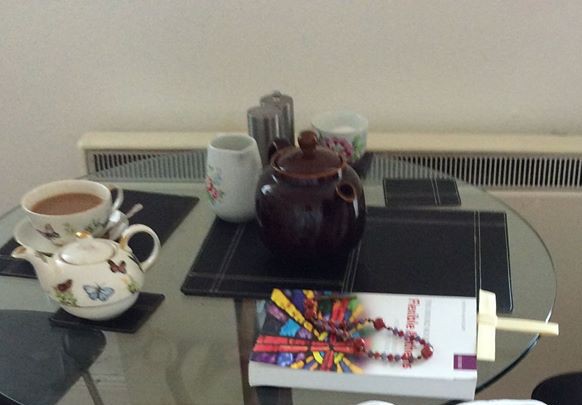
As of writing, we haven’t cracked murder by remote control, though we know for a fact Agatha Christie did. Ever read The Pale Horse? Guess what we’re reading over tonight’s Simply Hibiscus tea.
Though, we may skip the tea. It’s very astringent. Very pink. It may incite murder, not talk us out of it.
Murder
David Baker, 1994
1.
Language must suffice.
Years ago,
under a sweet June sky
stung with stars and swept back by black leaves
barely rustling,
a beautiful woman nearly killed me.
Listen,
she said,
and turned
her lovely face to the stars, the wild sky….
2.
No.
No: years ago,
under a sweet, June sky
strung with stars and swept back by black leaves
barely rustling,
under this sky
broad, bright, all rung around
with rustling elders—or intoxicating willows,
or oaks, I forget—
under this sky,
a beautiful woman killed me, nearly.
I say beautiful. You had to see her.
Listen,
she said,
and turned a lovely shell of her ear
to the swirl of stars
and the moon
smudged as a wingtip in one tree, not far.
3.
Yes: she scraped my back bloody against a rough trunk.
Yes: she flung back her lovely face
and her hair, holding me down,
and the tree shook slowly, as in a mild, persistent laugh
or wind,
and the moon high in that black tree
swung to and fro …
there were millions of stars
up where she stared past us,
and one moon, I think.
4.
Excuse me.
My friend, who loves poetry truly, says too much
nature taints my work.
Yes. Yes. Yes.
Too many birds, stars—
too much rain,
too much grass—
so many wild, bowing limbs
howling or groaning into the natural night …
and he might be right. Even here.
That is, if tree were a tree.
That is, if star or moon or even beautiful woman
craning the shell of her ear
were what they were.
They are, I think, not.
No: and a poem about nature contains anything but.
5.
When they descended to us, they were a cloud of stars
sweeping lightly. They sang to us urgently
about our lives,
they touched us
with a hundred thousand hair-soft, small legs—
and held down by such hungers, we let them cover us,
this beautiful woman, this me,
who couldn’t move,
who were stung—do you hear?—
who were stung again, were covered that quickly, crying
to each other
to fly away!
6.
… I just can’t erase
the exquisite, weeping language
of the wasps, nor her face in starlight
and so tranquil under that false, papery, bobbing
moon
just minutes before,
saying listen,
listen,
nor then the weight
of her whole natural body
pinning down mine
until we both cried out for fear, and pain,
and still couldn’t move.
7.
Language must suffice.
First, it doesn’t. Then, of course,
it does. Listen, listen.
What do you hear? This nearly killed me.
I’ll never know
why she didn’t just whisper Here they come, warn Move!
cry They’ll kill us!
Yes: I will save you …
Yes: I love you too much to watch you suffer!
But it’s all I recall, or now need.
And, anyway, I loved her, she was so beautiful.
And that is what I have had to say
before it’s too late,
before they have killed me,
before they have killed you, too,
or before we have all become something else entirely,
which is to say
before we are
only language.
You know what else provokes murder? The WordPress browser interface refuses to let us underline anything. We had to go to the app for that. And the app? It won’t let us align anything. Picture us here, surrounded by a tree that arrived on the day it was originally supposed to, after being set up by a benevolent uncle, contemplating murder. Of so, so, so many people.
 Chorister at Home