Advent III: Gaudete from the Choir Stalls

It was our Nine Lessons and Carols tonight, and we were an exceedingly good former chorister and resisted joining in the descants. Well, all right, we confess to fellow choristers and the body of the church et& et& to joining in on two separate lines to Hark the Herald. The thing is, we don’t know the melody to the third verse of that particular hymn. We’ve only ever sung the descant. So we were effectively sight-reading without the music this evening. And that’s a cruel thing to do to a soprano.

It’s also Gaudete Sunday, which means we can relax our Advent discipline a bit. ours, such as it is, would appear to be the blog, and to that end we’re doing something a bit different. We’re still thinking musically after the Nine Lessons, so we’re cobbling together more than the usual single anthem for you. Not to worry; not only will there not be nine of them, we promise no more earworms in the being of last night’s hornpipe.

We’ll start, because it’s Gaudete Sunday, with Hills of the North. This is far and away our favourite Advent hymn -who wouldn’t like a glad rush towards the Apocalypse? We’re being sincere there too, there are shades of Revelations about this hymn. And we’re giving it an airing because it’s woefully absent from the Anglican Hymnnal of the Church of Canada. We freely admit to grousing more than the average person about hymnals not called New English, but honestly, the selection in this one boggles us. It’s not just Hills of the North, the whole Advent section is weirdly curtailed. It doesn’t even have Lead Kindly Light. But that’s a rant for a different time. Here is Hills of the North -our version. There are two.


You’ll notice it’s slow enough to turn the choir blue. That’s not usual. But our only alternative was Songs of Praise not only with the wrong words but at such a clip as to be still more lunatic.  There is an average between the two -we’ve sung it -but it’s not prerecorded apparently.

To follow it, here’s one we used to air with regularity this time of year. It came with a good deal of gentle ribbing from the choir (all 5 of us) about Stainer’s lack of subtlety, but we love it anyways. Even if it does stick in our head for weeks after the fact of singing it.


You see what our choir meant about the subtlety? Even so, we miss it. But we won’t leave you to the endless musical loop that is that particular anthem. We’ll close with another omission from the Canadian Hymnal.


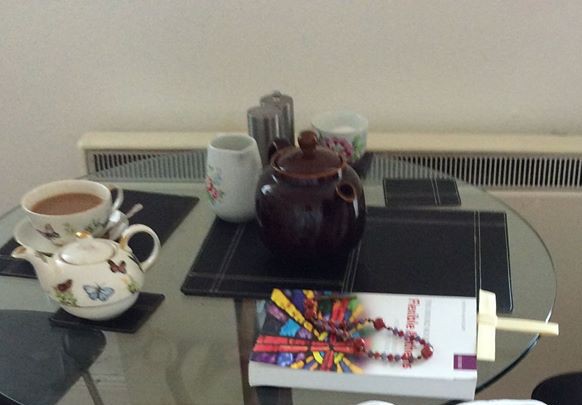
Nt quite Nine Lessons -more a ramble through music we miss this year. There are others too -we haven’t had any antiphonies – but these are high on our list. We’re listening to them accompanied by caramel shortbread tea. It would be heresy if it didn’t put us in mind of another thing we can’t get over here, Millionaire’s Shortbread. It’s the one aberrations to our rigid shortbread recipe we have time for. And the tea tastes the way we remember Millionaire’s Shortbread, though without the chocolate. It’s another sweet, dessert tea that doesn’t cloy, and it’s a lovely way to cap an evening of music and fellowship.

After all that, we can’t quite break with discipline after all, so here’s an irreverent thing that used to circulate through choir circles we knew whenever performances were coming due. Sing it to the tune of Immortal, Invisible and see if you ever sing the normal words again. We still have to think fractionally too long about it.

Immortal Impossible

 Immoral, impossible, God only knows
how tenors and basses, sopranos, altos
at service on Sunday are rarely the same
as those who on Thursday to choir practice came.

Unready, unable to sight-read the notes,
nor counting, nor blending, they tighten their throats.
The descant so piercing is soaring above
a melody only a mother could love.

They have a director, but no one knows why;
no one in the choir deigns to turn him an eye.
It’s clear by his flailing, he wants them to look,
but each singer stands there with nose in the book.

Despite the offences, the music rings out.
The folks in the pews are enraptured, no doubt.
Their faces are blissful, their thoughts appear deep,
but this is no wonder, for they are asleep.

*We would like to stress that whatever his sins, our conductor never flailed. Seemingly though, Thursday is the universal day for choir rehearsal. Funny the things that are unfailingly the same.


Advent II: Roses, Skis and White Tea

We’ve said before we’ve never met a white tea we disliked. And while all rules allow of an exception, Walnut Orange Scone, today’s calendar tea, is not that aberration. It doesn’t taste of scone, but we weren’t really expecting a tea to do that. Scones are, for lack of a better word, solid-tasting. You feel the effort of eating them. Tea on the other hand, and this white tea in particular, isn’t like that. It’s delicate, and floral, and whoever thought to combine white tea with orange blossom is, in our book, akin to genius. The warmth of the walnut laced through it is a lovely touch, and gives an extra weight to the tea. The company behind the calendar errs in only one particular; they think this is a morning tea. It’s not. It’s a comforting wrap of a tea to be drunk before bed. That would henceforth be our routine, but for the fact that we don’t think you want to read everlastingly about Walnut Orange Scone white tea, though we put ever so many poems next to it.

In liturgical news, it’s Advent II, which means Mary and Joseph have joined the tabletop crib, and here and there people are beginning to attend Nine Lessons and Carols. Ours isn’t until Gaudete Sunday, but over the water in Lang’s Auld Grey Toon of St Andrews, the service has been and gone, held deliberately early so the students can catch it.

This news was passed on to us today by a friend as we chatted on Skype, and it got us thinking about our early memories of the service. We were still nominally Presbyterian then, so knew nothing of what to expect. (Theological quarry; can one be nominally Presbyterian still and be possessed of a rosary?)

We remember very little about that first Nine Lessons bar the crowd, the candlelight and Crown of Roses.  We talked last Sunday of the glad expectation of Advent: Crown of Roses is the flip side to that coin. It’s slow, solemn, and hints at the Crucifixion. It has a weight to it that explains as no priest yet successfully done for us, why Advent is so often folded into talk of the Apocalypse.

In the event that you, like us that first Nine Lessons, don’t know Crown of Roses, it’s an anthem by Tchaikovsky. Normal people hear ‘Tchaikovsky’ this time of year and think Nutcracker. We hear his name and think Crown of Roses. Practically speaking, it’s scarcely done because it calls for a divisi from the basses, and it’s a well-established truth that there are never enough men in a choir. Back in St Andrews, our three-person-choir dared not touch it because our Sometimes Tenor would have inevitably had to carry the baseline alone, and that would have been an unkindness. Speaking seriously though, and not as a tongue-in-cheek chorister, it’s a rare, rich anthem, and the world should know it better.  It’s sung here by the All Saints’ Choir of Northampton.


Advent though, as we’ve said, is a funny, twofold season. Solemn on the one hand, almost giddily ebullient on the other. This was best typified by the Presbyterian minister we grew up with. Faced with a near-empty church in the winter months, he didn’t wail doom and End of Days but urged everyone instead to Get off your skis and onto your knees. This in spite of the fact that no god Presbyterian is in the habit of kneeling. That’s dangerously Romish. (Cf our leap to Scottish Episcopacy by way of Marian devotion if you doubt this.) But in the spirit of his old idiom, here’s a limerick for Advent II.

Winter Weather: Drift Into Church

From The Church Year in Limericks, Christopher M. Brunelle

With skis, on foot or by sleigh,
Your arrive is welcome today,
And your timely behaviour
Improves on our Saviour:
The Christ Child is still on his way!

(N.B. In the course of annotating this poem for posting, we’ve discovered these limericks began as an effort to enliven the beginning of choir rehearsals. We’ve had our share of those, and we love this book of verse all the more for its testament to the wilful ecclesiastical humour of the choir stalls. Not to mention we feel doubly vindicated about pairing these limericks with anthems!)

A Round Reel of Poetry: Tea for Accompaniment

It’s elegance meets….well the slightly less elegant tonight, as you’re getting tea and a verse with a dose of tartan. Though next to the ceilidhs we learned on, Scottish Country is the elegant cousin, so it’s not too amiss. Mondays are our dancing evening, and we’re strongly tempted to land you with Mairi’s Wedding, because we’ve not done that one yet here, and it would fit the pattern of our day. You’re not getting it, because it drives us fairly batty, even sung.

Besides, we’re sipping Silver Dragon Pearls tonight, and really, there are limits. Sometimes this Advent Calendar comes through in high style, and a tea this delicate, floral -and yes, high-grade -really deserves dignified accompaniment. Alas, we never claimed to be dignified. And since we’re still thinking in reels and jigs, you’re getting a wee verse about Scottish Country Dancing, no names given. Trust us; it’s much funnier this way.

Black_Watch_-_Campbell_tartan

A New Dance

Part Batt

Guess who’s written a brand new dance,
With a brand new figure in it,
Not easy to learn – but worth a try,
As you’ll hear, if you give me a minute.

It is, of course, a “meanwhile” dance
And sounds, perhaps, complex,
But it’s quite straightforward as long as you know
Your number, your partner, and sex.

Threes and fours on the opposite side –
You’ll find it better that way.
You’ve curtsied and bowed, so now get set
And cross your fingers and pray!

An inverted rondel is how it begins
And then the new figure you’ll see
With simple instructions on sheets 1 and 2
And diagrams 1, 2 and 3.

Two highland settings, a knotted barette,
And end in the form of a square.
Crossing reels, look behind you, and with any luck
You’ll find that your partner is there.

Your partner is there, but ignore him or her,
The pattern now subtly alters –
You grab someone else and all promenade round
Backwards – but only three quarters.

The Mic-Mac Rotary bit comes next,
You loop and you loop again,
A quadruple figure of eight, and then
A five-and-a-half-bar chain.

A two-and-a-half-bar turn ends the dance,
An experience no one should miss.
Wherever, whenever, whatever you’ve danced
You’ve never met something like this!

I hope you enjoy it – I think that you will –
And I do hope you think it’s alright
To give yo this preview of what he might dream
When he’s having a very bad night!

(Previously published in Reel 204)

saltire

After all that, you’re getting Mairi’s Wedding after all. If nothing else, it will give you a flavour of what all those verses are on about. It was also the first Scottish Country Dance we ever had thrown at us, and if you can look at it and tell us even one way in which that makes sense, we’ll bow to your wisdom. Personally, we’re still boggled.

Myn Lyking

Winter in Scotland and it’s been driech, which in plain English means it’s been raining doggedly since Thursday, when Murphy’s Law being in good working order, the family arrived. We’ve been trying to defend the appeal of a seaside town with sideways wind and twilight at 3 ever since. For our part, we’re combatting the weather this evening by drinking a late pot of Kashmiri Chai. It’s lighter than most chai, with a base in green tea; we discovered this pouring out, when the colour initially suggested the tea was understeeped. In fact it’s meant to be a golden colour. It’s further embellished by cinnamon, nutmeg and marigold flowers. And being chai, it is the ideal antidote to winter, whatever the weather.

We haven’t had much time spare for poetry hunting of late, what with trying to acclimatise three Canadians to Scotland. But last Sunday we were gifted a new carol by the conductor of our choir who told us to open Carols for Choirs to ‘Myn Lyking’ as if everyone knew of it. They should, so here this evening is both the Middle English text for you, and the carol to accompany it.

Myn Lyking 

15th Century (set by R. Terry)

I saw a fair mayden sytten and sing
She lulled a little childe, a sweete Lording.

Lullay mye lyking, my dere sonne, my sweeting.
Lully mydere herte, myn own dere derling.

That same Lord is he that made alle thing,
Of alle lord is his is lord, of alle kynges King.

There was mickle melody at that chylde’s birth
All that were in heav’nly bliss, they made mickle myrth.

Angels bright sang their song to that chyld;
Blyssid be thou, and so be she, so meek and so mild.