Season of Rinsed Mist and Raspberries

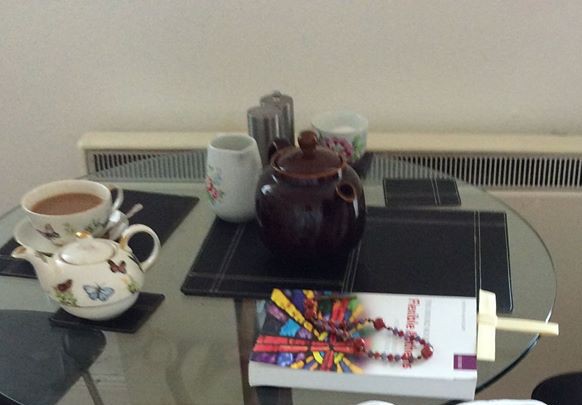
Incongruously, for a wintery night powdered in snow, the tea is called Raspberry Cream Pie.  It’s a rooibos, and its full of rose petals, honest-to-goodness frozen blackberries, and crystallised pink sugar. If you’re very disturbed, don’t worry. You’re in good company. The pink crystallised sugar gave us a turn too.

It’s not a bad tea though. Exceedingly sweet, but after the revelation about the crystallised sugar, that’s hardly a surprise. It also tastes powerfully of raspberry, which shouldn’t be surprising except for the utter lack of raspberry in evidence. All told, it’s a strange tea. Not, as we say, bad, but we’re not sure rooibos is supposed to be sweet. What we love about rooibos is its spice and zing, and it’s hard to detect any of that under all the crystallised pink sugar. Of course, it might help if we had a sweet tooth for things that weren’t peppermint squares and lemon-flavoured.

It’s billed as a dessert tea, and it’s undeniably that. Decadent on a level that’s worthy of a pre-Raphaelite painting. We have to say, our favourite dessert tea was called Secret Weapon. It was a white tea, full of almonds, liquorice root, orange peel and cornflowers. It was also our get-out-clause when we wanted a sweet after a meal during Lent seasons past. They don’t make it any more that we know of. But we say this because we want to drive home that a sweet tea doesn’t have to taste like confectionary or candy floss. Now, to be fair, Raspberry Cream Pie tastes more like a Cranachan that someone left the oats out of, but that’s hardly what your average tea-drinker goes into a cup of rooibos expecting. It certainly wasn’t what we were expecting.

But perhaps what’s most incongruous is that we’re getting this tea in an Advent Calendar.  A few sweet teas in winter don’t warrant a raised eyebrow, not really. But raspberries in December? Where are they getting them from?

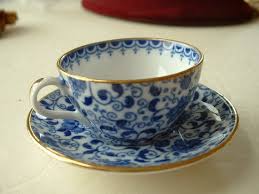
After all that, here’s a poem a bit more in season. It talks of mists and steam, and the kind of weather that we associate with a Scottish winter, and the kind of china that by rights belongs in harbour cafes. Blue and white pottery, you know the kind. We first came across it -the poem, not the pottery – in Ten Poems about Tea and at first reading we glanced off of it. It wasn’t obviously witty, it didn’t make us laugh, it didn’t rhyme -and yet it’s better stamped on our brains than some of the more obvious pieces in that collection. Without further ado then, here is Eavan Boland’s In Season.

In Season

Eavan Boland

The man and woman on the blue and white
mug we have owned for so long
we can hardly remember
where we got it
or how

are not young. They are out walking in
a cobalt dusk under the odd azure of
apple blossom,
going towards each other with hands outstretched.

Suddenly this evening, for the first time,
I wondered how will they find each other?

For so long they have been circling the small circumference
of an ironstone cup that they have forgotten,
if they ever really knew it, earth itself.

This top to bottom endlessly turning world
in which they only meet
each other meeting
each other
has no seasons, no intermission; and if

they do not know when light is rearranged
according to the usual celestial ordinance –
tides, stars, a less and later dusk –
and if they never noticed

the cotton edge of the curtains brightening earlier
on a spring morning after the clocks have changed
and changed again, it can only be

they have their own reasons, since
they have their own weather (a sudden fog,
tinted rain) which they have settled into

so that the kettle steam, the splash of new tea are
a sought-after climate endlessly folded
into a rinsed horizon.
spode

Do Not Sequester Our Common Sense

Tea tonight is called Lemon Pound Cake. Unlike some teas we’ve had, this one tastes the way the name suggests it will. It’s an especially lemony oolong that  is long in the mouth, the lemon we presume. We’ve only made up a cup -it’s late and we need sleep -but we’ll be going back to it. We have yet to meet an oolong we cannot drink, and citrus has long proven itself a good pairing with the tea. Something about it means that unlike jasmine, which grows bitter, or black tea, which stews, an oolong properly flavoured won’t oversteep. You have to be careful about it though. Our first year of university tastes of a now defunct tea called Vanilla Oolong. That could oversteep, and often if we were absent-minded and chatting with people, it did.

It’s one of our defying memories of first year though, something we mention since earlier in the evening we got talking books with people, and one of the questions to crop up was about what book defined our university experience. The thing is though, we’re Romanticists at heart. We dabbled in Wordsworth, Coleridge, Edgeworth and Wollstonecraft. None of those are really writers that define our degree. We looked at Austen too, and because of degree stipulations we even traded a bit in Old English and Restoration Literature. Again, much poetry. Though translating passages about Aelthelthryth’s neck tumour was, we grant, a pretty definitive moment.

Sometimes we railed against those degree stipulations. Never the Old English, we could read it happily forever, but Restoration literature is…weird. This from the woman who has read articles on whether there are zombies in Rhyme of the Ancient Mariner or not. Mary Pix’s The Innocent Mistress stands out as grievously bad. So bad in fact, that it’s no longer on the course. The Old Arcadia is also on our list of Seriously Bizarre. But sometimes after being strongarmed into a course, we’d get handed a gift of a text. Old English was like that, but over in the land of Restoration Literature, so was the poetry of Katherine Phillips.

She doesn’t get talked about much -a monarchist under Cromwell, why would she? But the great thing isn’t so much that she wrote independently, it’s that she defended her politics. When people went after her husband for her loyalty to the crown, she published a poem insisting she was responsible for her own opinions. And that was in-between the great hymns to love and friendship among women. This is none of those. It is, however,  our personal favourite. We want Do Not Sequester Our Common Sense to be the next sampler we stitch. Perhaps in whipped chain and herringbone stitches? What do you think?

On the Double Murther of a King

Katherine Phillips

I think not on the state, nor am concerned
Which way soever that great helm is turned,
But as that son whose father’s danger nigh
Did force his native dumbness, and untie
His fettered organs: so here is a cause

That will excuse the breach of nature’s laws.
Silence were now a sin: nay passion now
Wise men themselves for merit would allow.
What noble eye could see, (and careless pass)
The dying lion kicked by every ass?

Hath Charles so broke God’s laws, he must not have
A quiet crown, nor yet a quiet grave?
Tombs have been sanctuaries; thieves lie here
Secure from all their penalty and fear.
Great Charles his double misery was this,

Unfaithful friends, ignoble enemies;
Had any heathen been this prince’s foe,
He would have wept to see him injured so.
His title was his crime, they’d reason good
To quarrel at the right they had withstood.

He broke God’s laws, and therefor he must die,
And what shall then become of thee and I?
Slander must follow treason; but yet stay,
Take not our reason with our king away.
Though you have seized upon all our defense,

Yet do not sequester our common sense.
But I admire not at this new supply:
No bounds will hold those who at scepters fly.
Christ will be King, but I ne’er understood,
His subjects built his kingdom up with blood

(Except their own) or that he would dispense
With his commands, though for his own defense.
Oh! to what height of horror are they come
Who dare pull down a crown, tear up a tomb!

The Business of Cats

Tonight’s tea was confused. It’s called cinnamon rooibos chai, and while all of those are good things they do fight a bit when it comes to flavour. We should here double back a bit and add that it’s only chai in the sense of chai meaning tea. We can’t find evidence of the constituent parts of chai present. Just as well, considering the cinnamon barely registered. This may be our fault. We’re not of the ilk that leaves tea to brew for the request 4-5 minutes, mostly because we like to have the blog up this side of midnight. So it tasted primarily of rooibos, no bad thing, but less subtle than the smell of the tin promised. But it’s a good tea and warm. The kind you can drink to stave off a winter chill, and there’s certainly enough of that going around.

Along those lines we were going to find you a nice, topical poem about tea and winter, or one or the other. But then the Marschallin-Cat put in an appearance She variously sat on us, attempted to write the blog for us, and failing in those efforts, sat with her back to us, Sulking. The Sulking, if you’ve never observed it, is quite the spectacle, and not to be confused with that well-known book of similar name The Shining. Though we fancy there are horrors in store for anyone who ignores a Sulk. We, being disinclined to find out, took the hint. So much for tea and winter. Here’s a poem about life with cats instead.

img_0706

Busy, Busy

Francesco Marciuliano

It’s 8 AM and it’s time to nap
It’s 10 AM and it’s time to relax.
It’s 12 PM and it’s time to doze off
It’s 3 PM and it’s time to zonk out
It’s 6 PM and it’s time to slumber
It’s 9 PM and it’s time to snooze
It’s 12 AM and time to sleep
It’s 4 AM and it’s tim to hang upside down
from your bedroom ceiling, screaming.

Here we hasten to add that Miss Marschallin never screams. She’s not adverse to a light touch of singing at preternaturally early hours though. With that in mind, from the Marscahllin-Cat and us both, it’s goodnight. At least until 4 in the morning.


Life’s Little Absurdities

You’re getting a well-known poem today. We couldn’t resist, even if it does skip the calendar by weeks. We were out today doing our Christmas shopping, things for parcels, things for socks, and that rarity, cards that weren’t treacle-y. We’d like them to be vaguely Christmas themed (rather than, say, wintery), but provided they aren’t soppy, we’re disinclined to be fussy. Imagine our delight then, to read in a piece of poetical trivia, that The Journey of the Magi was supposed to line Christmas cards.

Christmas cards! Think of it. Set down this/ Were we lead all that way for / Birth, or Death? Or earlier, A cold coming we had of it. Not forgetting, I should be glad of a second death. Christmas cards! There were times when we regretted /the summer palaces  on slopes. We can’t decide if Faber & Faber commissioned the next Coventry Carol and got, well, Eliot in a theological mood, or if 1927 was the year of the unsentimental Christmas card.

Incredulous we might be, but we wouldn’t dare accuse those cards of soppiness. In fact, we’d probably buy them. Do Faber & Faber still do a line in them? We’ll take half a dozen stamped with that line about the camels galled, sore-footed, refractory/lying down in the melting snow to start with. Maybe if they go over well we’ll look into some inscribed with that bit about the innkeepers dicing for silver.  In the meantime, three guesses as to the poem of the evening.

As for the tea…A note on our poetry and tea ritual: Normally we brew the tea up in our little tea for one. We’re not doing that tonight. We took one look at the tea and recoiled in horror. Why? Someone, somewhere was struck with  the brilliant inspiration that what tea was missing was…youu’ll love this…coffee. Look, just because little Jassey Radlet, deep in the obscurity of Don’t Tell Alfred, feels (almost)  liking coffee makes her grown up, doesn’t mean we do. We can’t abide it. Not just the taste, but the smell, and the texture too. And here it is infiltrating our tea. We’re not sure we can even reasonably call this heresy. Someone has defiled the eighth sacrament. It is wrong.

So we’ve brewed tea in a mug. A teacup, actually, currently stranded from its saucer. Are we being a wee bit hyperbolic? Not really, no. Maybe a little. The thing is, we’ve been ambushed in previous years by coffee-infused tea, and the consequences were not good. And since our innate horror of pouring tea down the drain is strong, a mug it is.

Being reasonable though, coffee-tea doesn’t work as a concept. Watching it in the mug has brought this home to us. The coffee grounds escape the infuser and sink to the bottom of the cup, and that’s before they swamp the taste of the tea. What we really seem to be drinking is coffee that’s on nodding terms with tea, and it’s awful. We think it’s supposed to taste nutty, or something. How does one describe coffee? We don’t have the vocabulary for that.

But look, enough of this. A hard time we had of it indeed. Let’s move on to better things. And as you read, remember -Christmas cards!

The Journey of the Magi

T.S. Eliot

A cold coming we had of it,
Just the worst time of the year
For a journey, and such a long journey:
The ways deep and the weather sharp,
The very dead of winter.
And the camels galled, sore-footed, refractory,
Lying down in the melting snow.
There were times when we regretted
The summer palaces on slopes, the terraces,
And the silken girls bringing sherbet.
Then the camel men cursing and grumbling
And running away, and wanting their liquor and women, And the night-fires going out, and the lack of shelters, And the cities dirty and the towns unfriendly
And the villages dirty and charging high prices:
A hard time we had of it.
At the end we preferred to travel all night,
Sleeping in snatches,
With the voices singing in our ears, saying
That this was all folly.

Then at dawn we came down to a temperate valley,
Wet, below the snow line, smelling of vegetation;
With a running stream and a water mill beating the darkness, And three trees on the low sky,
And an old white horse galloped away in the meadow.
Then we came to a tavern with vine-leaves over the lintel, Six hands at an open door dicing for pieces of silver,
And feet kicking the empty wineskins.
But there was no information, and so we continued
And arrived at evening, not a moment too soon
Finding the place; it was (you may say) satisfactory.

All this was a long time ago, I remember, And I would do it again, but set down This set down
This: were we led all that way for
Birth or Death? There was a Birth, certainly,
We had evidence and no doubt. I had seen birth and death, But had thought they were different; this Birth was
Hard and bitter agony for us, like Death, our death.
We returned to our places, these Kingdoms,
But no longer at ease here, in the old dispensation,
With an alien people clutching their gods.
I should be glad of another death.

The Wintry Year; Alpine Punch and Lambs

We’ve had our first real snowfall of the year today. At six this morning it didn’t look of the staying kind, but sometime between then and now it turned into powder, and now it’s boot season as well as felt hat, scarf and gloved hands season. It makes today’s tea selection especially appropriate. Nothing says winter warmth more readily than a cup of rooibos tea.

This one is called Alpine Punch, and we’ve been buying it for years off our own bat, one of the inheritors of the much-mythologised Crumble Tea. They aren’t the same at all (nothing is the same as that tea was): this one is warmer and rounder in tone, with ginger and almonds as well as apple and cinnamon. It’s longer in the mouth too, and the rooibos means it has more spice in the taste than Crumble Tea ever did. We’ve used it before now to take the chill out of many a dreich Scots day, the kind when the wind comes rattling over the water from Norway and the haar is rolling in heavy off the sea. But it does in a pinch for a snowy day too.

Certainly we’d much rather be indoors nursing a cup of tea when the snow comes, than traipsing about in it. We like our weather the other side of a window, where it always looks lovely and we don’t hear Nelly Deane mentally telling us off for the acquisition of damp stockings. That, by the way, is what comes of studying English Literature. You remember all the most unlikely quotes and are duly ambushed by them at strange, improbable intervals.

Having said that, here’s a poem about snow that speaks to the hopefulness of the season. We initially supposed it was about spring lambing, but then we remembered that before now we’ve heard of winter lambs over in Ambridge, and people who know us know we get quite a lot of our agricultural understanding from that fictive idyll. The rest of it we owe to Hardy, and we recall he also has winter lambs in spots. Gabriel Oak mismothers one around this season, if we remember right. Anyway, this is neither Ambridge-isnpired nor more Hardy. It’s a poem by Phillip Larkin, and, like snow, rather lovely in its imagery.

First Sight

Phillip Larkin

Lambs that learn to walk in snow
When their bleating clouds the air
Meet a vast unwelcome, know
Nothing but a sunless glare.
Newly stumbling to and fro
All they find, outside the fold,
Is a wretched width of cold.

As they wait beside the ewe,
Here fleeces wetly caked, there lies
Hidden round them, waiting too,
Earth’s immeasurable surprise.
They could not grasp it if they knew,
What so soon will wake and grow
Utterly unlike the snow.

\

Advent II: Roses, Skis and White Tea

We’ve said before we’ve never met a white tea we disliked. And while all rules allow of an exception, Walnut Orange Scone, today’s calendar tea, is not that aberration. It doesn’t taste of scone, but we weren’t really expecting a tea to do that. Scones are, for lack of a better word, solid-tasting. You feel the effort of eating them. Tea on the other hand, and this white tea in particular, isn’t like that. It’s delicate, and floral, and whoever thought to combine white tea with orange blossom is, in our book, akin to genius. The warmth of the walnut laced through it is a lovely touch, and gives an extra weight to the tea. The company behind the calendar errs in only one particular; they think this is a morning tea. It’s not. It’s a comforting wrap of a tea to be drunk before bed. That would henceforth be our routine, but for the fact that we don’t think you want to read everlastingly about Walnut Orange Scone white tea, though we put ever so many poems next to it.

In liturgical news, it’s Advent II, which means Mary and Joseph have joined the tabletop crib, and here and there people are beginning to attend Nine Lessons and Carols. Ours isn’t until Gaudete Sunday, but over the water in Lang’s Auld Grey Toon of St Andrews, the service has been and gone, held deliberately early so the students can catch it.

This news was passed on to us today by a friend as we chatted on Skype, and it got us thinking about our early memories of the service. We were still nominally Presbyterian then, so knew nothing of what to expect. (Theological quarry; can one be nominally Presbyterian still and be possessed of a rosary?)

We remember very little about that first Nine Lessons bar the crowd, the candlelight and Crown of Roses.  We talked last Sunday of the glad expectation of Advent: Crown of Roses is the flip side to that coin. It’s slow, solemn, and hints at the Crucifixion. It has a weight to it that explains as no priest yet successfully done for us, why Advent is so often folded into talk of the Apocalypse.

In the event that you, like us that first Nine Lessons, don’t know Crown of Roses, it’s an anthem by Tchaikovsky. Normal people hear ‘Tchaikovsky’ this time of year and think Nutcracker. We hear his name and think Crown of Roses. Practically speaking, it’s scarcely done because it calls for a divisi from the basses, and it’s a well-established truth that there are never enough men in a choir. Back in St Andrews, our three-person-choir dared not touch it because our Sometimes Tenor would have inevitably had to carry the baseline alone, and that would have been an unkindness. Speaking seriously though, and not as a tongue-in-cheek chorister, it’s a rare, rich anthem, and the world should know it better.  It’s sung here by the All Saints’ Choir of Northampton.


Advent though, as we’ve said, is a funny, twofold season. Solemn on the one hand, almost giddily ebullient on the other. This was best typified by the Presbyterian minister we grew up with. Faced with a near-empty church in the winter months, he didn’t wail doom and End of Days but urged everyone instead to Get off your skis and onto your knees. This in spite of the fact that no god Presbyterian is in the habit of kneeling. That’s dangerously Romish. (Cf our leap to Scottish Episcopacy by way of Marian devotion if you doubt this.) But in the spirit of his old idiom, here’s a limerick for Advent II.

Winter Weather: Drift Into Church

From The Church Year in Limericks, Christopher M. Brunelle

With skis, on foot or by sleigh,
Your arrive is welcome today,
And your timely behaviour
Improves on our Saviour:
The Christ Child is still on his way!

(N.B. In the course of annotating this poem for posting, we’ve discovered these limericks began as an effort to enliven the beginning of choir rehearsals. We’ve had our share of those, and we love this book of verse all the more for its testament to the wilful ecclesiastical humour of the choir stalls. Not to mention we feel doubly vindicated about pairing these limericks with anthems!)

Tea and Friendship: Sacraments 8 and 9

A dear friend wrote to us today, and having heard of our Advent blogging effort, gifted us a rare gem of a poem. We had never come across it before, and loved it so much that we resolved immediately on reading it to send it out as this evening’s missive.

We’re drinking Forever Nuts this evening, as prescribed by the calendar. We know it well, the larder is full of it. People give it to us so that we won’t have to ration the last of our beloved ‘Crumble Tea.’ But the Crumble Tea is sacred to the Anglican Inquisition and only to be drunk when it is in session, so still we hoard it. In the meantime we make do with Forever Nuts.

It isn’t the same, the store is wrong about that; it’s too light, a herbal tisane with no underlying tea to balance the apple and cinnamon sweetness of it. If Crumble Tea (they called it Mom’s Apple Pie) was crumble in a cup, this is perhaps an apple turnover in a cup. Not wildly different, but not the same either. It’s still a good herbal tea though, a lovely way to round off a meal. And it tastes of autumn, confirming the serendipity of this gift by our friend back in St Andrews. It’s longer than we’d usually post, so pour a cup of tea, or something of your own choosing, and take a quarter hour to enjoy it.

Poem in October

Dylan Thomas

It was my thirtieth year to heaven
Woke to my hearing from harbour and neighbour wood
And the mussel pooled and the heron
Priested shore
The morning beckon
With water praying and call of seagull and rook
And the knock of sailing boats on the net webbed wall
Myself to set foot
That second
In the still sleeping town and set forth.

It was my thirtieth year to heaven
Woke to my hearing from harbour and neighbour wood
And the mussel pooled and the heron
Priested shore
The morning beckon
With water praying and call of seagull and rook
And the knock of sailing boats on the net webbed wall
Myself to set foot
That second
In the still sleeping town and set forth.

My birthday began with the water-
Birds and the birds of the winged trees flying my name
Above the farms and the white horses
And I rose
In rainy autumn
And walked abroad in a shower of all my days.
High tide and the heron dived when I took the road
Over the border
And the gates
Of the town closed as the town awoke.

A springful of larks in a rolling
Cloud and the roadside bushes brimming with whistling
Blackbirds and the sun of October
Summery
On the hill’s shoulder,
Here were fond climates and sweet singers suddenly
Come in the morning where I wandered and listened
To the rain wringing
Wind blow cold
In the wood faraway under me.

Pale rain over the dwindling harbour
And over the sea wet church the size of a snail
With its horns through mist and the castle
Brown as owls
But all the gardens
Of spring and summer were blooming in the tall tales
Beyond the border and under the lark full cloud.
There could I marvel
My birthday
Away but the weather turned around.

It turned away from the blithe country
And down the other air and the blue altered sky
Streamed again a wonder of summer
With apples
Pears and red currants
And I saw in the turning so clearly a child’s
Forgotten mornings when he walked with his mother
Through the parables
Of sun light
And the legends of the green chapels

And the twice told fields of infancy
That his tears burned my cheeks and his heart moved in mine.
These were the woods the river and sea
Where a boy
In the listening
Summertime of the dead whispered the truth of his joy
To the trees and the stones and the fish in the tide.
And the mystery
Sang alive
Still in the water and singingbirds.

And there could I marvel my birthday
Away but the weather turned around. And the true
Joy of the long dead child sang burning
In the sun.
It was my thirtieth
Year to heaven stood there then in the summer noon
Though the town below lay leaved with October blood.
O may my heart’s truth
Still be sung
On this high hill in a year’s turning.


Not as We Were

Tonight’s tea is an odd duck, a blend of white, green and jasmine tea with hibiscus for flavour. It’s called Buddha’s Blend, but that’s not the odd thing. It doesn’t taste the way it smells. That is the oddity. We opened the tin and observed to Miss Marschallin-cat that it was reminiscent of a blend we bought once from Wittards, Jubilee blend, a black tea flavoured with mango, mandarin and peach. That’s what Buddha’s Blend smelled of -suddenly we were back in the kitchen of the Grotto, number 68 North Street, spooning specialty Wittards tea into our teapot.

It doesn’t taste of those things though. Well, it wouldn’t, would it, with not a touch of mandarin, peach or even mango among the ingredients. That’s not to say it wasn’t lovely -it was – but it didn’t taste the way it smelled. A disconcerting culinary schism, by the way, if you’ve never experienced it. You might even say it was not as it was -for which reason, we’re giving you Hardy tonight.

Our love of Thomas Hardy’s poetry is well-documented. It might be the most beautiful in the English cannon to us. It conjures the England of coffee-table books as nothing else does, and is exhilaratingly playful in its word choice. Sometimes Hardy will even invent words wholecloth, like ‘norward’ here, or ‘illimited’ of The Darkling Thrush. At least, we’ve never seen anyone else make use of them.

More academically, Hardy, like Emily Dickenson, favours Common Metre -the metre of most hymn tunes. You can, if you’re so minded (this chorister is), set his poetry to everything from Helmsley to Aurelia, and quite a few others besides. It doesn’t work with this poem though. This one’s Dactylic Tetrameter, and if that sounds like a mouthful, suffice it to say you can waltz to this poem, more or less. Music and metre; preoccupations of ours. But here endeth the lesson. For a tea that’s not as it was, here’s a poem that breaks all its own -and Hardy’s -rules.

The Voice

Thomas Hardy

Woman much missed, how you call to me, call to me,
Saying that now you are not as you were
When you had changed from the one who was all to me,
But as at first, when our day was fair.
Can it be you that I hear? Let me view you, then,
Standing as when I drew near to the town
Where you would wait for me: yes, as I knew you then,
Even to the original air-blue gown!
Or is it only the breeze, in its listlessness
Travelling across the wet mead to me here,
You being ever dissolved to wan wistlessness,
Heard no more again far or near?
Thus I; faltering forward,
Leaves around me falling,
Wind oozing thin through the thorn from norward,
And the woman calling.

After Apple Picking

We’re drinking Saigon Chai tonight, just a cup because it’s late and we have, as our Greek lecturer used to say, an appointment with sleep. We’ve always liked Chai, the spice and the savour of it, and this is no exception. Something about it is peculiarly well-suited to winter. It’s a bit like drinking a down blanket, or something, all warmth and comfort.

It comes at the ideal moment; the weather here has turned suddenly wintery, and between the snap of the cold and the dark mornings and evenings, there’s no contesting the season. So as the autumn beats a hasty retreat, here’s a longer poem than we’d usually send up for an Advent submission, but an old favourite -and perfect for that heartbeat transition between seasons. Well, we think so.

After Apple-Picking

Robert Frost

My long two-pointed ladder’s sticking through a tree
Toward heaven still,
And there’s a barrel that I didn’t fill
Beside it, and there may be two or three
Apples I didn’t pick upon some bough.
But I am done with apple-picking now.
Essence of winter sleep is on the night,
The scent of apples: I am drowsing off.
I cannot rub the strangeness from my sight
I got from looking through a pane of glass
I skimmed this morning from the drinking trough
And held against the world of hoary grass.
It melted, and I let it fall and break.
But I was well
Upon my way to sleep before it fell,
And I could tell
What form my dreaming was about to take.
Magnified apples appear and disappear,
Stem end and blossom end,
And every fleck of russet showing clear.
My instep arch not only keeps the ache,
It keeps the pressure of a ladder-round.
I feel the ladder sway as the boughs bend.
And I keep hearing from the cellar bin
The rumbling sound
Of load on load of apples coming in.
For I have had too much
Of apple-picking: I am overtired
Of the great harvest I myself desired.
There were ten thousand thousand fruit to touch,
Cherish in hand, lift down, and not let fall.
For all
That struck the earth,
No matter if not bruised or spiked with stubble,
Went surely to the cider-apple heap
As of no worth.
One can see what will trouble
This sleep of mine, whatever sleep it is.
Were he not gone,
The woodchuck could say whether it’s like his
Long sleep, as I describe its coming on,
Or just some human sleep.


Favourite Things

The calendar yielded an old favourite today -one that, to judge from the website when we went to crib information for you, was brought back specially for the calendar. It’s called Glitter and Gold, and it’s a black tea laced with cinnamon and all sorts. That’s no description, coming from a self-professed tea-lover, but we did the research. It yielded no good result. Suffice it to say we’ve been drinking this tea for years without thinking about the contents much. It’s a Chinese tea, which, Julian Mallory of Excellent Women assures us is ‘always such a treat.’ To us it tastes of Christmas -the cloves, we presume.

Proving we can sometimes be reasonable, here’s an old favourite poem to go hand-in-hand with a favourite tea. It comes from Gaudy Night, and we have a sort of inkling we may have used it on here before. But we love it. ‘Conceited little thing’ -Peter meant in the Donne sense, we think -or not, it’s the poem we turn to when we want to still the world for a spell. (The joys of the boating scene, you understand, we savour for rereads only.) Between the giddy whirl that was yesterday, and the busy, half-mad bustle that is Advent as ordained by the claims of the world, we offer you this bit of literary respite.

That Still Centre

Dorothy Sayers, as found in Gaudy Night
Here, then, at home, by no more storms distrest,
Folding laborious hands we sit, wings furled;
Here in close perfume lies the rose-leaf curled,
Here the sun stands and knows not east nor west,
Here no tide runs; we have come, last and best,
From the wide zone through dizzying circles hurled,
To that still centre where the spinning world
Sleeps on its axis, to the heart of rest.

Lay on thy whips, O Love, that we upright,
Poised on the perilous point, in no lax bed
May sleep, as tension at the verberant core
Of music sleeps; for, if thou spare to smite,
Staggering, we stoop, stooping, fall dumb and dead,
And, dying, so, sleep our sweet sleep no more.