A Round Reel of Poetry: Tea for Accompaniment

It’s elegance meets….well the slightly less elegant tonight, as you’re getting tea and a verse with a dose of tartan. Though next to the ceilidhs we learned on, Scottish Country is the elegant cousin, so it’s not too amiss. Mondays are our dancing evening, and we’re strongly tempted to land you with Mairi’s Wedding, because we’ve not done that one yet here, and it would fit the pattern of our day. You’re not getting it, because it drives us fairly batty, even sung.

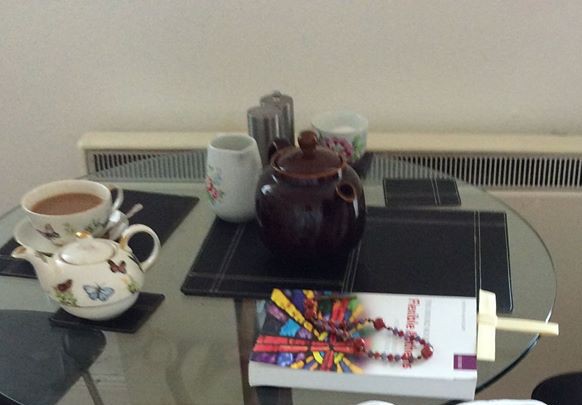
Besides, we’re sipping Silver Dragon Pearls tonight, and really, there are limits. Sometimes this Advent Calendar comes through in high style, and a tea this delicate, floral -and yes, high-grade -really deserves dignified accompaniment. Alas, we never claimed to be dignified. And since we’re still thinking in reels and jigs, you’re getting a wee verse about Scottish Country Dancing, no names given. Trust us; it’s much funnier this way.

Black_Watch_-_Campbell_tartan

A New Dance

Part Batt

Guess who’s written a brand new dance,
With a brand new figure in it,
Not easy to learn – but worth a try,
As you’ll hear, if you give me a minute.

It is, of course, a “meanwhile” dance
And sounds, perhaps, complex,
But it’s quite straightforward as long as you know
Your number, your partner, and sex.

Threes and fours on the opposite side –
You’ll find it better that way.
You’ve curtsied and bowed, so now get set
And cross your fingers and pray!

An inverted rondel is how it begins
And then the new figure you’ll see
With simple instructions on sheets 1 and 2
And diagrams 1, 2 and 3.

Two highland settings, a knotted barette,
And end in the form of a square.
Crossing reels, look behind you, and with any luck
You’ll find that your partner is there.

Your partner is there, but ignore him or her,
The pattern now subtly alters –
You grab someone else and all promenade round
Backwards – but only three quarters.

The Mic-Mac Rotary bit comes next,
You loop and you loop again,
A quadruple figure of eight, and then
A five-and-a-half-bar chain.

A two-and-a-half-bar turn ends the dance,
An experience no one should miss.
Wherever, whenever, whatever you’ve danced
You’ve never met something like this!

I hope you enjoy it – I think that you will –
And I do hope you think it’s alright
To give yo this preview of what he might dream
When he’s having a very bad night!

(Previously published in Reel 204)

saltire

After all that, you’re getting Mairi’s Wedding after all. If nothing else, it will give you a flavour of what all those verses are on about. It was also the first Scottish Country Dance we ever had thrown at us, and if you can look at it and tell us even one way in which that makes sense, we’ll bow to your wisdom. Personally, we’re still boggled.
Advent I: This is the Record of John

We’re into Advent proper now, and one of the things we most miss about having a choir is the Advent music. Oh, we love Christmas music as much as anyone, but we love the hopefulness of Advent, the way the atmosphere is pregnant with hope and anticipation, even more. ‘Little Lent,’ we’ve heard it called, and it is, because part of Advent is Apocalyptic. But it’s also ebullient, expectant, and whereas lent has a pall over it, Advent moves from darkness to light. It’s why we’re encouraged by today’s collect to ‘Cast off the works of darkness and put on the armour of light.’

With all that in mind, we thought this year, in the name of variety, we’d give our Advent Sundays on the blog over to posting a favourite Advent anthem, or maybe a hymn we miss. But lest you think we’re too serious about the whole thing, we’re going to include a poem with it -selections from the delightful Church Year in Limericks, a happy discovery of ours made while trying to track down another poetry anthology for work. After all, we must be able now and then to laugh at our doctrine as we would anything else, or risk the heresy of taking it all too seriously.

img_2199

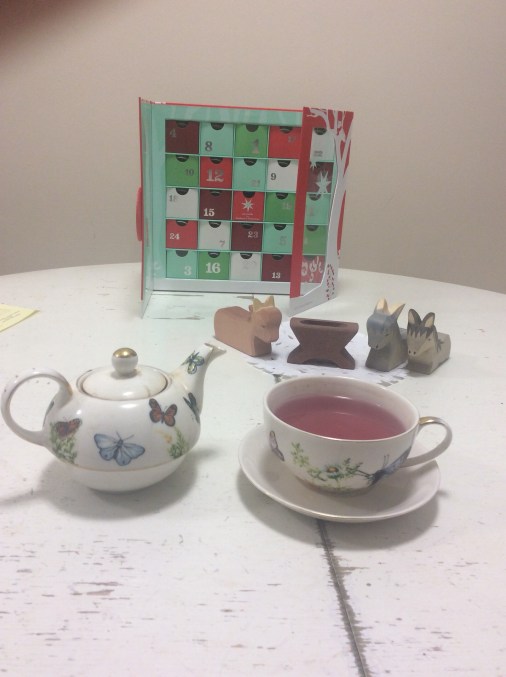
With that in mind, we shan’t grouse about the fact that tonight’s tea (see above) missed the memo that rose is the colour of Advent III, not I. It’s a returning tea to the Advent selection, Strawberry Parfait, and our abiding memory of it is twofold. In the first place, it tastes of pink. In the second, we last drank it after a trying ordeal negotiating our way back from Stirling bus station.

This year it still tastes of pink, and it’s still oddly sweet in a way that recalls a jelly donut. Personally, we keep expecting Truly Scrumptious and company to waltz around the nearest corner and start singing about it. It’s that sort of sweet. Not a bad tea, exactly, but another desert tea -and, oh grievous heresy -not one you’d want to take a biscuit with.  To temper the sweetness, a little, here’s an everlasting Advent favourite of ours, written by Orlando Gibbons and sung here by the Kings College Choir, Cambridge.


And when you’ve revelled in the still small sanctity of that, here’s a bit of levity to close. Who knew what the church calendar was missing was limericks?

Holiday Declarations

From The Church Year in Limericks by Christopher M. Brunelle, © Morning Star Music Publishers 2017

Our cranberries used to be relish
But now it’s our church they embellish
(with popcorn and string)
To welcome the King
Who saves us from fates that are hellish.


You’ll Have Had Your Tea

img_1897

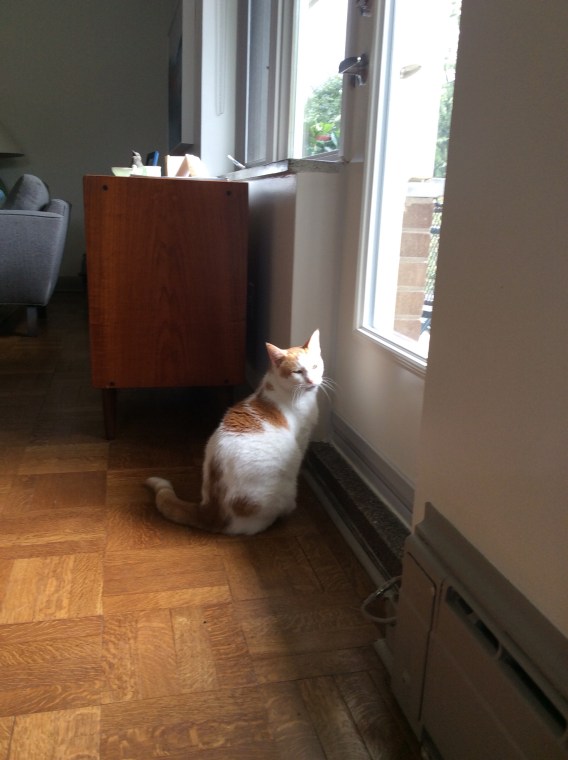
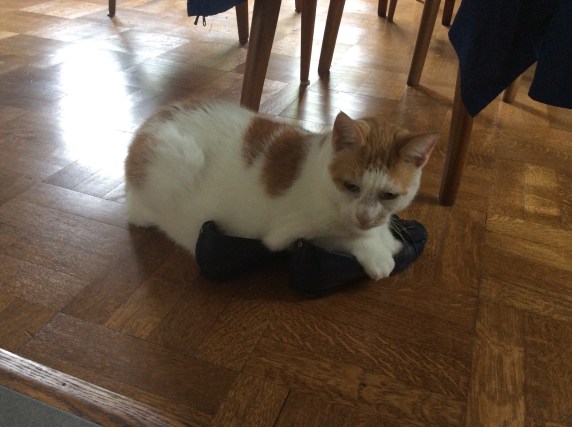
This is Dougie. He had two great missions in life; food and the guarding of shoes. If you wore the shoes, he sometimes attacked your feet for invading them.

He began, when we’d only met him long-distance, as Dougal, because of the ginger in his fur and that old sketch on I’m Sorry, I Haven’t a Clue called Sound Charades, in which two comedians perpetually began their half of the play with cries of:

‘Hamish!’

‘Dougal!’

‘You’ll have had your tea.

‘Oh, no…’

No one had ever had their tea, to hear ‘Hamish’ and ‘Dougal.’ Neither had Dougie, if you believed everything he had to say on the subject of food.

But Dougal was too Scotch a name for the Canadians he lived with, and anyway, don’t cats always have half a dozen names? So he became Dougie, more Canadian for a Canadian cat, but his origin story was apt, because he was perpetually wanting his tea. And shoes to guard. And people to sit on. But no one does comedic sketches about those things. You’ll Have Had Your Tea it was.

Now I’m having my tea, in quite a different sense, and it goes by the dubious name of ‘Chocolate Macaroon.’ I won’t reiterate the spiel about chocolate in tea. But coconut…to anyone else I suspect it’s inoffensive enough. It tastes of suncream to me, probably because that’s what suncream smells of. Also, curiously, it evokes Nice Biscuits, a culinary misnomer if ever there was one. So all told it’s not won me over yet, which is okay. We’re on day two of this Advent calendar and there’s always a couple of dodgy selections. (Coffee tea of last year comes readily to mind.)

Maybe I just feel guilty about the fact that I’m having tea when Mr Dougie can no longer join me and attack my shoes while I sip it. Pancreatic cancer in cats is like that -not the sort of thing you can reverse.

But objectively, if you aren’t averse to coconut, and if you’re not in converse with departed cats, this isn’t a bad tea. Decadent, and not what you’d want to take with your toast at breakfast, but rich and desert-esque. The sort of thing you’d foist on Tommy and Tuppence at one of there Ritz-staying ventures.

In the meantime, here’s a poem, Dougie. Other cats I’ve been known to sing to. Mr Keys got Hansel and Gretel, specifically the ditty about the mouse in the straw, and Her Nibs is partial to Vilja Lied, but you and I weren’t quite on singing terms. I had the temerity to wear my shoes, after all, and you preferred we sit together instead. And who was I to argue with you, world’s most placid cat? So no music for you, but here’s Tennessee Williams, who had he never written a play, would, we feel confident be remembered for his verse.

We Have Not Long to Love

Tennessee Williams

We have not long to love.
Light does not stay.
The tender things are those
we fold away.
Coarse fabrics are the ones
for common wear.
In silence I have watched you
comb your hair.
Intimate the silence,
dim and warm.
I could but did not, reach
to touch your arm.
I could, but do not, break
that which is still.
(Almost the faintest whisper
would be shrill.)
So moments pass as though
they wished to stay.
We have not long to love.
A night. A day….
We didn’t have you nearly long enough to love, Dougie. You were supposed to live on the spoils of the land (or at least veterinary selected cat-food) for years to come. There would have been shoes to wrestle and tea to be had, and maybe we’d have eventually got to singing terms. Apparently celestial shoes had greater need of your defence. Do them proud. And until we catch up again, it seems a safe bet to think that as no cat-friendly patch of hereafter would starve you, we can fairly suppose you’ll have had your tea, then.
img_1902

Tea and Not-Quite-Advent

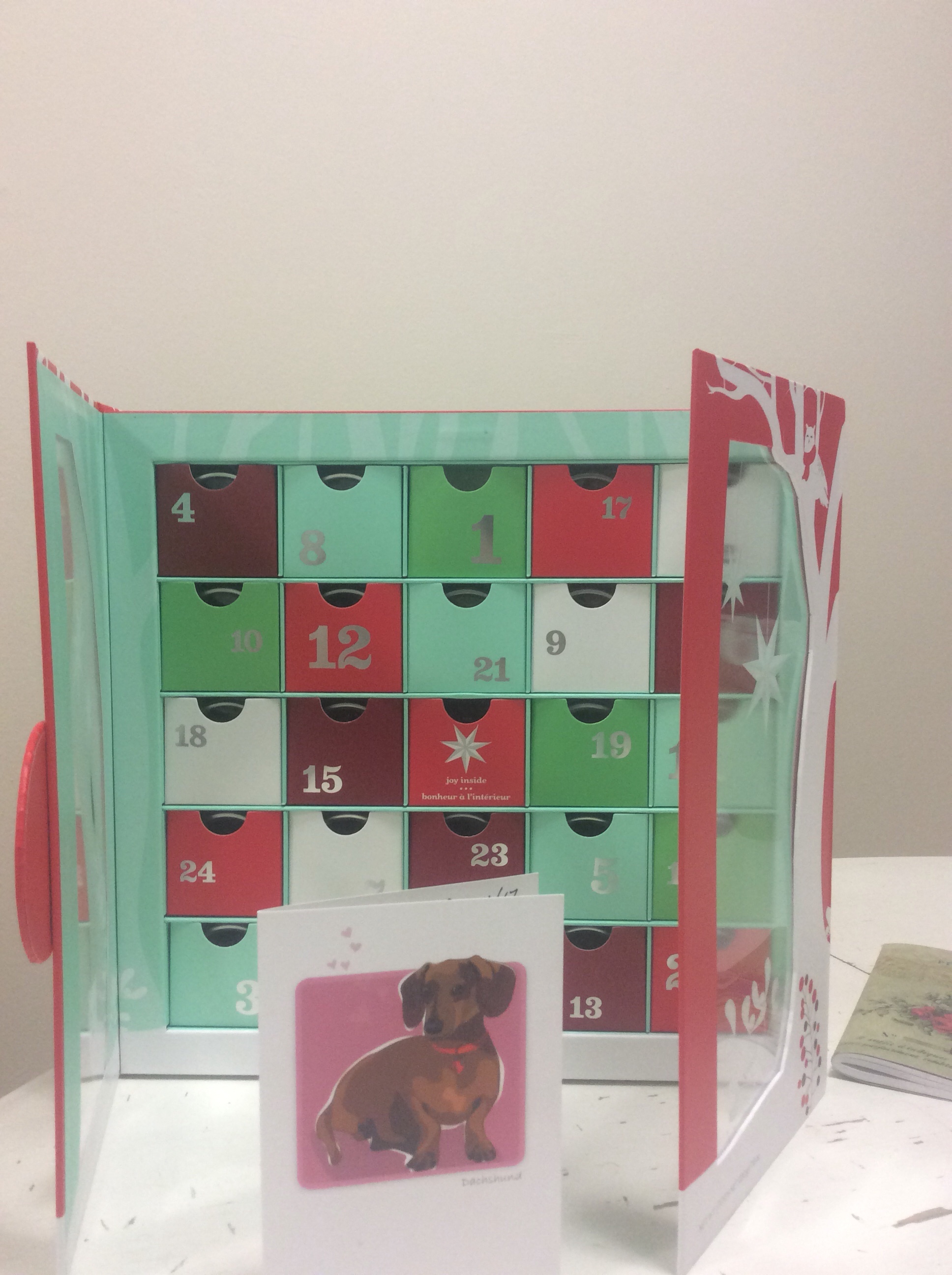
It’s not-quite-Advent, but we’re back anyway, with another tea calendar and more poetry for this December. This one was a gift from the Dachshunds of Dawlish, presumably for removing Her Imperiousness the Marschallin Cat to quarters elsewhere. (She’ll be back in March, we both will, but don’t let on. We’re enjoying the tea!)

Today it’s a blend called Let it Snow, which it most definitely isn’t, and as long as we’re walking to the subway, we’re not complaining. It’s quite cold enough without adding to it. Anyway, it’s a creamy green tea with white chocolate in it, and anyone who forgets our sentiments on tea and chocolate, we like them separate, is the succinct version. But there’s cloves too, and other spices, also custard, which has no business being in tea. Actually, we’re doubtful about custard in anything, we can’t pin that one on the tea. Still, the prices suit it, and all those oddities, chocolate, custard, theybdo add a creaminess to it. The jury’s still out on whether green tea should be creamy though. We’ll get back to you.

Until then, here’s a poem by Carol Ann Duffy. It’s one of those Tea poems we think probably everyone knows, and if we’re honest, we weren’t converted to it’s cause until we heard it read st a wedding reception. He, you understand was a coffee devotee, whereas, she, like us, preached the Gospel of Tea. Do we’ve come to love it for the memory it evokes. Without further ado, here it is.

Tea

Carol Ann Duffy

I like pouring your tea, lifting
the heavy pot, and tipping it up,
so the fragrant liquid streams in your china cup.
Or when you’re away, or at work,
I like to think of your cupped hands as you sip,
as you sip, of the faint half-smile of your lips.
I like the questions – sugar? – milk? –
and the answers I don’t know by heart, yet,
for I see your soul in your eyes, and I forget.
Jasmine, Gunpowder, Assam, Earl Grey, Ceylon,
I love tea’s names. Which tea would you like? I say
but it’s any tea for you, please, any time of day,
as the women harvest the slopes
for the sweetest leaves, on Mount Wu-Yi,
and I am your lover, smitten, straining your tea.

English Toffee and Poetry Fragments

We’re doing the unheard of this evening and brewing tea in a mug. We’ve reconciled this with our conscience by deciding that what we’re really doing is christening a gift of a Christmas mug with a cup of English Toffee tea. Also, we’re too tired to observe the complete sacrament of tea. This is a shame, as English Toffee is clearly a tea that deserves sacramaentalisig. It’s a beautiful balance of Pu’erh tea and toffee flavour -enough to give it a shape but not so much as to trigger our lack of a sweet tooth into protest. Chiefly though it’s existing to revitalise us.

Somewhere on the internet there exists a wonderful rewrite of ‘Ye Watchers and Ye Holy Ones’ to an Easter theme, and it begins, Now Christ is risen from the dead/the Choristers can go to bed… Sadly, no one has yet troubled with a Christmas equivalent, but you can take it on good authority that the sentiment is the same. More so, in fact, since the marathon combination of the Tridium and Easter taps into reserves of energy that Christmas Eve doesn’t begin to plumb. Probably there is an interesting theological nuance to be teased out here, but we don’t feel equal to the task presently.

The Canadian family will vouch for the fact our brains are still somewhere in the choir vestry, probably frozen due to the boiler failure we continue to experience. Forced to explain what a minced pie was (one of the relocated Canadians rather sweetly worried it might not be vegetarian) we managed to garble things about boiled fruit and sugar but didn’t do much better -though we did usefully recollect that Cromwell once banned them.

Here, before we settle into a long day of restorative reading, is one last poem for the last of the Advent teas. There might be more of it, but the version we’re recording comes hand-written from the inside of a Christmas card . We relay it with warm wishes for a Happy Christmastide.

From ‘THe Gude and Goldie Ballats’

(attributed Martin Luther, translated John Wedderburn)

This day to you is born ane child

Of Mary meek and virgin milde,

That blessed bairn being and kind 

Sall you rejoice baith hart and mind.


Christmas Eve and Twelve O’Clock

In what turns out to be grand Christmas tradition, the heating failed this evening at Midnight Mass, so we’re drinking a late cup of tea with just cause. It’s a black tea laced with candy cane and peppermint, and aptly called Santa’s Secret -and it’s exactly what we need. Our hands are still cold. Also, we’ve sung almost continuously for two hours and our voice gave out somewhere after the last top G in ‘Hark the Herald.’ We’ll do it all again tomorrow and gladly, but in the meantime, tea is welcome, especially when it tastes so nice as this one does.

Strictly speaking, we’re now into Christmas day, but as somewhere it’s bound to be evening still, here’s a poem by Thomas Hardy that has it’s roots in an old belief that at midnight on Christmas eve the oxen kneel to observe the Christ. Enjoy it -and Happy Christmas from Scotland!

The Oxen

Thomas Hardy

Christmas Eve, and twelve of the clock.
“Now they are all on their knees,”
An elder said as we sat in a flock
By the embers in hearthside ease.
We pictured the meek mild creatures where
They dwelt in their strawy pen,
Nor did it occur to one of us there
To doubt they were kneeling then.
So fair a fancy few would weave
In these years! Yet, I feel,
If someone said on Christmas Eve,
“Come; see the oxen kneel,
“In the lonely barton by yonder coomb
Our childhood used to know,”
I should go with him in the gloom,
Hoping it might be so.


Myn Lyking

Winter in Scotland and it’s been driech, which in plain English means it’s been raining doggedly since Thursday, when Murphy’s Law being in good working order, the family arrived. We’ve been trying to defend the appeal of a seaside town with sideways wind and twilight at 3 ever since. For our part, we’re combatting the weather this evening by drinking a late pot of Kashmiri Chai. It’s lighter than most chai, with a base in green tea; we discovered this pouring out, when the colour initially suggested the tea was understeeped. In fact it’s meant to be a golden colour. It’s further embellished by cinnamon, nutmeg and marigold flowers. And being chai, it is the ideal antidote to winter, whatever the weather.

We haven’t had much time spare for poetry hunting of late, what with trying to acclimatise three Canadians to Scotland. But last Sunday we were gifted a new carol by the conductor of our choir who told us to open Carols for Choirs to ‘Myn Lyking’ as if everyone knew of it. They should, so here this evening is both the Middle English text for you, and the carol to accompany it.

Myn Lyking 

15th Century (set by R. Terry)

I saw a fair mayden sytten and sing
She lulled a little childe, a sweete Lording.

Lullay mye lyking, my dere sonne, my sweeting.
Lully mydere herte, myn own dere derling.

That same Lord is he that made alle thing,
Of alle lord is his is lord, of alle kynges King.

There was mickle melody at that chylde’s birth
All that were in heav’nly bliss, they made mickle myrth.

Angels bright sang their song to that chyld;
Blyssid be thou, and so be she, so meek and so mild.

The Year’s Midnight

The sun set, if you’re curious, at half-past three today. We’ve been sitting in darkness ever since, writing lots and drinking tea. We made the mistake of going out at midday (twilight?) and got caught in torrential rain for our trouble. We should have known better than to risk the excursion without a hat. But the thing about St. Andrews is that it does very particular, almost localised weather. It wasn’t raining, looking out the french windows at the back of the house. It was raining out the front.
Tonight we’re drinking spiced apple tea. It smells of what we’d call apple cider -the non-alcoholic cider particular to Canada, with clovers, cinnamon and nutmeg in. The flavour of it is lovely, but sadly it’s not designed for a tea-infuser. The pieces of dried apple and clove are too big. No matter, we’re just going to have to drink it in vats, and that’s not something we’ll complain about.
Here, as promised, on the year’s midnight, is John Donne’s ‘St Lucy’s Day.’ Never was there a more apt summation of the fleeting Scottish winter day.
A Nocturnal upon St Lucy’s Day
Joh Donne
‘Tis the year’s midnight, and it is the day’s,
Lucy’s, who scarce seven hours herself unmasks;
         The sun is spent, and now his flasks
         Send forth light squibs, no constant rays;
                The world’s whole sap is sunk;
The general balm th’ hydroptic earth hath drunk,
Whither, as to the bed’s feet, life is shrunk,
Dead and interr’d; yet all these seem to laugh,
Compar’d with me, who am their epitaph.
Study me then, you who shall lovers be
At the next world, that is, at the next spring;
         For I am every dead thing,
         In whom Love wrought new alchemy.
                For his art did express
A quintessence even from nothingness,
From dull privations, and lean emptiness;
He ruin’d me, and I am re-begot
Of absence, darkness, death: things which are not.
All others, from all things, draw all that’s good,
Life, soul, form, spirit, whence they being have;
         I, by Love’s limbec, am the grave
         Of all that’s nothing. Oft a flood
                Have we two wept, and so
Drown’d the whole world, us two; oft did we grow
To be two chaoses, when we did show
Care to aught else; and often absences
Withdrew our souls, and made us carcasses.
But I am by her death (which word wrongs her)
Of the first nothing the elixir grown;
         Were I a man, that I were one
         I needs must know; I should prefer,
                If I were any beast,
Some ends, some means; yea plants, yea stones detest,
And love; all, all some properties invest;
If I an ordinary nothing were,
As shadow, a light and body must be here.
But I am none; nor will my sun renew.
You lovers, for whose sake the lesser sun
         At this time to the Goat is run
         To fetch new lust, and give it you,
                Enjoy your summer all;
Since she enjoys her long night’s festival,
Let me prepare towards her, and let me call
This hour her vigil, and her eve, since this
Both the year’s, and the day’s deep midnight is.

Spiced Tea and Cats

We’re steeping a pot of what calls itself Cardamom French Toast Tea, and so far all things are promising. We gather from both grandmothers that Canadians -or perhaps its only our family -deem the correct way to eat this delicacy involves tomato sauce. As we’ve never agreed with this particular doctrine, we’re relieved to find the tea (it’s a black tea at its roots) tends towards cinnamon and maple, no tomatoes involved. It tastes of spice, which is more than welcome; we’ve long been partial to spiced black tea but ran through our Wittards stock some time ago. We’ll make do with other things, but there’s nothing like Wittards Imperial Blend, or Kusmi’s Prince Vladimir with its cloves and vanilla, to take the cold out of a winter afternoon. Cardamom French Toast does not fall short.

We’re seriously tempted this evening to give you the series of limericks about the Marschallin-cat. She’s at our elbow and most insistent that we pay her suitable homage. But there are almost certainly superior writers who have treated much the same theme. Our favourite comes from a collection that purports to be written by cats and begins, unforgettably, why are you screaming?

Why Are You Screaming 

(Francesco Marciuliano)

Why are you screaming?

Did I do something wrong?

Why are you crying?

How can I make it right?

Would you like it in a different colour?

Would you like it in a different size?

Would you like it in a different room?

I just wanted to show my love,

I just wanted to express my thanks,

I just wanted to lay a dead  mouse on your sheets.

But now you are screaming,

And I don’t know how to make you stop.

img_0421
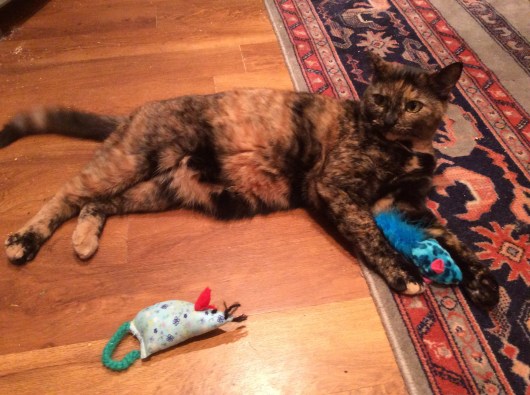
Happily for us, all Miss Marschallin’s dead mice are shades of blue. Much less screaming.

Just the Ordinary Thing…

Everything we’ve been saying for weeks about green tea being the perfect compliment to fruit and nuts is realised in tonight’s tea. It’s an almond green tea that would be much too sweet were it herbal. As it is it’s a beautifully balanced cup that tastes a bit like drinking an almond slice. We’re drinking it in leisurely fashion and musing on church and family, because part of them visiting means trying to explain Scottish Episcopalianism to long-term Presbyterians.

There’s no good way of explaining why this is fraught and complicated except to try and describe the service from the ‘other side’ of the pews, as it were.

 No one is thinking very hard about the clockwork and how it fits together because we’re all doing six different things at once. The thurifer’s censing the choir, who are trying not to asphyxiate because they are trying to sing, and while all of that is happening the priest is preparing the altar for communion and the congregation is anticipating the moment the thurifer turns on them so they remember to bow, and so it goes on. And because it’s Christmas there are half a dozen furbelows that have been added to make sure everyone knows it’s Christmas (because the midnight service mightn’t give that away), which means we’re all guessing. The choir are trying not to melt the folders and the organist (who only has half the asperges and that in a completely different setting to the one his choir is canting) is approximating how long to improvise for and watching the communion queue to see whether to deploy the emergency communion hymn, and there’s always going to be a surplus of wafers ‘just in case’ because it’s one of those occasions when you anticipate the 500.

The point is, none of us knows what we’re doing, not really, and it doesn’t really matter. We’ll still try and explain, because that’s part of giving them welcome, and we’d hate for them to feel all adrift somewhere that’s made us so at home. Also, we know the service book isn’t exactly expansive in its communication. We’ll do our best, but  S. J. Forrest still says it best in his critique of services, and we’re seriously tempted to let him have the last word.

What’s The Use?

by S.J. Forrest

(transcribed by Father James Siemens, AF)

‘Oh just the usual thing you know; the BCP all through,
Just pure and unadulterated 1662;
A minimum of wise interpolations from the Missal,
The Kyrie in Greek, the proper Collects and Epistles,
The Secret and the Canon and the Dominus Vobiscum,
(Three aves and a salve at the end would amiss come);
To the “militant” and “trudle” there is little need to cling,
But apart from these exceptions, just the ordinary thing.’

‘Oh, just the usual thing you know; we’re C of E of course,
But beautify the service from a mediaeval source,
With various processions, and in case you shouldn’t know,
There are tunicled assistants who will tell you where to go;
And should you in bewilderment liturgically falter,
Just make a little circumambulation of the altar.
The blessing, like a bishop, you majestically sing;
But apart from these exceptions, just the ordinary thing.’

‘Oh, just the usual thing you know; but very up to date,
Our basis is the liturgy of 1928,
With lots of local colouring and topical appeal,
And much high-hearted happiness, to make the service real;
Our thoughts on high to sun and sky, to trees and birds and brooks,
Our altar nearly hidden in a library of books;
The Nunc Dimittis, finally “God Save The Queen” we sing;
But, apart from these exceptions, just the ordinary thing.’

‘Oh, just the usual thing you know, we trust that you’ll be able
To mingle with the reredos and stand behind the Table;
(For clergymen who celebrate and face the congregation,
Must pass a stringent glamour-test before their ordination!)
Patristic ceremonial; economy of gesture,
Though balanced by a certain superfluity of vesture;
With lots of flanking presbyters all gathered in a ring,
But, apart from these exceptions, just the ordinary thing.’