Dec 8

Today’s tea was a gorgeous Saigon Chai. We did our best to make it properly, iwth lots of milk and rock sugar from a friend. We don’t typically sweeten tea, but we make an exception for chai, because traditionally that’s how you make it.

Really traditionally, you’re supposed to our the tea into gently simmering milk and whisk it to keep it aerated. And then you do this thing where you pour it back and forth between pans from a lofty height, which is…not great technique for your household blinky person.

That’s ‘partially sighted’ to the layperson.

Though actually, we’ve done the whisking thing while visiting the academic sister, and while it’s involved, it makes for a lovely tea.

This one turns out quite nicely even without all that fuss. There’s a good mixture of spices in there, and the sweetness helps emphasize the. We got two pots out of the packet, and are sorry we don’t have more.

Normally, we try not to recycle poems too much. We figure some people come back annually and would get bored if every year was the same stuff. But we’ve just given you a lengthy lecture on chai, so this poem is too perfect not to reuse. It was Kenny Knight or Carol Ann Duffy, and she’s great, but we know which option we’d pick.

Lessons In Tea Making
Kenny Knight

When I first learnt to
Pour tea in Honicknowle

In those dark old days
Before central heating

Closed down open fireplaces
And lights went out in coal mines

And chimpanzees hadn’t yet
Made their debuts on television

And two sugars
Was the national average

And the teapot was the centre
Of the known universe

And the solar system
Wasn’t much on anyone’s mind

And the sun was this yellow
Thing that just warmed the air

And anthropology’s study
Of domestic history hadn’t

Quite reached the evolutionary
Breakthrough of the tea-bag

And the kettle was on
In the kitchen of number

Thirty two Chatsworth Gardens
Where my father after slurping

Another saucer dry would ask
In a smoke-frog voice for

Another cup of microcosm
While outside the universe blazed

Like a hundred towns
On a sky of smooth black lino

And my father with tobacco
Stained fingers would dunk biscuits

And in the process spill tiny drops
Of Ceylon and India

It had to be couplets, eh, Knight? It’s a good thing we like this poem. You have no idea how many of your bloody couplets we just fought the blog to realign.

Day 7

We’re drinking today’s tea late, and honestly, it’s not because the day was busy. It was busy, but the plain fact is that you don’t drink camomile tea in the middle of the day unless you are actively trying to nap.

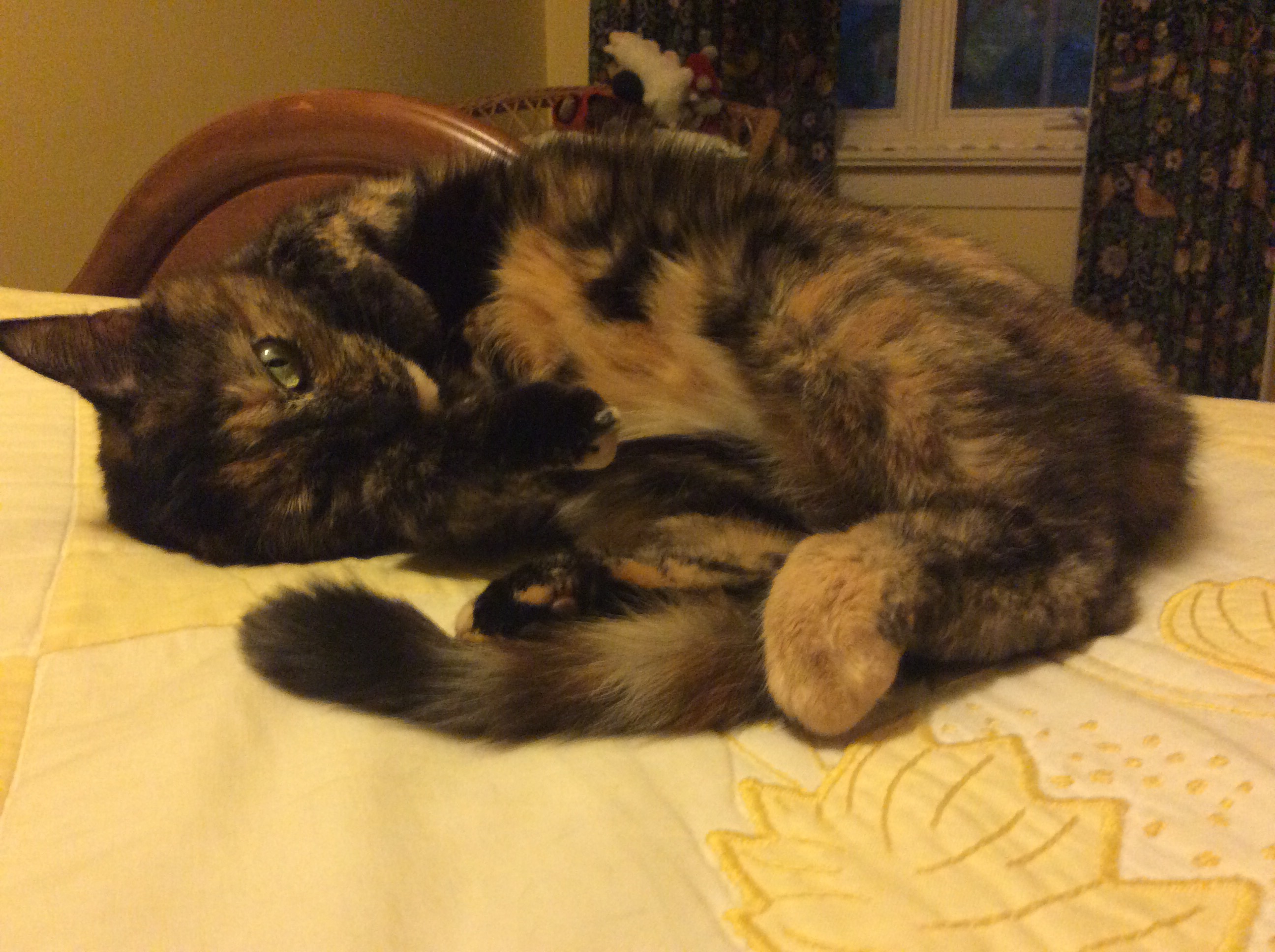
Normally, we make an excellent cat. We like sun, and we like lounging and a general sensibility of coziness. We’re less keen on sleeping all day, though. Miss Resi makes an absolute specialty of it. It’s a whole production. First, she circles thricely. Then, trhicely she pads her blankets. Next…Oh, hang on, that’s a poem, isn’t it? A really terrible paraphrase about the cat that drowns in a goldfish pond. What was wrong with Victorians?

Where was I? Ah, all that glisters is not always gold, and camomile tea is never a good idea before two and a half hours of Scottish Country Dance. Actually, by the time we got to the dancing bit, we were doing a pretty good job of losing the plot without our least favourite sleepy-time tea.

No, really. Lavender’s nicer. What is it about camomile that tastes inherently of dry hay? Please feel free to leave your favourite way to improve it in the comments. We wished we loved it.

But we’re drinking it now, right before bed, where the cat will join us. She has a very busy day. She gets up, and she sleeps. Then she sleeps and gets up. Then she rest before napping and – oh? You say we’re paraphrasing another cat poem? Well have one we haven’t poked fun at in the blog.

The Cat’s Dream
Pablo Neruda

How neatly a cat sleeps,
sleeps with its paws and its posture,
sleeps with its wicked claws,
and with its unfeeling blood,
sleeps with all the rings-
a series of burnt circles-
which have formed the odd geology
of its sand-colored tail.

I should like to sleep like a cat,
with all the fur of time,
with a tongue rough as flint,
with the dry sex of fire;
and after speaking to no one,
stretch myself over the world,
over roofs and landscapes,
with a passionate desire
to hunt the rats in my dreams.

I have seen how the cat asleep
would undulate, how the night
flowed through it like dark water;
and at times, it was going to fall
or possibly plunge into
the bare deserted snowdrifts.
Sometimes it grew so much in sleep
like a tiger’s great-grandfather,
and would leap in the darkness over
rooftops, clouds and volcanoes.

Sleep, sleep cat of the night,
with episcopal ceremony
and your stone-carved moustache.
Take care of all our dreams;
control the obscurity
of our slumbering prowess
with your relentless heart
and the great ruff of your tail.

Dec. 6: St Nicholas Day

There’s nothing like lying in bed at tw oAM to give you an existential crisis. Ours was brought to us by the bin calendar, which said tomorrow, Weds, Dec 7 was recycling.

But then we thought, no, because today was the fifth. And then we thought, did we lose a day?! And we lay awake forever trying to figure out what day we lost and how, because we were pretty sure the blog was up-to-date.

Eventually, we had the brainwave to check the calendar, and Wednesday was definitely the sixth. Huzzah! No days lost. New problem: Why is the recycling calendar wrong? If you already surmised we looked at last year’s recycling calendar, have a biscuit with your tea. Have two.

Then picture our two AM anguish as we chase down the correct schedule on the Ontario Government website. It really, really didn’t want us to find it. Or figure out which of the five available options was ours. Eventually, we found a non-government website that let us input the postal code to figure out which area was ours, and – oh frabjious day! – it was still recycling. Huzzah again!

We spent today extremely sleepy. We’re recovering with green tea before tonight’s Scottish Dance session. The calendar took us back to Nepal, and we have a lovely green tea at our elbow. We’re about to go drink it.

But first, we thought we’d give you a poem so you could appreciate how all that made us feel. Don’t worry, you haven’t lost the ability to read English. It’s just gone wobbly.

The Jabberwocky
Lewis Caroll

’Twas brillig, and the slithy toves
 Did gyre and gimble in the wabe:
All mimsy were the borogoves,
And the mome raths outgrabe.

“Beware the Jabberwock, my son!
The jaws that bite, the claws that catch!
Beware the Jubjub bird, and shun
The frumious Bandersnatch!”

He took his vorpal sword in hand;
Long time the manxome foe he sought—
So rested he by the Tumtum tree
And stood awhile in thought.

And, as in uffish thought he stood,
The Jabberwock, with eyes of flame,
Came whiffling through the tulgey wood,
And burbled as it came!

One, two! One, two! And through and through
The vorpal blade went snicker-snack!
He left it dead, and with its head
 He went galumphing back.

“And hast thou slain the Jabberwock?
Come to my arms, my beamish boy!
O frabjous day! Callooh! Callay!”
He chortled in his joy.

’Twas brillig, and the slithy toves
Did gyre and gimble in the wabe
All mimsy were the borogoves,
And the mome raths outgrabe.

Dec. 5: That Green and Pleasant Land

When we saw Big Ben on today’s Advent door, we crossed our fingers for Cream of Earl Grey tea. Our luck paid off.

The thing about Cream of Earl Grey is that it’s the rare Earl Grey we like. Typically, we associate it with the taste of soap. But there’s a couple non-bergamot ingredients in this tea that round it out nicely. Sadly, we used it all up over three pots today. Just file it under Twas We Want More Of.

So, what do you pair with a beloved tea? A beloved poem. If you’ve been here before, you can probably see this one coming.

We have no apologies. It’s late, we’ve been dancing, and what’s not to love about Thomas Harry’s nature poetry? He’s not even offending one or both wives here!

The Darkling Thrush

Thomas Hardy

I leant upon a coppice gate
      When Frost was spectre-grey,
And Winter’s dregs made desolate
      The weakening eye of day.
The tangled bine-stems scored the sky
      Like strings of broken lyres,
And all mankind that haunted nigh
      Had sought their household fires.
The land’s sharp features seemed to be
      The Century’s corpse outleant,
His crypt the cloudy canopy,
      The wind his death-lament.
The ancient pulse of germ and birth
      Was shrunken hard and dry,
And every spirit upon earth
      Seemed fervourless as I.
At once a voice arose among
      The bleak twigs overhead
In a full-hearted evensong
      Of joy illimited;
An aged thrush, frail, gaunt, and small,
      In blast-beruffled plume,
Had chosen thus to fling his soul
      Upon the growing gloom.
So little cause for carolings
      Of such ecstatic sound
Was written on terrestrial things
      Afar or nigh around,
That I could think there trembled through
      His happy good-night air
Some blessed Hope, whereof he knew
And I was unaware.

Advent I

Tonight we’re going to tell you a story. This is about us and the family we live with, and how every year, we order the same Christmas tree from the same people.

‘You need to order the Christmas tree,’ says our father.

We always order the tree, so that’s not a problem. ‘How about we order it for the third,’ we say.

‘Excellent,’ he says. ‘December third. Perfect.’

‘Good,’ we say. ‘We’ll order it for December third.’

We agree on December third for the tree’s arrival. We say December third a lot.

We go off and order the tree. For December third.

‘No,’ says he, ‘that doesn’t work. I’m not here to set up the tree on December third. Make it December second.’

Briefly, but only briefly, we contemplate murder. We wonder if there has ever been a Death By Christmas Tree reported, and if not, if that’s because no one’s thought of it yet, or because the person who committed it got away with it. We meditate on how one gets away with Christmas Tree murder. We decide hefting a nine-foot weapon is maybe beyond our skill set.

So, we call the nursery and change the tree’s arrival to December second. They make a note. We make a note. We now all agree the tree will arrive on December second. We may or may not double- triple- and quadruple-check that this date works for all invocled. We say December second a lot to confirm.

December second arrives. There is no tree. There is no tree when our father goes to do the shopping at eleven. There is no tree when we are having tea at noon. There is still no tree when we leave for the family ceilidh at two-thirty.

There is no tree when we return from the family ceilidh at five-thirty, by which point the nursery is closed.

So, this morning we get on the phone. The problematic father-object is now en route to New Brunswick. The nursery is confused. We are one of several people on this street to not get our tree on the date specified. They ask if we checked the porch, and admittedly, this wasn’t a thing anyone did, but you have to think we’d notice nine foot of Christmas tree, surely to God.

The nursery is apologetic. They take our order details. They trot off to check stuff. They call back. It’s always the same guy, by the way. Lovely man with the kind of plummy British accent on loan from Downton. Very soothing to listen to. He says that the tree is now scheduled for delivery. Want to guess on what day? Go on, guess.

And then guess what was on the porch when, after all that faff, we went out to grab the newspaper. Go on, have a guess. Have three. The first two don’t count.

As of writing, we haven’t cracked murder by remote control, though we know for a fact Agatha Christie did. Ever read The Pale Horse? Guess what we’re reading over tonight’s Simply Hibiscus tea.

Though, we may skip the tea. It’s very astringent. Very pink. It may incite murder, not talk us out of it.

Murder
David Baker, 1994

1.

Language must suffice.

Years ago,

               under a sweet June sky

stung with stars and swept back by black leaves

barely rustling,

a beautiful woman nearly killed me.

Listen,

she said,

and turned

her lovely face to the stars, the wild sky….

2.

No.

No: years ago,

                     under a sweet, June sky

strung with stars and swept back by black leaves

barely rustling,

under this sky

broad, bright, all rung around

with rustling elders—or intoxicating willows,

or oaks, I forget—

                           under this sky,

a beautiful woman killed me, nearly.

I say beautiful. You had to see her.

Listen,

she said,

and turned a lovely shell of her ear

to the swirl of stars

and the moon

                  smudged as a wingtip in one tree, not far.

3.

Yes: she scraped my back bloody against a rough trunk.

Yes: she flung back her lovely face

and her hair, holding me down,

and the tree shook slowly, as in a mild, persistent laugh

or wind,

            and the moon high in that black tree

swung to and fro …

there were millions of stars

up where she stared past us,

and one moon, I think.

4.

Excuse me.

My friend, who loves poetry truly, says too much

nature taints my work.

Yes. Yes. Yes.

Too many birds, stars—

                                 too much rain,

                                 too much grass—

so many wild, bowing limbs

howling or groaning into the natural night …

and he might be right. Even here.

That is, if tree were a tree.

That is, if star or moon or even beautiful woman

craning the shell of her ear

were what they were.

They are, I think, not.

No: and a poem about nature contains anything but.

5.

When they descended to us, they were a cloud of stars

sweeping lightly. They sang to us urgently

about our lives,

they touched us

with a hundred thousand hair-soft, small legs—

and held down by such hungers, we let them cover us,

this beautiful woman, this me,

who couldn’t move,

who were stung—do you hear?—

who were stung again, were covered that quickly, crying

to each other

                     to fly away!

6.

          … I just can’t erase

the exquisite, weeping language

of the wasps, nor her face in starlight

and so tranquil under that false, papery, bobbing

          moon

just minutes before,

saying listen,

listen,

nor then the weight

of her whole natural body

                                       pinning down mine

until we both cried out for fear, and pain,

and still couldn’t move.

7.

Language must suffice.

First, it doesn’t. Then, of course,

it does. Listen, listen.

What do you hear? This nearly killed me.

I’ll never know

why she didn’t just whisper Here they come, warn Move!

cry They’ll kill us!

Yes: I will save you …

Yes: I love you too much to watch you suffer!

But it’s all I recall, or now need.

And, anyway, I loved her, she was so beautiful.

And that is what I have had to say

before it’s too late,

                               before they have killed me,

before they have killed you, too,

or before we have all become something else entirely,

which is to say

before we are

only language.

You know what else provokes murder? The WordPress browser interface refuses to let us underline anything. We had to go to the app for that. And the app? It won’t let us align anything. Picture us here, surrounded by a tree that arrived on the day it was originally supposed to, after being set up by a benevolent uncle, contemplating murder. Of so, so, so many people.
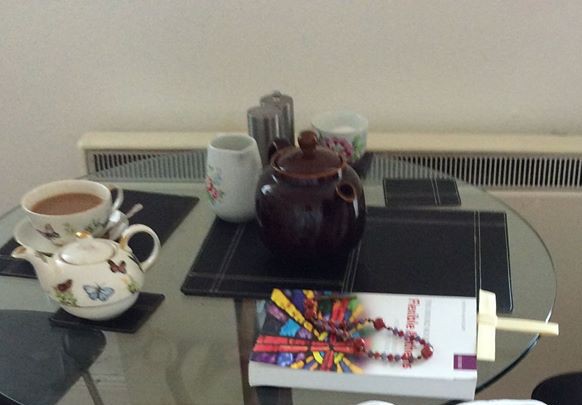
Dec 2: La Vie en Rose

No root canals, but there was a ceilidh, so things are definitely moving in the right direction.

Ceilidhs are always good fun for getting new people into Scottish Country dance. We’re convinced they were designed to be danced drunk – that’s definitely how a lot of kilted, would-be-Scots Americans danced them back in St Andrews.

There was pizza afterwards but we didn’t hang about for that. Blame the tooth trouble. Instead we had today’s tea. There should be a great segue here, about how it was a Scottish tea…

But according to the Trip Around the World Calendar, we went to Paris with Cupid’s Breakfast.

Yeah, no, we have nothing either. Poor Cupid is Greek, and the tea is a beautiful black tea with roses that anyone can buy us more of. You know, if they feel bad about not understanding what to feed us post root canal. Just a thought.

Let’s presume marketing thought it was romantic. It’s definitely a gorgeous tea.

Let’s see if we can find you a poem a bit more French than the tea, though.

Le Pont Mirabeau, or Under the Mirabeau Bridge

Guillaume Apollinaire

Under the Mirabeau bridge flows the Seine
And our loves
Must I remember them
Joy always followed pain

The night falls and the hours ring
The days go away I remain

Hand in hand let us stay face to face
While underneath the bridge
Of our arms passes
The water tired of the eternal looks

The night falls and the hours ring
The days go away I remain

Love goes away like this flowing water
Love goes away
Life is so slow
And hope is so violent

The night falls and the hours ring
The days go away I remain

Days pass by and weeks pass by
Neither past time
Nor past loves will return
Under the Mirabeau bridge flows the Seine

The night falls and the hours ring
The days go away I remain

Twelve of the Clock

We were on terrible choral form tonight, singing the descants from the congregation. On the other hand, the chap beside us was clearly singing the tenor line from the congregation, so clearly the choristers of St Thomas’s accept that this is a thing erstwhile choristers do. We’re running with it.

The thing you have to understand is that there are some hymns, like Hark the Herald we can only sing harmony on. We’d have to think far harder about how the melody of verse three goes than if we belted the descant. Ditto the Sing choirs of angels bit in O Come, All Yea Faithful. That’s a bit different though, because years as a specifically British chorister conditioned us to sing Cantet nunc io, cantent agnelorum. We don’t know what it is about Canadian Anglicans that they eschew a good Latin carol when it’s handed to them like that. But ah, well. No one’s hit us on the nose for our congregational descants yet, so we’ll cut them some slack. Tis the season, and that.

We tell you all this because we’ve just squeaked back from midnight mass. It’s supposed to be the Snowstorm of the Century, and for our money the year we had the ice quakes was worse. Okay, so It’s -10 feeling colder out, but the snow has stopped and that first year we moved back it stuck stubbornly at -30 all December. In fact, we walked home from Mass in -30 that year. It wasn’t ideal.

But all that aside, we’re thawing to a late-night cup of Sugerplum Fairy. You’re thinking this is a herbal plum tea, aren’t you? So were we. But it’s pears. Yes, yes, we know. Sugarplum but flavoured with pear. Look, we just report the facts. We don’t try to explain the logic of the eponymous David. Quite honestly, he feels weirdly God-like when we write this blog, in an Old Testament sort of way. A bit whimsical, a bit judgmental, and prone to totally inexplicable decisions. Like naming a tea centred around pears after the Sugarplum Fairy. You think they’d at least pick the dance of the dancing pears from The Nutcracker for this, yes?

  There’s a hint of Christmas spices here, but it’s predominantly a sweet tea. We think it could be a really lovely green tea – the tannin would balance out the sweetness nicely.

Speaking of, that’s 24 days of no green tea. We did discover over breakfast, when we drank Santa’s Secret properly, that it was a green-black hybrid, but we’re not sure that counts. Talk about bizarre decisions.

But you know what they didn’t do this year? They didn’t do that awful coffee-tea hybrid thing we always end up ranting about. You didn’t notice, did you? We never once had to lecture David and Co on how coffee isn’t tea and never the twain shall meet. Is it possible someone reads this blog?

In case they do, we’d better end with something sensible. We know tonight’s tea has a Nutcracker theme, but Thomas Hardy is our tradition. Besides, no one writes a better Christmas Eve poem. We’ve said it before, and we’ll say it again. So, enjoy The Oxen.

The Oxen
Thomas Hardy

Christmas Eve, and twelve of the clock.
“Now they are all on their knees,”
An elder said as we sat in a flock
By the embers in hearthside ease.

We pictured the meek mild creatures where
They dwelt in their strawy pen,
Nor did it occur to one of us there
To doubt they were kneeling then.

So fair a fancy few would weave
In these years! Yet, I feel,
If someone said on Christmas Eve,
“Come; see the oxen kneel,

“In the lonely barton by yonder coomb
Our childhood used to know,”
I should go with him in the gloom,
Hoping it might be so.

Doesn’t he do the loveliest and most unexpected things with wordplay? It’s in the books too, but gets obscured by the sheer agony of, say, Tess. You can pay more attention to linguistic playfulness in Hardy’s poetry because he’s not always battering your heart into fine pieces. Look at the rhymes, too. He’s got a rare gift for true rhyme, and some of them are not obvious.

But enough of that. No oxen kneeling here, but Dachshunds sleeping. That’s this chorister’s cue. Happy Christmas from the Dawlish Dachshunds, the Marscahllin- Cat and the resident Chorister at Home.

Go forth and make a joyful noise, with or without descants. And drink a cup of Christmas tea for us.

With Apologies to Rocky

We nearly didn’t have today’s tea. Santa’s Secret is a black tea, and if we’ve learned anything over the years, it’s that we cannot have black tea when we have cramp. Not for the first 48 hours, anyway.

There’s a whole list in this vein, but that’s up at the top. But we feel mostly human at the moment, so we are drinking an extremely weak cup.

It shares a lot of DNA with Candy Cane Crush, but we think this does the same job better. For one thing, that awful candy cane film doesn’t feature. THere’s candy cane in the tea, but for whatever reason, you can brew Santa’s Secret without having to scrub everything furiously afterwards to get the melted sugar off.

For another, it’s a better balance of tea to sweetness. There’s just a hint of candy cane here. It’s less like drinking an after eight and more like drinking lightly flavoured black tea. We should be clear; We quite like the after eight taste of Candy Cane Crush, but it’s not for everyone. If you want a Christmassy black tea that you can serve to anyone, this is the better bet.

There’s not a lot to regale you with today. Supposedly it’s the snowstorm of the century. We spent most of it lying on the floor and Rocky Dachshund spent it climbing the walls. Buffy and hte Maschallin Cat, still the world’s oddest Accidental Double Act, spent it blissfully asleep.

We promised Rocky we would make it up to him by including a poem in tribute. The cat got one early on but all poor Mr Rocky has had is his reputation maligned. He only eats those coasters because no one else does, honest, guv. If it wasn’t necessary he’d eat something else instead, like carpets or cushions or maybe the Cat. But the cat keeps hitting his nose, so coasters it is.

Anyway, here’s a poem for Rocky about the joys of being a dog.

If Feeling Isn’t In It
John Brehm

You can take it away, as far as I’m concerned—I’d rather spend the afternoon with a nice dog. I’m not kidding. Dogs have what a lot of poems lack: excitements and responses, a sense of play the ability to impart warmth, elation . . . .  
                                                                                   Howard Moss

Dogs will also lick your face if you let them.
Their bodies will shiver with happiness.
A simple walk in the park is just about
the height of contentment for them, followed
by a bowl of food, a bowl of water,
a place to curl up and sleep. Someone
to scratch them where they can’t reach
and smooth their foreheads and talk to them.
Dogs also have a natural dislike of mailmen
and other bringers of bad news and will
bite them on your behalf. Dogs can smell
fear and also love with perfect accuracy.
There is no use pretending with them.
Nor do they pretend. If a dog is happy
or sad or nervous or bored or ashamed
or sunk in contemplation, everybody knows it.
They make no secret of themselves.
You can even tell what they’re dreaming about
by the way their legs jerk and try to run
on the slippery ground of sleep.
Nor are they given to pretentious self-importance.
They don’t try to impress you with how serious
or sensitive they are. They just feel everything
full blast. Everything is off the charts
with them. More than once I’ve seen a dog
waiting for its owner outside a café
practically implode with worry. “Oh, God,
what if she doesn’t come back this time?
What will I do? Who will take care of me?
I loved her so much and now she’s gone
and I’m tied to a post surrounded by people
who don’t look or smell or sound like her at all.”
And when she does come, what a flurry
of commotion, what a chorus of yelping
and cooing and leaps straight up into the air!
It’s almost unbearable, this sudden
fullness after such total loss, to see
the world made whole again by a hand
on the shoulder and a voice like no other.

About Harbours, As Promised

When we resumed the blog this Advent, we introduced you to Rocky the Dachshund. Rocky is a tan Dachshund with a lovely white stripe down his front, and he is extremely charming. He is, in fact, Rockingham Napier, Charmer of WRENS. Alias: The Coaster Eater.

We can hear you already: Rocky would never! He is Extremely Cute! The friend in the Civil Service got there first and was more vocal.

Here’s the thing about Rocky Dachshund: He’s extremely cute and he could get away with murder. See further the coasters. What happens is that every morning, someone has their coffee. And because someone in this scenario has the memory of a goldfish, they leave the coaster on the coffee table. And along comes this very charming, very cute Coaster Eater, whose name rhymes with, let’s say Docky, and munches the cosater

Not a lot, you know. Just a little. A bite off the corner. A munch along the edges. It gives them unique shape, like. So, anyway, Docky-Maybe-Rocky munched the first coaster into pieces. We salvaged the second one. We’ve mostly been diligent about coasters three through six until this evening. Whereat the Coaster Eater cannibalised a whole coaster.

No one noticed. He popped up nice and surreptitious on one of the chairs, where he seized on the neglected coaster. Then he tok it back to his bed and ate it into a shadow of its former self. He did this nice and quietly, so no one heard him. The mess was spectacular. The Coaster Eater was extremely happy. Some, unreasonable human, might say unlawfully happy.

We now have two and three quarter coasters in this pattern, if you want to know.

It’s a nice pattern though, of the St Andrews harbour. We know the view well. Now we know it even better, because the plot twist of the evening was that we spent two hours chasing down the origins of this coaster set. And yes, yes, we have others. But everyone loves these ones. And the scenery makes them sentimental.

(And sometimes, we go to ridiculous lengths, as for instance, that time we hunted down a replacement valerian dolphin for the cat on a German-only website despite not speaking German.)

Finally, though, we found them and tried to order them. Whereat the site declared our cart empty. Three attempts later, we decided it was a fault with our tablet, so hopped over to the laptop where we type this blog. Here a new wrinkle; The algorithm refused to display the item we wanted. Round and round we went, which is how finding these coasters, no name, only keywords, took hours.

We did eventually find and replace them. Call that a satisfying end to this story. And you’d better believe we bought the things in triplicate. Do we need twelve coasters of St Andrews? No. Will the Coaster Eater gobble at least two? Almost certainly. And candidly, we can’t face a repetition of tonight. It doesn’t matter how cute Rocky, er sorry, Docky, is. It’s the next bus to Shelbourne if he tries that again.

After all that, here’s a poem about harbours. Maybe it will sell you on why someone would forgive a Dachshund like Docky his crimes. Since, you know, Rocky is much too cute to commit any.

Harbour Dawn
L.M. Montgomery

There’s a hush and stillness calm and deep,
For the waves have wooed all the winds to sleep
In the shadow of headlands bold and steep;
But some gracious spirit has taken the cup
Of the crystal sky and filled it up
With rosy wine, and in it afar
Has dissolved the pearl of the morning star.

The girdling hills with the night-mist cold
In purple raiment are hooded and stoled
And smit on the brows with fire and gold;
And in the distance the wide, white sea
Is a thing of glamor and wizardry,
With its wild heart lulled to a passing rest,
And the sunrise cradled upon its breast.

With the first red sunlight on mast and spar
A ship is sailing beyond the bar,
Bound to a land that is fair and far;
And those who wait and those who go
Are brave and hopeful, for well they know
Fortune and favor the ship shall win
That crosses the bar when the dawn comes in.

The tea? Oh, right. Let’s tell you about the tea. It’s called Tinsel Today, and we went looking for info on it to tell you what was in it. None came up, so we’re gambling and saying that it’s new this year. We’ve certainly never had it before.

It’s quite a nice herbal tea. There’s a bit of ginger in there to give it life, and what looks like the suggestion of rooibos leaves. There aren’t enough to give it the robustness of a normal rooibos, but it’s still a warm tea for a winter evening. And it comes highly recommended by your favourite Chorister at Home.

For Little Things

It’s one of those chameleon teas today. It is billed as one thing and tastes like another. It’s got a nice, straightforward name; Peanut Butter Cup. Does what it says on the tin, you think? You’d be wrong.

Now, we’re always a bit odd about chocolate teas, so maybe our guard went up to start with. Maybe it went doubly up because tea shouldn’t be the kind of thing that can trigger anaphylaxis.

But for all that, this is a lovely tea. Except for the minor detail that it tastes like neither chocolate nor peanut butter. We’re prepared to say it tastes a bit like roasted chestnuts. There’s a nuttiness in the tea certainly. But from the flavour of it, we think that comes more, bizarre as this sounds, from the use of dark chocolate in the tea. The cocoa brings out subtler notes in the leaves that come across as faintly roasted.

It’s almost like a smoked tea, like Lapsung. But not quite, because it doesn’t get in your nose the same way. Whatever it is, it’s very nice. What it’s not is a peanut butter cup. And that’s absolutely fine. We love a peanut butter cup, we love this tea, and we accept that one of these things is not like the other.

But we got another opportunity to do a bit of tea sampling today, because a friend surprised us with a tea parcel.

We know, it’s Christmas and that’s what friends do. But this friend is way out in Australia and up to her eyes in managing children’s choir recitals and dogs and more choir recitals and Christmas and even more choir stuff and the dog again. And did we mention choirs? So we weren’t expecting a long-distance  ‘thinking of you’ type anything because we’ve been there and done the headless chicken routine, and something has to give.

Not, apparently, our tea. So, we had the delightful chance to sit down with tea named Jane Austen and enjoy that when we finally, finally got to the end of today’s workload.

It was billed as a rose tea, smelled like Turkish delight, and tasted like a rose garden. Okay, it tasted like a rose garden if rose gardens cultivated really high-quality Assam. We’re ear-marking this tea supplier as someone we want to return to and not just because of the literary names.

Now, on this basis, we thought about finding you one of Jane Austen’s poems. She wrote them, and they do exist. They’re sort of hen’s teeth on the internet, though. So, instead, we dug up a poem by the other literary great behind the tea parcel, L.M. Montgomery.   

We almost posted her piece about harbours but that would involve an explanation and we’ve wittered quite enough tonight. We’ll tell you about The Great Harbour Adventure tomorrow. Remind us. Until then, here’s a tribute to unexpected mementos of long-distance friendships.

For The Little Things
L.M. Montgomery

Last night I looked across the hills
And through an arch of darkling pine
Low-swung against a limpid west
I saw a young moon shine.

And as I gazed there blew a wind,
Loosed where the sylvan shadows stir,
Bringing delight to soul and sense
The breath of dying fir.

This morn I saw a dancing host
Of poppies in a garden way,
And straight my heart was mirth-possessed
And I was glad as they.

I heard a song across the sea
As sweet and faint as echoes are,
And glimpsed a poignant happiness
No care of earth might mar.

Dear God, our life is beautiful
In every splendid gift it brings,
But most I thank Thee humbly for
The joy of little things.