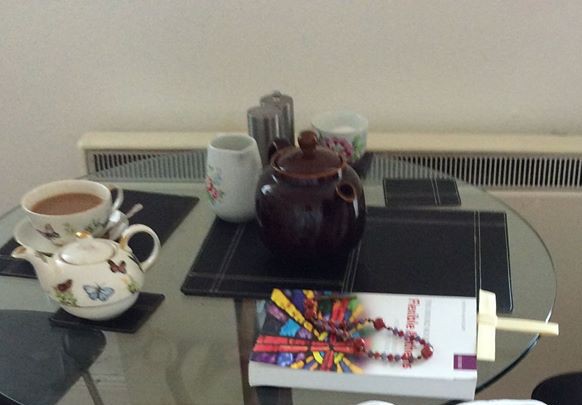
Tea With My Aunts

This evening choir ran short, since no one had a list of the hymns and the anthem was both straightforward and familiar. To that end we returned home, made a cup of today’s Advent tea and listened to a podcast cheerfully dissect a favourite TV show -just to make sure we weren’t the only people on earth for whom that constituted a hobby. The tea was a white tea, ginger and pear, and although we associate pears with sunnier weather, the ginger rendered it suitably wintery. We’ve never encountered a white tea we disliked, and this was no exception. Being lighter to start with, they seem to adapt more readily to being flavoured, than say, green tea.

We also finally got around to sampling a bit of the St Nicolas Day tea, which purported to taste of apple cider. In fact it does, but possibly the sweetest apple cider we’ve ever had. That could have done with having a green tea underneath to cut the sweetness. We say that not out of any kind of expertise, but because the Advent Calendar issuer once kept us in what we called Crumble Tea and they called Mom’s Apple Pie, and it was the cousin to this cider-inspired infusion. Green tea, cinnamon and something apple-tasting, and it was apple crumble in a cup. Ideal for a winter night. We keep sampling its tea inheritors, and though some have come close, nothing is nearly as good -but then, none of them was also a green tea.

After that dictate on how people who know how to make tea should be making tea, have a poem in which everything is in it’s proper place.

Tea With My Aunts 

John Arlott

Tea with my aunts at half-past four,

Tea in a world without a war;

The widow-queen is still alive

In Grampa’s house at Albert Drive,

And firm the monkey-puzzle tree

He planted at the Jubilee.

A frilly, fragile cup of tea

Unsafely balanced on my knee,

Aunt Anna mellows as I take

Another slice of home-made cake,

She rustles in her stiff grey gown

And takes her endless knitting down.

A chastely ringed and blue veined hand,

A weak white neck in velvet band,

With modest touch aunt Susan plays

The tranquil ‘Sheep May Safely Graze’

Of Bach, the tune she used to play

On Sunday evenings years away,

To whiskered men of gentle sort

Who paid her strained and stately court.

The Landseer cattle in the hall,

The massey antlers on the wall,

The monumental two-year clock,

A faith in class as firm as rock,

And all the house are just the same

As on the day the family came,

Firm barred against the new and strange

And devil-prompted thoughts of change.

The gilt-edged shares will never drop,

But yearly yield a steady crop

To feed a world of certain grace,

Where servants knew their proper place.

The bombs that broke the windows here

Have not destroyed the atmosphere.

Why the Flood Came

Today we revisited the coffee cake tea of two days ago. But at some point in the afternoon we paused in our writing -some of it creative, much of it for UCAS -and made a pot of what the Calendar calls ‘nutty and spice.’ It seems to be equal parts nuts and spices, and emerging from that semi-somnolent place writing induces, it was just what we needed. It tastes of crisp autumn weather, never a bad thing this time of year because often by the time we make afternoon tea the sun has set and it’s easy to forget that so lately as November the sun set in the afternoon.

We’re cheating a bit this evening, because UCAS exhausted our creative energy sometime around the third pot of tea. As we approach that terrifying rush for Christmas, here’s a piece of liturgical humour from the Advent church newsletter that we thoroughly appreciated on reading;

Why the Flood Came 

Originally from the parish magazine of All Saints’, Worlingham

And the Lord said unto Noah; ‘where is the Ark which I have commanded thee to build?’

And Noah said unto the Lord; ‘Verily I have had three carpenters off ill. The gopher wood supplier hath let me down -yea even though the gopher wood hath been on order for nigh twelve months. The damp course specialist hath not turned up. What can I do, O Lord? ‘

And the Lord said unto Noah; ‘I want that ark finished after seen days and seven nights.’ And the Lord said unto Noah; ‘it will be so.’

And it was no so.

And the Lord said unto Noah, ‘What seemeth to be the trouble this time?’

And Noah said unto the Lord; ‘ Mine subcontractor hath gone bankrupt. The pitch which Thou commandest me to put on the outside and the inside of the ark hath not arrived. The plumber hath gone on strike.’

Nora rent his garments and said; ‘The glazier departeth on holiday to Majorca -yea even though I offered him double time. Shem, my son who helpeth me on the ark side of the business, hath formed a pop group with his brothers Ham and Japheth. Lord, I am undone. The gopher wood is definitely in the warehouse. Verily and the gopher wood supplier waiteth only upon his servant to find the invoices before he delivereth the gopher wood to me.

And the Lord grew angry and said unto Noah; ‘what about the animals? Of the fowls after thier kind, and every creeping thing of the earth after his kind, two of every sort have I ordered to come to thee to keep alive. Where, for example, are the giraffes? And where are the clean beasts, the male and female, to keep their seed alive upon the face of the earth?’

And Noah said; ‘the van cometh on Tuesday and yea, it will be so.’

And the Lord said to Noah,;  ‘How about the unicorns?’

And Noah wrung his hands and wept, saying; ‘Lord, they are a discontinued line. Thou canst not get unicorns for love nor money.’

And God said; ‘Where are the monkeys and the bears and the hippopotami and the elephants, and the zebras and the hartebeests, two of each kind, and of the fowls of the air by sevens and the male and female?’

And Noah said unto the Lord; ‘They have been delivered to the wrong address but should arrive on Friday, all save the fowls of the air by sevens, for it hath just been told unto me that fowls of the air are sold only in half dozens.

And Noah kissed the earth and said; ‘Lord, Thou knowest in Thy wisdom what it is like with delivery dates.’

And the Lord in his wisdom said; ‘Noah, my son, I knowest -why else dost tho think that I have caused a flood to descend upon the earth?’

Put the Kettle On

After all our frustration with coffee-flavoured tea, we were apprehensive to discover today’s tea was meant to taste of coffee cake. It turns out that this was needless; it’s only a well-spiced black tea with lots of cinnamon, which is an institution we can endorse. Especially because great swathes of today were spent on an imperfectly heated 23 Bus Service to Stirling.

Happily too, this means we can reinstate the ritual of having leaf tea at breakfast. In the absence of a good black tea, we’ve defaulted to Twinings teabags, because it doesn’t matter how big the leaves or high the grade, green tea is insufficient to wake us up in the morning. And yes, we freely acknowledge that we’re a bit snobbish about our tea. We like to think of it as ritual though, because after all, what could be more ritualistic than tea? Here’s a poem from Ten Poems about Tea that recognises this all too well.

Alternative Anthem

John Agard

Put the kettle on
Put the kettle on
Is the British answer
to Armageddon

Never mind taxes rise
Never mind trains are late
One thing you can be sure of
and that’s the kettle, mate.

It’s not whether you lose
It’s not whether you win
It’s whether or not
you’ve plugged the kettle in.

May the kettle ever hiss
May the kettle ever steam
It is the engine
that drives our nation’s dream.

Long live the kettle
that rules over us
May it be limescale free
and may it never rust.

Sing it on the beaches
Sing it from the housetops
The sun may set on empire
but the kettle never stops.

Strawberries and Austen

This evening’s Advent tea sample assures us it is serenity in a tin, which assertion we’re disinclined to question, since after all the chaos that is a High Anglican Advent Service, we welcome the concept. It’s not just the choreography at Mass either. We’re supposed to be moving back to Canada, Marschallin-cat and all, and are presently making arrangements. Also we’re applying via UCAS for teacher training, but no two universities use the same application window, and they still make more sense than the Canadian courses we’ve looked at. Serenity in tins or otherwise is readily welcomed.

This particular cupful tastes and smells of strawberries. There’s reship in there too, but it seems mostly to colour the tea, not flavour it. Consequently we’re sitting here drinking tea and thinking of Emma and Highbury where strawberries meant ‘English verdure, English culture English comfort seen under a sun bright, without being oppressive.’  Except that the light’s gone and we’re in Scotland.

With her in mind though as we drink our strawberry tea, here’s a poem by Jane Austen, who we’ve credited with many things previously, but never verse.

Happy the Lab’rer

Jane Austen

Happy the lab’rer in his Sunday clothes!
In light-drab coat, smart waistcoat, well-darn’d hose,
Andhat upon his head, to church he goes;
As oft, with conscious pride, he downward throws
A glance upon the ample cabbage rose
That, stuck in button-hole, regales his nose,
He envies not the gayest London beaux.
In church he takes his seat among the rows,
Pays to the place the reverence he owes,
Likes best the prayers whose meaning least he knows,
Lists to the sermon in a softening doze,
And rouses joyous at the welcome close.

Kneel with the Listening Earth

We’re drinking something called Genmaicha tonight, and it’s evidence of a flavoured tea that works. It’s flavoured with popped rice, and if that sounds odd, it doesn’t taste it. It offers a subtle, almost nutty taste to the tea, which means it bears up well against mince pies.

We defend the mince pies, by the by, on the basis that tonight was the Nine Lessons and Carols service. In the days that we were still in the choir, we were always offered them in the reception afterwards as a thank-you, and accordingly it came to mark the point at which mince pies became acceptable Advent fare. Clearly the habit has stuck. Also, we had guests this evening and wanted to offer them a suitable sweet.

We’re still humming the music from the Nine Lessons and thinking of Advent this evening, so we thought we’d cheat a bit and borrow a poem we’ve posted before that anticipates the season.

After Trinity 

John Mead Faulkner

We have done with dogma and divinity,
Easter and Whitsun past,
The long, long Sundays after Trinity
Are here with us at last;
The passionless Sundays after Trinity,
Neither feast-day nor fast.

Christmas comes with plenty,
Lent spreads out its pall,
But these are five and twenty,
The longest Sundays of all;
The placid Sundays after Trinity,
Wheat-harvest, fruit-harvest, Fall.

Spring with its burst is over,
Summer has had its day,
The scented grasses and clover
Are cut, and dried into hay;
The singing-birds are silent,
And the swallows flown away.

Post pugnam pausa fiet;
Lord, we have made our choice;
In the stillness of autumn quiet,
We have heard the still, small voice.
We have sung Oh where shall Wisdom?
Thick paper, folio, Boyce.

Let it not all be sadness,
Nor omnia vanitas,
Stir up a little gladness
To lighten the Tibi cras;
Send us that little summer,
That comes with Martinmas.

When still the cloudlet dapples
The windless cobalt blue,
And the scent of gathered apples
Fills all the store-rooms through,
The gossamer silvers the bramble,
The lawns are gemmed with dew.

An end of tombstone Latinity,
Stir up sober mirth,
Twenty-fifth after Trinity,
Kneel with the listening earth
Behind the Advent trumpets
They are singing Emmanuel’s birth.

Lessons in Tea Making

‘I drink tea and I almost like coffe,’ says Jassey Radlett in one of Don’t Tell Alfred‘s more obviously good lines, ‘aren’t I grown up, Fanny?’

We have to confess that if a love of coffee is vital to growing up, we’re doomed. We have tried it in nigh on every conceivable combination; with sugar, with milk and sugar, with milk and no sugar, plain -and we can’t drink it. If we want a drink that lingers in our nose for hours, we’ll pour a cup of lapsang. Imagine our surprise to discover the tea in this morning’s Advent door was full of coffee. Well, green tea mixed with coffee.

Remember how we said we didn’t really want Cocoa in tea? We take it back. We’d sooner cocoa than coffee. If we have to choose. It’s not that we object to dressing tea up -we are lastingly indebted to the Advent Calendar’s inventors for a green tea that tastes of apple crumble in a cup. It’s just that in spite of our best efforts to give up childish things, we do not like coffee. Not in cake, nor ice cream, and not in tea.

Happily for us, today’s tea tastes mostly of green tea. You see, there are advantages to pouring out prematurely.  If it tastes of anything untealike, it’s chocolate, and as we say, if forced to choose…At least the first cup did. The taste of coffee emerged with a vengeance to prevent our ever swallowing more than a mouthful of the second cup.

We don’t presume to tell you how to take your tea of course. We leave that to other people.

Lessons in Tea Making

Kenny Knight

When I first learnt to
Pour tea in Honicknowle

In those dark old days
Before central heating

Closed down open fireplaces
And lights went out in coal mines

And chimpanzees hadn’t yet
Made their debuts on television

And two sugars
Was the national average

And the teapot was the centre
Of the known universe

And the solar system
Wasn’t much on anyone’s mind

And the sun was this yellow
Thing that just warmed the air

And anthropology’s study
Of domestic history hadn’t

Quite reached the evolutionary
Breakthrough of the tea-bag

And the kettle was on
In the kitchen of number

Thirty two Chatsworth Gardens
Where my father after slurping

Another saucer dry would ask
In a smoke-frog voice for

Another cup of microcosm
While outside the universe blazed

Like a hundred towns
On a sky of smooth black lino

And my father with tobacco
Stained fingers would dunk biscuits

And in the process spill tiny drops
Of Ceylon and India

Snow Day

We opened the Advent Calendar this morning to a tea called Snow Day. It professes to be full of peppermint leaves, white chocolate, cocoa and something called cream flavouring. (No, we don’t know what that is. We’re sort of afraid to ask.) At a glance then it is trying to taste of mint hot chocolate. At the risk of sounding snobbish, while we love tea, and we love hot chocolate, we don’t necessarily like them together. Luckily for us, Snow Day actually tastes of peppermint creams, which is a curious choice for a tea since there are only so many peppermint creams a person can eat in a sitting, and it turns out that that threshold is reached before the end of a second cup of tea. It’s not a bad green tea though, provided you like mint lots. This happens to be true of us.

Here’s a poem for today by Thomas Hardy, whose poetry is too often forgotten in favour of his novels. It gets the feel of a British winter to the bone, and just to be novel, in a year of things that have sometimes seemed overwhelming and bleak, it’s hopeful.

The Darkling Thrush

Thomas Hardy

I leant upon a coppice gate
      When Frost was spectre-grey,
And Winter’s dregs made desolate
      The weakening eye of day.
The tangled bine-stems scored the sky
      Like strings of broken lyres,
And all mankind that haunted nigh
      Had sought their household fires.
The land’s sharp features seemed to be
      The Century’s corpse outleant,
His crypt the cloudy canopy,
      The wind his death-lament.
The ancient pulse of germ and birth
      Was shrunken hard and dry,
And every spirit upon earth
      Seemed fervourless as I.
At once a voice arose among
      The bleak twigs overhead
In a full-hearted evensong
      Of joy illimited;
An aged thrush, frail, gaunt, and small,
      In blast-beruffled plume,
Had chosen thus to fling his soul
      Upon the growing gloom.
So little cause for carolings
      Of such ecstatic sound
Was written on terrestrial things
      Afar or nigh around,
That I could think there trembled through
      His happy good-night air
Some blessed Hope, whereof he knew
      And I was unaware.

Playing Catch-Up, Spark, and Lyric Opera

We’re behindhand updating this week. Holidays have done terrible things to our understanding of where we are in the week. We took yesterday as Thursday, for instance, feeling sure we flew back from Chicago on Wednesday and had lost a day that way. (In fact it was Tuesday we lost.)

Confusion about days aside, it’s been a good holiday so far. Presently we are delving into Muriel Spark’s Loitering with Intent  and are thereby reaffirming our belief she is a writer who can do no wrong. In true Spark fashion it is proving weird and wonderful, but we love the sheer strangeness of her stories. We long ago decided their oddness was one of their most compelling qualities.

In other news, Christmas really has come early in the shape of an excursion to Chicago’s Lyric Opera to see Bel Canto, a world premier, and the ever-beloved The Merry Widow.

Bel Canto, we suspect, is the book that made us fall in love with opera. Of course we had to see it when we realised Chicago Lyric had turned it into an opera. We were longing to find out how fictional soprano Roxanne Coss’s music (she’s held in regard for her ‘Song to the Moon’) was realised. No composer would want to clutter his opera with parodies, and even if he did, who could do justice to Dvorjak? We’ve said before his music leaves us weeping, and Song to the Moon’ is the most beautiful aria in opera as far as we’re concerned. Parodying that was going to be no small feet. We went, consequently, keyed up with anticipation. Our mother had reservations, we suspect.

‘I hope it isn’t too modern,’ she said before we set out.

Was it modern, yes. Always lyrical, no.  Why would it be? The story -loosely based on a terrorist incident in Peru back in 1997 -is not a lyrical story. It’s dramatic, striking, memorable and compelling, even ugly in places. Lopéz’s music isn’t always the lyric and melodious music we associate with opera, but always it is suitable, and we could say nothing better of it. It personifies the story we loved at 15, we can ask no more.

As for the music of Roxanne Coss (here sung by Danielle de Niese), it is written for her, a gift from Lopéz, and it grows and expands in melodiousness as her character changes. It is raw in spots, achingly sweet in others, and like ‘Song to the Moon’, it leaves us wanting to weep. Stylistically, Lopéz might be different to Dvorjak but the feeling  behind the music, the colours and the feelings he evokes, recall Dvorjak to us in spades.

Now we are home, being lovingly persecuted by Dachshunds, muddling days of the week and better than that, drinking Red Rose Tea. You can’t get it in Scotland and we’ve missed it.