Not as We Were

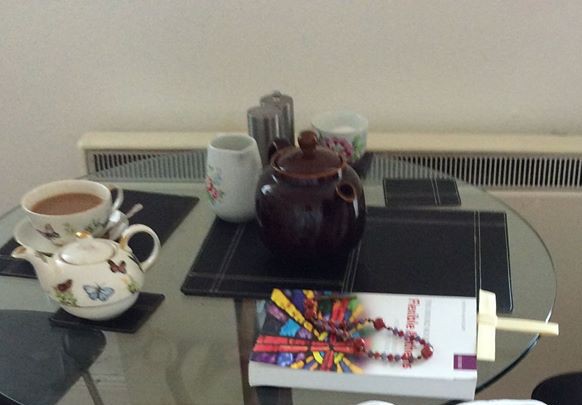
Tonight’s tea is an odd duck, a blend of white, green and jasmine tea with hibiscus for flavour. It’s called Buddha’s Blend, but that’s not the odd thing. It doesn’t taste the way it smells. That is the oddity. We opened the tin and observed to Miss Marschallin-cat that it was reminiscent of a blend we bought once from Wittards, Jubilee blend, a black tea flavoured with mango, mandarin and peach. That’s what Buddha’s Blend smelled of -suddenly we were back in the kitchen of the Grotto, number 68 North Street, spooning specialty Wittards tea into our teapot.

It doesn’t taste of those things though. Well, it wouldn’t, would it, with not a touch of mandarin, peach or even mango among the ingredients. That’s not to say it wasn’t lovely -it was – but it didn’t taste the way it smelled. A disconcerting culinary schism, by the way, if you’ve never experienced it. You might even say it was not as it was -for which reason, we’re giving you Hardy tonight.

Our love of Thomas Hardy’s poetry is well-documented. It might be the most beautiful in the English cannon to us. It conjures the England of coffee-table books as nothing else does, and is exhilaratingly playful in its word choice. Sometimes Hardy will even invent words wholecloth, like ‘norward’ here, or ‘illimited’ of The Darkling Thrush. At least, we’ve never seen anyone else make use of them.

More academically, Hardy, like Emily Dickenson, favours Common Metre -the metre of most hymn tunes. You can, if you’re so minded (this chorister is), set his poetry to everything from Helmsley to Aurelia, and quite a few others besides. It doesn’t work with this poem though. This one’s Dactylic Tetrameter, and if that sounds like a mouthful, suffice it to say you can waltz to this poem, more or less. Music and metre; preoccupations of ours. But here endeth the lesson. For a tea that’s not as it was, here’s a poem that breaks all its own -and Hardy’s -rules.

The Voice

Thomas Hardy

Woman much missed, how you call to me, call to me,
Saying that now you are not as you were
When you had changed from the one who was all to me,
But as at first, when our day was fair.
Can it be you that I hear? Let me view you, then,
Standing as when I drew near to the town
Where you would wait for me: yes, as I knew you then,
Even to the original air-blue gown!
Or is it only the breeze, in its listlessness
Travelling across the wet mead to me here,
You being ever dissolved to wan wistlessness,
Heard no more again far or near?
Thus I; faltering forward,
Leaves around me falling,
Wind oozing thin through the thorn from norward,
And the woman calling.

Christmas Eve and Twelve O’Clock

In what turns out to be grand Christmas tradition, the heating failed this evening at Midnight Mass, so we’re drinking a late cup of tea with just cause. It’s a black tea laced with candy cane and peppermint, and aptly called Santa’s Secret -and it’s exactly what we need. Our hands are still cold. Also, we’ve sung almost continuously for two hours and our voice gave out somewhere after the last top G in ‘Hark the Herald.’ We’ll do it all again tomorrow and gladly, but in the meantime, tea is welcome, especially when it tastes so nice as this one does.

Strictly speaking, we’re now into Christmas day, but as somewhere it’s bound to be evening still, here’s a poem by Thomas Hardy that has it’s roots in an old belief that at midnight on Christmas eve the oxen kneel to observe the Christ. Enjoy it -and Happy Christmas from Scotland!

The Oxen

Thomas Hardy

Christmas Eve, and twelve of the clock.
“Now they are all on their knees,”
An elder said as we sat in a flock
By the embers in hearthside ease.
We pictured the meek mild creatures where
They dwelt in their strawy pen,
Nor did it occur to one of us there
To doubt they were kneeling then.
So fair a fancy few would weave
In these years! Yet, I feel,
If someone said on Christmas Eve,
“Come; see the oxen kneel,
“In the lonely barton by yonder coomb
Our childhood used to know,”
I should go with him in the gloom,
Hoping it might be so.


An August Midnight

Among the scents we actively recoil from in drinks, coconut is one of them, or so it emerged this morning when we opened the tin with this day’s tea. We’ve never liked  coconut but we can sometimes bear it in things if it isn’t the main ingredient. This isn’t true of tea, possibly because no drink on earth should smell of suncream. In this particular instance, we’re immensely grateful that the tea doesn’t taste as it smells, but that might be because we were afraid of leaving it to steep. We’ve never really been curious to find out what suncream tastes like, you understand.

All told though, and if you can get past -or indeed have no issue with -the smell of coconut, it’s a nice tea, smooth, creamy and reminiscent of those flavoured custard creams sold briefly by Lidl (the coconut variety, naturally). We used to buy them in the summer and eat them out in the garden. With that in mind, here’s a poem we’ve long associated with summer writings and the act of creation -though we now suspect that for years we misunderstood the title. No matter, the day’s almost run out here in Scotland, and goodness knows Miss Marschallin-cat would be grievously offended if we didn’t consider her august company.


An August Midnight

Thomas Hardy

I

A shaded lamp and a waving blind,
And the beat of a clock from a distant floor:
On this scene enter–winged, horned, and spined –
A longlegs, a moth, and a dumbledore;
While ‘mid my page there idly stands
A sleepy fly, that rubs its hands . . .

II

Thus meet we five, in this still place,
At this point of time, at this point in space.
– My guests parade my new-penned ink,
Or bang at the lamp-glass, whirl, and sink.
“God’s humblest, they!” I muse. Yet why?
They know Earth-secrets that know not I.

Snow Day

We opened the Advent Calendar this morning to a tea called Snow Day. It professes to be full of peppermint leaves, white chocolate, cocoa and something called cream flavouring. (No, we don’t know what that is. We’re sort of afraid to ask.) At a glance then it is trying to taste of mint hot chocolate. At the risk of sounding snobbish, while we love tea, and we love hot chocolate, we don’t necessarily like them together. Luckily for us, Snow Day actually tastes of peppermint creams, which is a curious choice for a tea since there are only so many peppermint creams a person can eat in a sitting, and it turns out that that threshold is reached before the end of a second cup of tea. It’s not a bad green tea though, provided you like mint lots. This happens to be true of us.

Here’s a poem for today by Thomas Hardy, whose poetry is too often forgotten in favour of his novels. It gets the feel of a British winter to the bone, and just to be novel, in a year of things that have sometimes seemed overwhelming and bleak, it’s hopeful.

The Darkling Thrush

Thomas Hardy

I leant upon a coppice gate
      When Frost was spectre-grey,
And Winter’s dregs made desolate
      The weakening eye of day.
The tangled bine-stems scored the sky
      Like strings of broken lyres,
And all mankind that haunted nigh
      Had sought their household fires.
The land’s sharp features seemed to be
      The Century’s corpse outleant,
His crypt the cloudy canopy,
      The wind his death-lament.
The ancient pulse of germ and birth
      Was shrunken hard and dry,
And every spirit upon earth
      Seemed fervourless as I.
At once a voice arose among
      The bleak twigs overhead
In a full-hearted evensong
      Of joy illimited;
An aged thrush, frail, gaunt, and small,
      In blast-beruffled plume,
Had chosen thus to fling his soul
      Upon the growing gloom.
So little cause for carolings
      Of such ecstatic sound
Was written on terrestrial things
      Afar or nigh around,
That I could think there trembled through
      His happy good-night air
Some blessed Hope, whereof he knew
      And I was unaware.