Ever since a friend who knew us especially well gifted us The Towers of Trebizond by Rose Mccauley we’ve debated writing this post on Good Friday. And every Good Friday we lose our nerve. We’re being daring this year because we’ve spent an inordinate amount of time venting to journal pages about the version of The Royal Banners Forward Go in Canada’s Anglican hymnal.
We’re the first to admit we do change badly, so it’s entirely possible this is an extension of that. But as we discussed it with a friend -the same friend, in fact, who gave us Trebizond -we realised it was more than that.
‘Some people,’ she said, ‘don’t like blood and gore in their hymns, and they sanitise them.’
And because this conversation was happening over Skype and we could, we threw up our hands and flailed them and said ‘But Passiontide is bloody! That’s the whole point!’
There is a great tradition -at least their is in our variety of church -of not only sacramentalising the blood of Christ, but of mythologising it too. We write liturgies to it, we render it in idyllic paintings of beatific Christs with exposed hearts, and yes, we hymn it. It can be -indeed we have often found it to be -powerfully moving. But when we hymn it like that, there’s a danger we forget exactly what we’re memorialising, especially at Good Friday services as we kiss the cross and take reserve communion. Because the reality of the thing is, however we look at it, that crucifixion was brutal. We’re no historians, and that might be why for us Rose Mccauley’s Towers of Trebizond says it best. She writes of heroine Laurie’s arrival into Jerusalem,
What one feels in Jerusalem, where it all began, is the awful sadness and frustration and tragedy, and the great hope and triumph that sprang from it and still spring, in spite of everything we can do to spoil them with our cruelty and mean stupidity, and all the dark unchristened deeds of christened men. Jerusalem is a cruel, haunted city, like all ancient cities; it stands out because it crucified Christ; and because it was Christ we remember it with horror, but it also crucified thousands of other people, and wherever Rome (or indeed any one else) ruled, these ghastly deaths and torturings were enjoyed by all, that is, by all except the victims and those who loved them, and it is these, the crucifixions and the flayings and the burnings and the tearing to pieces and the floggings and the blindings and the throwing to the wild beasts, all the horrors of great pain that people thought out and enjoyed, which make history a dark pit full of serpents and terror, and out of this pit we were all dug, our roots are deep in it, and still it goes on, though all the time gradually less. And out of this ghastliness of cruelty and pain in Jerusalem on what we call Good Friday there sprang this Church that we have, and it inherited all that cruelty, which went on fighting against the love and goodness which it had inherited too, and they are still fighting, but sometimes it seems a losing battle for the love and goodness, though they never quite go under and never can. And all this grief and sadness and failure and defeat make Jerusalem heartbreaking for Christians, and perhaps for Jews, who so often have been massacred there by Christians, though it is more beautiful than one imagines before one sees it, and full of interest in every street, and the hills stand round it brooding.
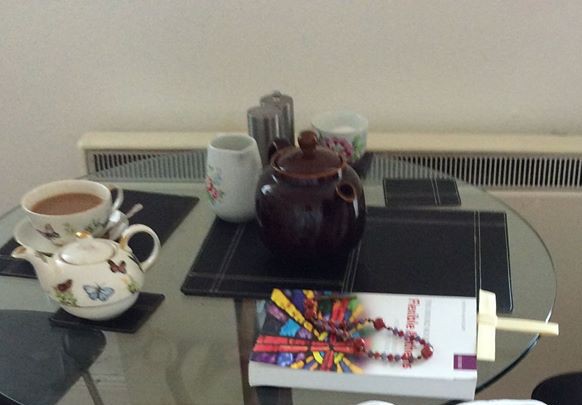
Perhaps it is different for different for different readers. When we read that passage the first time though we were on Iona, and we felt the resonance of it in our bones. We’re not often brought to our knees by literature, but we were then. For a little while we closed the book and stared at the cover, and that was enough. Now we go back to it almost ritualistically during Holy Week to give us the grounding for the things we will sing, the texts we will hear read, to remind us how deeply human and imperfect are the roots our faith sprang from, and to remind ourselves that these things we do, the veneration and the Mandata, are more than Anglican tradition.
Because it is Christ we remember. That’s what struck us most powerfully that summer on Iona. Because however literally one takes scripture, crucifixions did happen, and no doubt they were awful. And yet because it is Christ we remember and the occasion becomes triumphal, glorious, even bearable. If we choose our hymns and translations right it can even seem neat. Perhaps in a world that can often feel alive with horrors we need this one clean, bearable hurt. Any yet, for all we’re not theologians we humbly submit that Lent was never meant to be comfortable, nor Passiontide or Holy Week either. We know we ourselves turned to God for His humanity -all of it. When the horror and hurt of the world feels overwhelming we want a God that understands, and of course He does, because what we learn in Passiontide, on Good Friday, all through Lent, is that He has experienced those horrors first-hand.
Yes, part of Lent is sacrifice. Part of it to, as the old anthem has it is a closer walk with God. We take up that cross and its accompanying brutality, and we dwell with it and live with it, and know that we are not alone, however unbearable our grievances. It is there we find comfort, and only then do we turn, hopeful and expectant, to Easter.


 Chorister at Home