Reading Experience

We want to begin by stressing we are book-lovers. We love the smell of them, and the feel of them, and weight of them. We go to great lengths to preserve their spines out of a deep-rooted belief that to do anything less is Abuse of Book and on par with High Treason. We say all this because what follows is a defence of the kindle.

Every now and again someone will see us with ours and say, ‘I still like books.’

Or, ‘Don’t you think you remember less reading on a screen? Doesn’t it irritate you that it needs charging?’

There’s any number of arguments against the kindle, as there is against anything. But there’s a value too that we don’t think is lauded enough; it’s a godsend to the partially sighted. We’re just sighted enough that growing up, no one offered us large-print as an option until university. Preferably we read at size 16. But the number of books printed size 16? Our local library has perhaps ten large-print books together and they’re always Jilly Cooper. That’s not a condemnation, because we’ve never read her and know nothing about her books. There have got to be partially-sighted people in my town with less vision than us, who have read those ten books to death out of a lack of choice.

There are things like Daisy Machine, but we could write a whole other post on the evils of the Daisy Machine. Suffice it to say we could never make ours work, and like any 13 year old, refused to lose a Saturday afternoon to a class on how to use one. That’s why years later our Daisy is stuck at the beginning of Jane Austen’s Emma,  though we’re sure we bookmarked wherever it was we got to on first listen. It’s also why any reading we did, we did in print.

Vision acuity notwithstanding though, we only read with half of one eye, which makes things slow, and with dense or close-typed prose we read even slower. The way our eyes work we have to keep stopping to relocate the beginning of the next line. If the print’s too small, we’re liable to read the same line two or three times before we get to the next one. We read Caleb Williams with a line-guide, because we kept losing our place, Virginia Woolfe too. The first time we read Vindications of the Rights of Women it was a library copy designed for people who could read the last row on the eye-chart accurately. But we read Maria or the Wrongs of Womenirritating, didactic thing though it was -on a kindle. We read it in the largest font-size on offer, and we couldn’t believe the difference. We even took notes, a thing we would never do in a book proper, because we’re fastidious about our books.

We wouldn’t say we never went back, but we can’t say enough about the difference our kindle has made. Suddenly, as long as the book’s on Amazon, we can read it with font as large as we like, and it won’t cost us more.There’s no need to bookmark, but we could, because unlike Daisy, we can intuit the workings of the kindle. We don’t need the line-guide, and we don’t lose our place. We never catch ourselves rereading a line we’ve read already and we never have to stop because our eyes are swimming from over-reading. No, it’s not a book. Yes, it needs charging. It has definite merit though, and we’d hate for people to lose sight of that.


The Naming of Cats

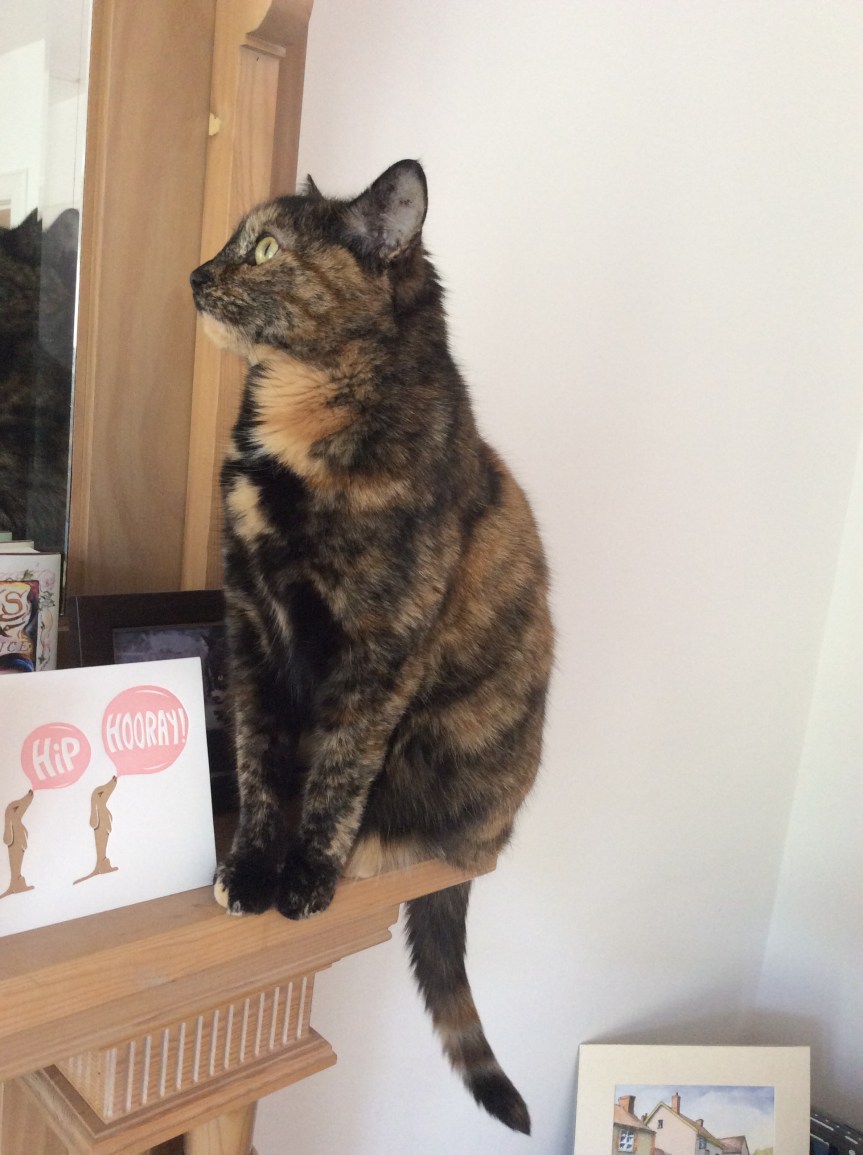
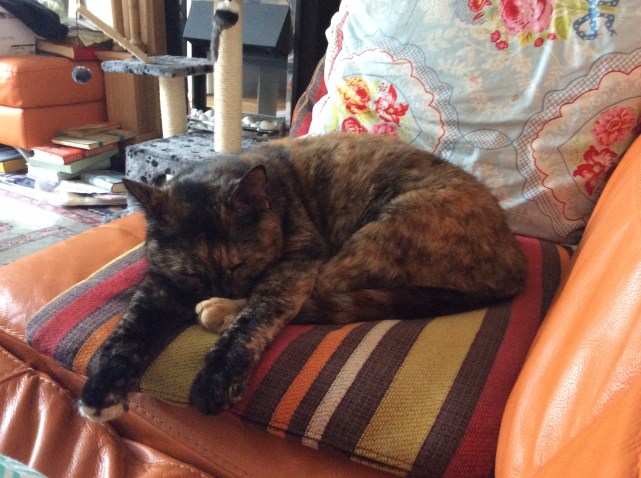
T.S. Eliot would be pleased, we think, as the Marschallin-cat, does in fact have three different names, always assuming you count the one the cat keeps to itself, which we do.

We don’t usually write about Miss Marschallin -except to mention her elliptically -but we thought, what with it being International Cat Day we owed her a proper mention on the blog, and an explanation of her name while we were about it. This because whenever anyone meets her they look at us confusedly and say, ‘how do we say it? Why is she called that?’

In the first instance it was Iris. Iris because the Lothian Cat Rescue found her wandering the botanic gardens. We like irises too, we call them Trinity Flowers and love their colours, but it wasn’t this cat’s name. It wasn’t grand enough.

We were once told by a friend though that we were destined to raise a clowder of Latin-speaking, opera-singing cats that ran the world. And why not, we thought? Well perhaps not running the world, and if it comes to the point, don’t most cats do that anyway? But we liked the idea of a cat named after an opera. Not Tosca though. We understand why she has her own book, and all that, but she also flings herself off a tower to certain doom. We were sort of hoping for an opera with a heroine who lived, and those come at a bit of a premium.

It would have been about this time we stumbled across Der Rosenkavalier, and the Marschallin won us over completely. She might break our hearts, but she’s also that rarity in a lyric soprano role, a woman who doesn’t die. Field Marschallin Marie-Therese is a bit of a mouthful though, so the Marschallin-cat is only that one paper. To us, courtesy of a line of translation by the Met Opera –they used to call me little Resi – she is Resi. She might be the proudest creature in christendom, but as we happen to feed her, we reckon we can take a liberty or two.

img_0612

That is how she became Resi, the Marschallin-cat. These do suit her; proud, regal, and with devastatingly plaintive meow, we couldn’t have called her anything else. She’s not as self-sacrificial as her namesake, but really, who ever heard of a self-sacrificial cat? Besides, whatever she is or isn’t, she’s incontestably  a soprano -like us- and accordingly has a taste for dramatics, high notes and the determined assumption that the world revolves around her. Which is why she refuses to believe today is International Cat Day. According to her Imperiousness the Marschallin-cat, every day is International Cat Day, world without end, amen.

Resi

In Case of Fire

We wrote recently about some of our favourite first lines in literature. In a similar spirit, we’ve drawn up a list of books we’d rescue in the event of fire, or flood or general disaster. Admittedly in the event, if forced to choose, we’d run around like a headless chicken trying yo salvage everything. But if we had to draw up a shortlist, gun to heart, this might be a reasonable approximation.

Persuasion -Jane Austen. What can we hope to say about this that’s remotely our own? It’s our favourite of all Austen’s writing. If it’s not as polished and sparkling as Pride and Prejudice we don’t care; the emotional claustrophobia of Anne Eliot’s limited perspective, the stunning piece of writing that is Wentworth’s letter, we could read this book forever. Instead we choose to cherish it like a rare and valuable tea, rereading it only at intervals.  There has never been a rereading when we haven’t worried it will all go wrong, even knowing Austen is famed for her marriage plots and neat conclusions.  It’s truly that strange and wonderful rarity, a living book.

Gaudy Night – Dorothy Sayers. One of the Lord Peter books, it contains one of literature’s great love-scenes in the shape of a boating expedition on the Cherwell. There are two others equal to it, the letter-scene of Persuasion, and a subsequent Harriet and Peter exchange in Busman’s Honeymoon. There’s no murder, to the horror of some critics, but the still centre of this book is exactly where it needs to be, that is, at the core of Harriet and Peter’s relationship. Whoever said romances were only about courtship? At their most effective they’re about trying and wanting to understand each other. Sayers understood that.

Excellent Women- Barbara Pym. Mildred Lathery describes this as (and we paraphrase) one of those stream of conscience books about women at the kitchen sink, and she’s not completely wrong, this being her story after all. It’s also more than that, because only Pym could make an identity crisis out of a refusal to put the kettle on. Often accused of lacking a plot, Mildred is one of those passive and observant protagonists whose narrative motivation is to gain agency. The first of many excellent women made excellent not by their virtues but by their perpetually falling short of the standards they set themselves, Mildred Lathery is one of literature’s great heroines, even if she doesn’t mean to be.

The Essence of the Thing -Madeleine St John. We’ve been told it’s cheating to prize this particular book above St. John’s others because it’s the one that was noticed, shortlisted for a booker prize in 1997. We don’t think it too egregious of us though, considering that we know entirely too many well-read, intelligent people who have never read or even heard of it.This is a shame; the book is rife with literary gems. Our favourite, taken from Johnathan’s reflections on the collapse of his relationship to Nicola is the observation that they ‘are no longer in a state of marmalade-sharing existence.’

Fall on Your Knees – Ann-Marie MacDonald. What can we say that we haven’t said previously? It’s a brilliant modernisation of the Gothic. It’s devastatingly good. It is possessed of a landscape that is alive, almost as much so as the characters who inhabit it. It’s an under-appreciated book by a Canadian writer that deserves to be better known. Go read it.

The Way the Crow Flies – Anne-Marie MacDonald. As is becoming apparent, we like her lots. We also  hold her and this book responsible for our love of all things Cold War related.

The Inn at Lake Devine – Elinor Lipman. More even than L.M.Montgomery, this novel captures the spirit of summers we spent by the lake. At once thoughtful and idyllic, Lipman writes with lightness of touch and devastating sincerity. We were told once she wasn’t taken seriously, but we think -and hope -that’s changed, because if not it’s a sin. Few writers can equal her for her fluency in the foibles and faults of humanity.

My Turn to Make the Tea- Monica Dickens. She is, if you’re curious, related to that other great Dickens. Her books are shorter though, the humour different. This one is set in a newsroom, and reflects (we’re told with terrifying and timeless accuracy) the perils of a local newspaper.

Momento Mori – Muriel Spark. Only Muriel Spark could make the making of a cup of tea gothic. We read this book for the first time while on the Isle of Iona, determined to discover the identity of the voice on the ‘phone insisting ‘remember you must die.’ With a hook like that, it can’t have been only us?

 The Town in Bloom –Dodie Smith.  At the risk of heresy…this is better than I Capture the Castle. Mouse is our favourite of Smith’s heroines, before even Cassandra Mortmain. We’re not sure how or why The Town in Bloom went out of print, but we’re glad it was rescued. Partially autobiographical (if Look Back with Mixed Feelings is any account to go on) it’s all about the London theatre life, and four young girls trying for the stage. The moment at which it absolutely won our hearts was Molly’s exasperated declaration on arriving at their new home, ‘they said this flat was converted, but I think it’s still a heathen!’

A Far Cry from Kensington – Muriel Spark. We like her lots too. This slice-of-life book is set in  the Kensington of the 1950s, so abandon any anxiety about it being overly posh. The world of Church End Villas is no such thing. What it is, is delightful, and strange, and all the many things we’ve come to cherish about a Spark novel. This one is partly satire on Spiritualism, notes on Catholicism and on the London publishing industry. It is also our favourite of all her novels.

Through the Praise of Children and Infants

As a rule, we try not to rant here. We favour reasoned opinions and carefully constructed arguments. This Sunday we can’t help ranting though, so we ask ahead that you forgive us. We also ask for your opinion. We’d love to know if we’re over-reacting, if we’re wrong, or if you agree.

The passive-aggressive reader who has appeared on the readers’ rota was back with a vengeance today. She waited with excruciating exactitude for the children to exit the church, which they did slowly, and yes, jabbering a little, as children do, and then began the reading.

Here’s the thing about pauses in a High Anglican Mass, much like the pauses in Jane Austen (and for more on those we direct you to the wonderful Nora Bartlett), they are purposeful. They draw attention to themselves, and if you’re going to use them it had better not be to say with austerity ‘a rather late reading from the book of Ecclesiastes,’ as happened today.

Children chatter. They’re excitable. They talk. This should be, but is not, a truth universally acknowledged. We taught all year at a primary school and we’ll vouch for the fact the closest any of our P2s got to Mime-hood was the wee lad who dressed up as one for Mardi Gras. It’s inevitable that on occasion they talk in church, and maybe there are times and places for chattering and jabbering, and maybe church isn’t one of those, but isn’t the whole point of being a child that you learn those places and times?

The thing that upsets us though, more even than the implicit assumption that these children should be seen and not heard by this morning’s reader (in 2016 –ye gods and little fishes!) is the message it sends. If the basic tenet of our church worship is ‘you are welcome, as are your children, but only provided they’re well-behaved, don’t scream and don’t interfere with our worship,’ something is wrong not only with the worship, but the church. How on earth, with a message like that, do we expect newcomers to feel at home? How, with a message like that will any child ever feel welcomed into the body of the church? More than that, are we going to turn away families on the strength of an aversion to noise? We devoutly hope not.

The rector understands this, which is why what it actually says on the order of service is ‘in the green room there are activities for children who wish to leave during the Mass. We have a soft space in the side chapel for young children. We apologise for the summer hiatus of the Children’s Church. It will resume in September. You aren’t obligated to make use of it, but its there. If you want it.’ Or words to that effect.

And the ones that don’t make use of these things? We love having them with us. As far as we’re concerned all that chatter and babble is a joyful noise in itself, and while we’re not the sort to throw scripture about lightly, there’s certainly a precedent for taking it that way. We know it isn’t only our KJV that says of the children of such is the kingdom of heaven.

To our passive-aggressive reader this morning we say, we should be welcoming those children, not pointedly turning them away. We certainly shouldn’t make the parents feel they’re at fault for incursions of noise, jubilant or otherwise. There’s a reason we say at every baptism, we welcome you, we will care for you, we will share our faith with you. The word of God won’t ever be lost in our efforts to sustain that promise of inclusivity and welcome, not ever.

To Everything A Season; Music for Summer

We’re told normal people measure summer by the length of the days, which isn’t unreasonable. We may even have done this once. Now, summering in Scotland, where summer lasts one week, and doesn’t always fall in summertime (in our first honours year it arrived and went again in March, with temperatures of 25 that never returned), we gauge the season by the time of year at which we instinctively turn to Pete Seeger, the Weavers, Ian&Sylvia, Gordon Lightfoot, and Peter, Paul and Mary. It bemuses the people who associate us with opera, but  Darcy Farrow, Early Mornin’ Rain, Did She Mention My Name, and A-Round the Corner (B-Neath the Berry Tree) are as synonymous with summer for us as suncream and the long vac are for others.

This is the music we sang away at summer camp, first at Gay Venture on Kashagawigamog, and later at Tawingo. (Camp Occonto, which fell awkwardly between them has the distinction of leading us in virtually nothing but Fish Gotta Swim from Showboat , at least in our memory.) It was also the music our family reached for on long car journeys, when we weren’t listening to Paul Temple, naturally. Failing that, we put it on once we’d actually arrived on lake Huron and wanted something to listen to while doing the washing up. More than once we scrubbed dishes to the jubilant exclamations of Tzena, the Canadian revision to This Land is Your Land, The Weaver’s gentle swipes at The Rock Island Line, the bizarre but wonderful predicament of Charlie on The M.T.A.

For that reason this music has become our piece of Canada abroad. Not because the music is all of it Canadian -we know it isn’t – but for the associations it holds; of sitting shivering and damp haired by icy Kashagawigamog, dining hall sing-songs and the stifling heat of a sun-baked car. If you do wonder about Canadian summer though, then go listen to The Travellers; they aren’t wrong, the black fly can indeed be found everywhere.


I Write This…

…Sitting on a startlingly orange sofa, as it happens, and balancing a lap-desk, not being possessed of a proper one. There’s the kitchen table, but we’ve an aversion to putting the computer at the same table where we take our tea. What we really sat down to do though wasn’t catch the atmosphere and character of Kinness Place, but collect together some of our favourite openings to books.

I write this sitting in the kitchen sink. Is there a better beginning than Dodie Smith’s opening gambit to I capture the Castle? We have spent years trying to equal this one in our own writing, and likely won’t ever succeed. True at once to Cassandra’s voice, the tone of the story and our sense of the castle, this makes the promise that the story more than lives up to.

‘Take my camel, dear,’ said Aunt Dot as she climbed down from this animal on her return from High Mass. On the strength of that sentence, an Oxford friend sent us Rose McCauley’s The Towers of Trebizond.  The Oxford friend was right; we did love it. The story of Aunt Dot, Laurie, Fr Chantrey-Pigg and their journey to Turkey is full not only of evocative landscapes but also of some of the most nuanced treatment of religion we’ve read. We still go shivery thinking of Laurie’s first introduction to Jerusalem. We won’t spoil it. Read it. We want another person to help unravel the symbolism of the camel. Unconvinced?  The symbolic camel in question, and the High Mass both transpire in Oxford. Aunt Dot’s just that eccentric.

Long ago in London, in 1945, all the nice people were poor. It sounds like a fairytale, and Muriel Spark does have an ear for modern fairytales. This one is the beginning to The Girls of Slender Means. There is nothing you need to know about it except that the martyr is not a martyr and there is an unexploded bomb in the back garden of the May of Tech Club.

They’re all dead now. So begins Ann-Marie MacDonald’s gothic novel Fall on Your Knees. This was the sentence that set us collecting sentences. The fact that we fell in love with the novel was purely an afterthought.

I suppose it must have ben the shock of hearing the telephone ring, apparently in the church, that made me turn my head and see Piers Longridge in one of the side-aisles behind me. It wouldn’t be us without at least one Pym. She’s best read in well-worn cream paperbacks that smell of book. This is the opening of A Glass of Blessings, our second favourite after Excellent Women. Somehow she cuts right to the inciting  incident while still leaving us with the fuzzy impression that we’re not reading a carefully crafted novel, only a slice of someone’s life.

My father had a face that could stop a clock. This was the sentence that set us on our love of Jasper Fforde and Thursday Next. We don’t read much fantasy or sic-fi. This manages to be both at once, as well as a consummate exercise in spot-the-literary-allusion. We’ve never looked back but have gone on to read this man’s work compulsively. Wherever academic coach Stephen Bloom is now, we owe him a tremendous debt for the recommendation.

Finally, what must be our favourite opening to a novel ever. High, high above the North Pole, on the first day of 1969, two professors of English Literature approached each other at a combined velocity of 1200 miles an hour. This owes to David Lodge, specifically Changing Places. No one has ever made us laugh quite so much.

There are others of course; this is by no means a comprehensive list. We’ve tried to dodge our more obvious favourites, but we also can’t believe we’ve omitted so many; Lipman, Hardy, Monica Dickens are but a few. Some day we’ll draw up a list of favourite books and perhaps get around to doing her justice. In the meantime, go read!

The Avengers, and Others

On Saturday we saw the end of Outlander, the one TV show we’ve watched with anything like regularity since coming to Scotland. As ever, we afterwards went over to the good people of the podcast  Storywonk, where they specialise in story and narrative to hear them dissect the episode and take it to pieces. We do this ourselves to books, television, anything with plot, so listening to them brings with it a sense that we are among our people, and not chronically doomed to be over-analytical as a result of five years reading English. Or if we are, at least we’re in good company.

The first thing they drew out was the title card, which featured a snippet from The Avengers -not the Marvel comic people, but Steed and Emma Peel. We saw it and loved it, but listening to the podcast, there was some question, seemingly, as to how well that piece of detail-work agreed with people unfamiliar with the reference. We can’t hope to answer that because we grew up on The Avengers. In the early 2000s. We loved it, so loved the title card, and gleefully waxed lyrical to the cat about the show. We also realise it’s hopelessly out of our time. It did get us thinking though, about other shows we grew up on that probably had no place in our lives under more normal circumstances. In no order then there was..

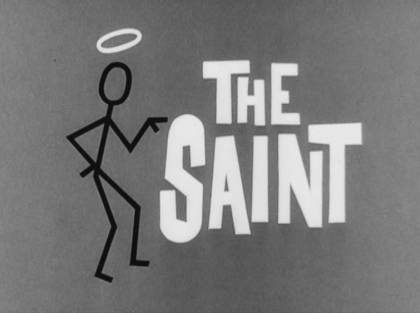
The_Saint_titlecard

The Saint. Alternately Infamous or Famous depending on the introduction, Simon Templar’s arrival was heralded by a chime that declared him the titular ‘Saint.’ We loved him, but would never travel anywhere with him; he was always tripping over dead bodies and plots for robbery.

Perry Mason. It wasn’t a complete episode unless in the course of a court scene, mum turned to the assembled family and said of Perry’s adversary, ‘Hamilton Burger, like ‘hamburger,’ do you get it?’ We’re not sure if Perry Mason is responsible for our love of Crime Fiction, or if we would have stumbled into that by way of Agatha Christie anyway. We do know that increasingly we have less and less patience for Christie, whose characters suffer from the clunky named (by us) English-Is-Author’s-Fist-Language-But-Protagonist’s-Second-Syndrome, but continue to love Perry Mason and Della.

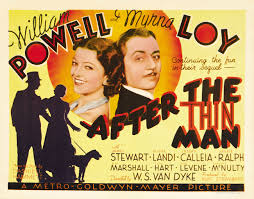
Thinman

The Thin Man. The modern reference, we think, is a thing called Nick and Nora’s Infinite Playlist. Well, we spotted the reference. Our brother spent hours insisting it was a coincidence and the writers had never heard of detectives Nick and Nora Charles, or their dog Asta. A shame if he’s right, because they are charming people. And where would we be without Asta?

Rumpole of the Bailey. This was a newer discovery, as of this Christmas, and it has the distinction of being one of the few court-oriented series that never caused our father (a lawyer) to cry out in exasperation, ‘but he can’t say that! No competent lawyer would ever ask that!’

Yes Minister, for which we had no patience when aged about 8 and first introduced to it. Now though, and even before we started having to watch our country reassemble itself, we recanted and changed our minds. While we think of it, anyone else for Hacker running the country?

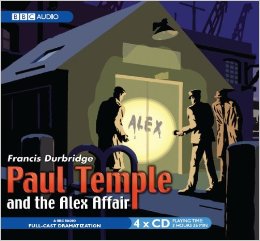
Temple

Finally, not a television show, but certainly integral to our sense of being brought up out-of-time, the radio series Paul Temple. We can’t be the only people who can still hear pitch-perfect the crispness of the CA who read out starring Peter Cook as Paul Temple, and Margery Westbury as his wife Steve,  but we’d bet happily on being some of the youngest people to make that claim.

Almost certainly there were others, but these are the ones that stand out. We’ll doom you to the same cheerful fate as ourselves,whistling a theme that was a key feature to drives out to lake Huron, at least for us.

Stir Up a Little Glandess

We’ve talked before about the void that seems to open up when we shift back into Ordinary time for the summer. Not long after the fact we said as much to a fellow church-goer and when we ran across each other again at last week’s agape, she handed over the following poem. We wanted to share it because it really can’t be just us who thinks there is too much green in the church calendar, and because the poet has said infinitely better -and in verse no less -much of what we’ve tried to express before.

After Trinity

John Meade Falkner

We have done with dogma and divinity,
Easter and Whitsun past,
The long, long Sundays after Trinity
Are with us at last;
The passionless Sundays after Trinity,
Neither feast-day nor fast.

Christmas comes with plenty,
Lent spreads out its pall,
But these are five and twenty,
The longest Sundays of all;
The placid Sundays after Trinity,
Wheat-harvest, fruit-harvest, Fall.

Spring with its burst is over,
Summer has had its day,
The scented grasses and clover
Are cut, and dried into hay;
The singing-birds are silent,
And the swallows flown away.

Post pugnam pausa fiet;
Lord, we have made our choice;
In the stillness of autumn quiet,
We have heard the still, small voice.
We have sung Oh where shall Wisdom?
Thick paper, folio, Boyce.

Let it not all be sadness,
Not omnia vanitas,
Stir up a little gladness
To lighten the Tibi cras;
Send us that little summer,
That comes with Martinmas.

When still the cloudlet dapples
The windless cobalt blue,
And the scent of gathered apples
Fills all the store-rooms through,
The gossamer silvers the bramble,
The lawns are gemmed with dew.

An end of tombstone Latinity,
Stir up sober mirth,
Twenty-fifth after Trinity,
Kneel with the listening earth,
Behind the Advent trumpets
They are singing Emmanuel’s birth.

In Defence of Said

Ever since we took to actively writing on the internet -about three years ago now -we’ve stumbled from time to time across advise written by writers for writers. Sometimes it’s writers’ forums, sometimes memes, and lots of it has been insightful and interesting. The  piece of advice that routinely flummoxes us is the one that suggests overuse of the verb ‘said’ in dialogue is monotonous.

Here’s the thing about ‘said;’ we don’t read it. It’s an invisible word. The brain is programmed to see ‘said’ and absorb it for what it is, a dialogue tag. In other words, the reader glosses over it and registers not the verb only who has spoken. The minute a writer substitutes ‘said’ for another word it needs to be purposeful, and more importantly, it needs to make sense, because the writer is now calling attention to the speaker. It might be that there’s a narrative reason for this; the scene-level conflict might be escalating, or s/he might be striving to convey a particular emotion. Even then though, we’re not sure its necessary to swap ‘said’ for another verb because  appending an adverb to it should be sufficient to convey feeling. We as readers absorb that along with the speech marker.

Speaking from experience, we know we stumble over characters who grumble, speak through gritted teeth, while smiling or laughing. (Try that last one; one or the other is possible but not both at once.) We confess too, that list is only the beginning of the tip of a massive iceberg.

It  might feel monotonous to write, but we are great defenders of ‘said.’ We will, therefore, go on using it, be there ever so many memes that list potential synonyms. We don’t notice it when we read, it doesn’t clutter the conversation or pull us out of the narrative, and more importantly, it makes sense.

The Turn of the Screw

It was with a certain amount of trepidation we went to hear Britten’s The Turn of the Screw yesterday evening. Not because the Byre Theatre’s opera productions have ever let us down, but because in researching The Turn of the Screw we had discovered it revolved around a 12-tone thematic construction, a thing which we have before now found challenging. We blame this on our first imperfect  introduction to it through  exposure to Wozzeck, an opera to which we still have a deeply visceral and vehement reaction, though we can and do acknowledge the genius behind its creation. Last night’s revelation though was that it’s not the 12-tone system or even atonality we can’t stand; it’s just Wozzeck.

The Turn of the Screw, perhaps more than Berg, whose work predates Schoenberg’s scale, relies on a twelve-tone sequence to separate its scenes. It recurs in a theme-and-variation structure and goes on to forms the basis for the opera. More musically competent people have before now dissected it’s importance to the opera, and the symmetry of the scene division. We suspect that it works for us in Turn of the Screw to better effect not because it’s given a tonal recontextualisation but because it serves the story.

Each reintroduction of the theme makes use of instruments that prove integral to the ensuing scene. More than that though, the theme darkens as the narrative does. The perpetual shifting of the key signature too denies us the luxury of settling into familiar territory; the foundations of this opera are perpetually shifting. It’s the synthesis of form and function at it’s best, and it made for riveting listening. We couldn’t look away, much as we wanted to.

This more than anything is perhaps what set us contrasting it with Wozzeck, a story we feel sure set out to achieve the same end. The deliberate choice for dissonance, for atonality necessarily reflects the kind of story being told and should make for uncomfortable listening. It should also draw us in, and that’s something Berg has never done. It feels too consciously an exercise and we disengage. Perhaps more problematically, the shifts in key and structure in Wozzeck feel sudden. It isn’t that part of the floor has shifted, it’s that the floor has been pulled out from under our feet and left us scrabbling for any kind of hold on the narrative.

The Turn of the Screw in contrast feels much more gradual as it slips into darkness. It mirrors speech rhythms, and we listen more closely. It spawns competing, often dissonant musical lines that demand the listener lean closer to understand. It is when we do that darkness asserts itself and doom feels imminent. The ceremony of innocence, as the characters repeatedly assert, is indeed drowned, but it is too late, because having been drawn in, we must know the ending.

Of course, we don’t think it hurt either that the cast –especially the boy playing Miles –was a commendable one. Music, as we’ve no doubt said before, is very much a living thing and its success is in the hands of the singers. These ones more than served their craft and we’re sorry we were ever doubtful.