After Apple Picking

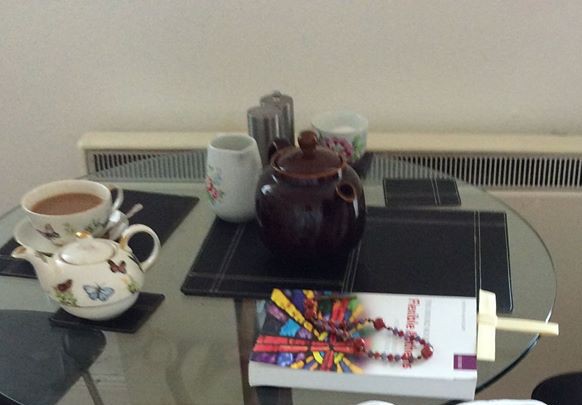
We’re drinking Saigon Chai tonight, just a cup because it’s late and we have, as our Greek lecturer used to say, an appointment with sleep. We’ve always liked Chai, the spice and the savour of it, and this is no exception. Something about it is peculiarly well-suited to winter. It’s a bit like drinking a down blanket, or something, all warmth and comfort.

It comes at the ideal moment; the weather here has turned suddenly wintery, and between the snap of the cold and the dark mornings and evenings, there’s no contesting the season. So as the autumn beats a hasty retreat, here’s a longer poem than we’d usually send up for an Advent submission, but an old favourite -and perfect for that heartbeat transition between seasons. Well, we think so.

After Apple-Picking

Robert Frost

My long two-pointed ladder’s sticking through a tree
Toward heaven still,
And there’s a barrel that I didn’t fill
Beside it, and there may be two or three
Apples I didn’t pick upon some bough.
But I am done with apple-picking now.
Essence of winter sleep is on the night,
The scent of apples: I am drowsing off.
I cannot rub the strangeness from my sight
I got from looking through a pane of glass
I skimmed this morning from the drinking trough
And held against the world of hoary grass.
It melted, and I let it fall and break.
But I was well
Upon my way to sleep before it fell,
And I could tell
What form my dreaming was about to take.
Magnified apples appear and disappear,
Stem end and blossom end,
And every fleck of russet showing clear.
My instep arch not only keeps the ache,
It keeps the pressure of a ladder-round.
I feel the ladder sway as the boughs bend.
And I keep hearing from the cellar bin
The rumbling sound
Of load on load of apples coming in.
For I have had too much
Of apple-picking: I am overtired
Of the great harvest I myself desired.
There were ten thousand thousand fruit to touch,
Cherish in hand, lift down, and not let fall.
For all
That struck the earth,
No matter if not bruised or spiked with stubble,
Went surely to the cider-apple heap
As of no worth.
One can see what will trouble
This sleep of mine, whatever sleep it is.
Were he not gone,
The woodchuck could say whether it’s like his
Long sleep, as I describe its coming on,
Or just some human sleep.
 

Nicholas of Myra, Mint Tea and Pickled Children

img_2200

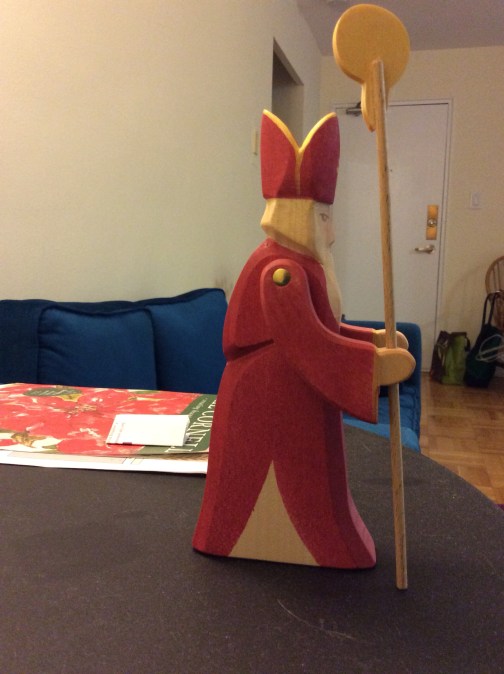
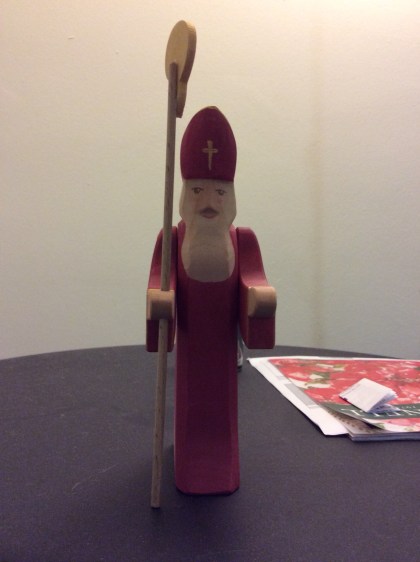
St Nicholas’ Day has brought a mint tea we cannot finish. We managed nine-tenths of a cup before giving up on it, give or take. The second cup was a non-starter. The thing of it is, we do like mint. In chocolate creams, in the Girl Guide cookies no one else will buy, as a savoury herb…we’ve even had it in teas we’ve enjoyed. This is called Moroccan Mint, which may make a difference. We vaguely recall that there’s a way you brew Moroccan tea that isn’t the same as other teas, but we don’t know what it is; it’s not something we drink much of. Oolongs and black teas are our defaults -oh, and Silver Needle and rare Jasmines in decadent moods.

Part of the problem is that with nothing else to ballast the mint, it looses its freshness in tea all on its own. That’s our opinion and we’re sticking to it. We’d be curious to see how this Moroccan Mint tasted iced, because we’re tolerably sure that would improve the taste. Ask us again in the summer. We’re not icing anything until it’s the weather for it. Except Bishop’s bread.

In fact, Bishop’s Bread is one of our home-grown traditions from living in Scotland, although in fact we inherited the recipe from Judy Plum, she of Pat of Silver Bush. Well, doesn’t everybody go hunting for the recipes mentioned in passing in the book of the moment? Just us? No one else was inspired to try lobster courtesy of Jo March’s failure with it, or find out what Susan Baker’s Orange Shape was? (It’s a coloured blanche-mange, in the event you were and hadn’t met with an answer yet.)

img_2202

Admittedly, how Bishop’s Bread isn’t fruitcake in a loaf shape with a fancy name is still unclear to us. We differentiate it by marking it with a marzipan mitre and crozier. Oh, and we bake it while listening to Britten’s St Nicholas Mass, which we don’t do when baking Christmas Cake. If you don’t know your Britten, then you may not know this piece, which is a shame; it’s still the most fun we’ve ever had as a chorister, and we’re including Gerontius’s demons in that list. Here’s our favourite of the choruses for your St. Nicholas Day.


We freely admit that Pickled Boys aren’t for everyone though, much as we love singing its Alleluias. So here, to leven it, is a poem for today. We’d love to give you a St Nicholas one, but alas they would all appear to be twee. Now, maybe that would counteract the poor pickled boys, but even so, we can’t stomach it. Really, where is The Church Year in Limericks when needed? Instead, because Nicholas and children go hand-in-hand rather nicely, here’s a poem by Robert Louis Stevenson. Nothing about winter, but it’s certainly the time of year when we’d welcome a lamplighter at the door, what with departing for work in the dark and coming home in the same.  Oh, and for an added bonus, it’s not overly twee!

The Lamplighter

Robert Louis Stevenson

My tea is nearly ready and the sun has left the sky.
It’s time to take the window to see Leerie going by;
For every night at teatime and before you take your seat,
With lantern and with ladder he comes posting up the street.

Now Tom would be a driver and Maria go to sea,
And my papa’s a banker and as rich as he can be;
But I, when I am stronger and can choose what I’m to do,
O Leerie, I’ll go round at night and light the lamps with you!

For we are very lucky, with a lamp before the door,
And Leerie stops to light it as he lights so many more;
And oh! before you hurry by with ladder and with light;
O Leerie, see a little child and nod to him to-night!

We’re determined to send you away singing though, or maybe just to introduce you to Britten’s St Nicholas. So to close, here’s the second movement. It’s written for children, the rhythm won’t stay put, and the words are devilishly hard to get right at the pace you’re supposed to sing them. But it’s good fun, and we guarantee you’ll be singing it, or trying to, for days to come.

Favourite Things

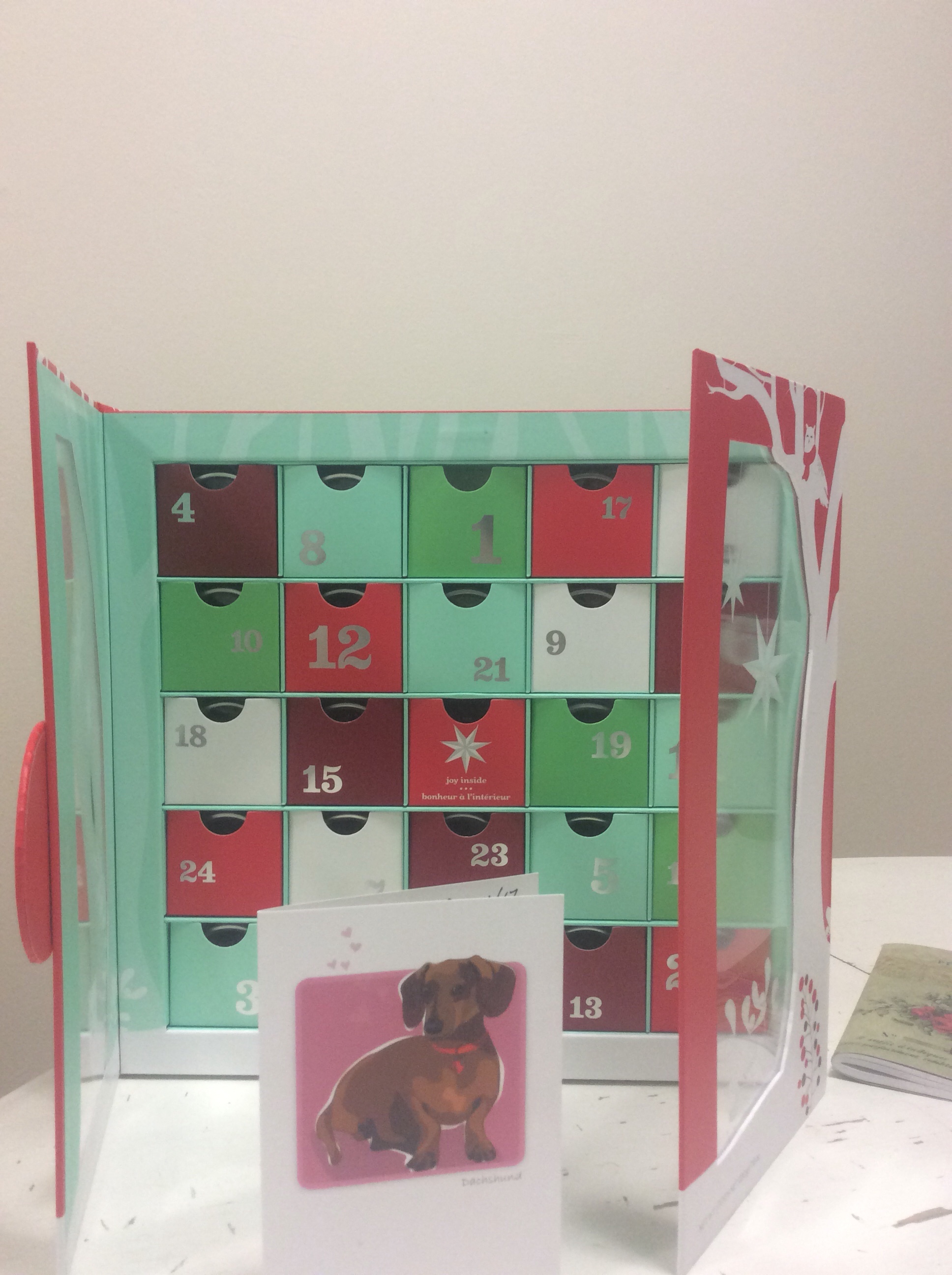
The calendar yielded an old favourite today -one that, to judge from the website when we went to crib information for you, was brought back specially for the calendar. It’s called Glitter and Gold, and it’s a black tea laced with cinnamon and all sorts. That’s no description, coming from a self-professed tea-lover, but we did the research. It yielded no good result. Suffice it to say we’ve been drinking this tea for years without thinking about the contents much. It’s a Chinese tea, which, Julian Mallory of Excellent Women assures us is ‘always such a treat.’ To us it tastes of Christmas -the cloves, we presume.

Proving we can sometimes be reasonable, here’s an old favourite poem to go hand-in-hand with a favourite tea. It comes from Gaudy Night, and we have a sort of inkling we may have used it on here before. But we love it. ‘Conceited little thing’ -Peter meant in the Donne sense, we think -or not, it’s the poem we turn to when we want to still the world for a spell. (The joys of the boating scene, you understand, we savour for rereads only.) Between the giddy whirl that was yesterday, and the busy, half-mad bustle that is Advent as ordained by the claims of the world, we offer you this bit of literary respite.

That Still Centre

Dorothy Sayers, as found in Gaudy Night
Here, then, at home, by no more storms distrest,
Folding laborious hands we sit, wings furled;
Here in close perfume lies the rose-leaf curled,
Here the sun stands and knows not east nor west,
Here no tide runs; we have come, last and best,
From the wide zone through dizzying circles hurled,
To that still centre where the spinning world
Sleeps on its axis, to the heart of rest.

Lay on thy whips, O Love, that we upright,
Poised on the perilous point, in no lax bed
May sleep, as tension at the verberant core
Of music sleeps; for, if thou spare to smite,
Staggering, we stoop, stooping, fall dumb and dead,
And, dying, so, sleep our sweet sleep no more.

A Round Reel of Poetry: Tea for Accompaniment

It’s elegance meets….well the slightly less elegant tonight, as you’re getting tea and a verse with a dose of tartan. Though next to the ceilidhs we learned on, Scottish Country is the elegant cousin, so it’s not too amiss. Mondays are our dancing evening, and we’re strongly tempted to land you with Mairi’s Wedding, because we’ve not done that one yet here, and it would fit the pattern of our day. You’re not getting it, because it drives us fairly batty, even sung.

Besides, we’re sipping Silver Dragon Pearls tonight, and really, there are limits. Sometimes this Advent Calendar comes through in high style, and a tea this delicate, floral -and yes, high-grade -really deserves dignified accompaniment. Alas, we never claimed to be dignified. And since we’re still thinking in reels and jigs, you’re getting a wee verse about Scottish Country Dancing, no names given. Trust us; it’s much funnier this way.

Black_Watch_-_Campbell_tartan

A New Dance

Part Batt

Guess who’s written a brand new dance,
With a brand new figure in it,
Not easy to learn – but worth a try,
As you’ll hear, if you give me a minute.

It is, of course, a “meanwhile” dance
And sounds, perhaps, complex,
But it’s quite straightforward as long as you know
Your number, your partner, and sex.

Threes and fours on the opposite side –
You’ll find it better that way.
You’ve curtsied and bowed, so now get set
And cross your fingers and pray!

An inverted rondel is how it begins
And then the new figure you’ll see
With simple instructions on sheets 1 and 2
And diagrams 1, 2 and 3.

Two highland settings, a knotted barette,
And end in the form of a square.
Crossing reels, look behind you, and with any luck
You’ll find that your partner is there.

Your partner is there, but ignore him or her,
The pattern now subtly alters –
You grab someone else and all promenade round
Backwards – but only three quarters.

The Mic-Mac Rotary bit comes next,
You loop and you loop again,
A quadruple figure of eight, and then
A five-and-a-half-bar chain.

A two-and-a-half-bar turn ends the dance,
An experience no one should miss.
Wherever, whenever, whatever you’ve danced
You’ve never met something like this!

I hope you enjoy it – I think that you will –
And I do hope you think it’s alright
To give yo this preview of what he might dream
When he’s having a very bad night!

(Previously published in Reel 204)

saltire

After all that, you’re getting Mairi’s Wedding after all. If nothing else, it will give you a flavour of what all those verses are on about. It was also the first Scottish Country Dance we ever had thrown at us, and if you can look at it and tell us even one way in which that makes sense, we’ll bow to your wisdom. Personally, we’re still boggled.

Advent I: This is the Record of John

We’re into Advent proper now, and one of the things we most miss about having a choir is the Advent music. Oh, we love Christmas music as much as anyone, but we love the hopefulness of Advent, the way the atmosphere is pregnant with hope and anticipation, even more. ‘Little Lent,’ we’ve heard it called, and it is, because part of Advent is Apocalyptic. But it’s also ebullient, expectant, and whereas lent has a pall over it, Advent moves from darkness to light. It’s why we’re encouraged by today’s collect to ‘Cast off the works of darkness and put on the armour of light.’

With all that in mind, we thought this year, in the name of variety, we’d give our Advent Sundays on the blog over to posting a favourite Advent anthem, or maybe a hymn we miss. But lest you think we’re too serious about the whole thing, we’re going to include a poem with it -selections from the delightful Church Year in Limericks, a happy discovery of ours made while trying to track down another poetry anthology for work. After all, we must be able now and then to laugh at our doctrine as we would anything else, or risk the heresy of taking it all too seriously.

img_2199

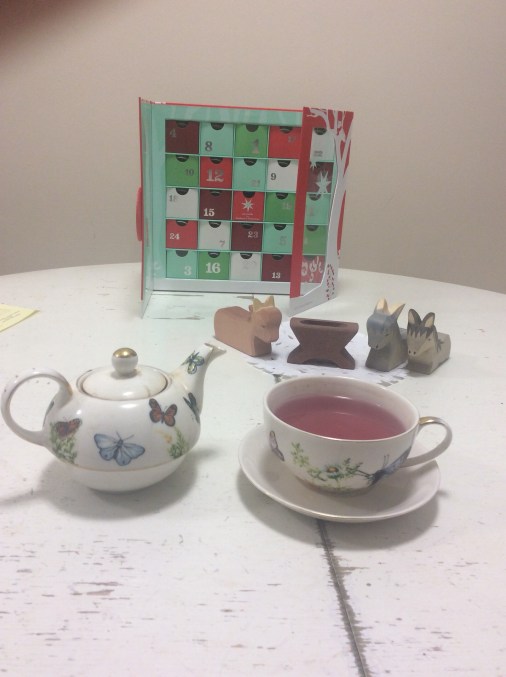
With that in mind, we shan’t grouse about the fact that tonight’s tea (see above) missed the memo that rose is the colour of Advent III, not I. It’s a returning tea to the Advent selection, Strawberry Parfait, and our abiding memory of it is twofold. In the first place, it tastes of pink. In the second, we last drank it after a trying ordeal negotiating our way back from Stirling bus station.

This year it still tastes of pink, and it’s still oddly sweet in a way that recalls a jelly donut. Personally, we keep expecting Truly Scrumptious and company to waltz around the nearest corner and start singing about it. It’s that sort of sweet. Not a bad tea, exactly, but another desert tea -and, oh grievous heresy -not one you’d want to take a biscuit with.  To temper the sweetness, a little, here’s an everlasting Advent favourite of ours, written by Orlando Gibbons and sung here by the Kings College Choir, Cambridge.


And when you’ve revelled in the still small sanctity of that, here’s a bit of levity to close. Who knew what the church calendar was missing was limericks?

Holiday Declarations

From The Church Year in Limericks by Christopher M. Brunelle, © Morning Star Music Publishers 2017

Our cranberries used to be relish
But now it’s our church they embellish
(with popcorn and string)
To welcome the King
Who saves us from fates that are hellish.


You’ll Have Had Your Tea

img_1897

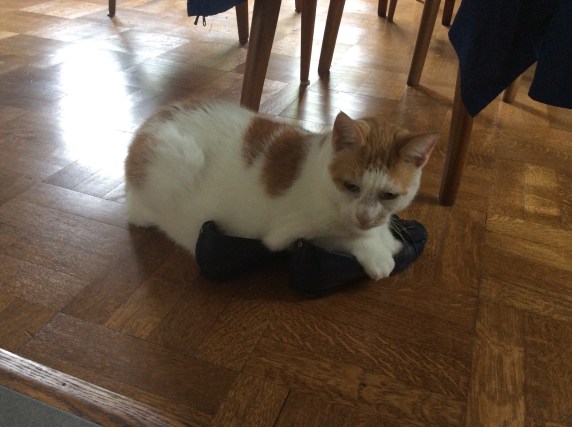
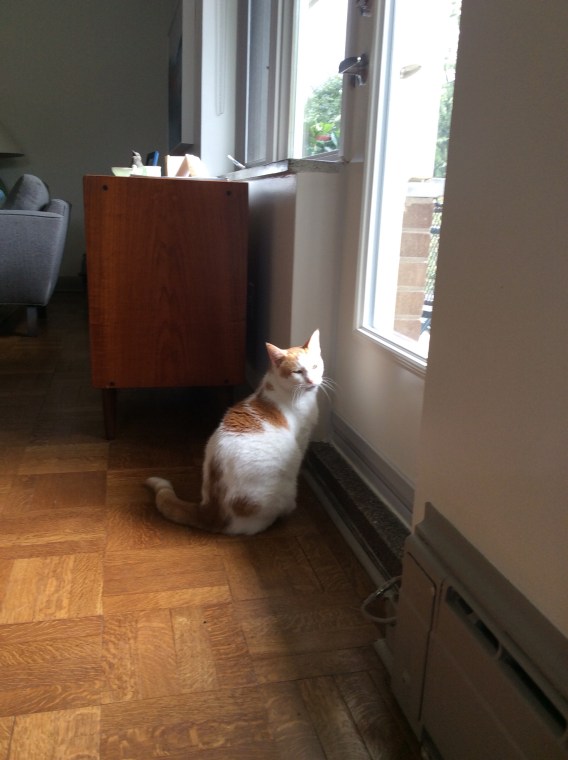
This is Dougie. He had two great missions in life; food and the guarding of shoes. If you wore the shoes, he sometimes attacked your feet for invading them.

He began, when we’d only met him long-distance, as Dougal, because of the ginger in his fur and that old sketch on I’m Sorry, I Haven’t a Clue called Sound Charades, in which two comedians perpetually began their half of the play with cries of:

‘Hamish!’

‘Dougal!’

‘You’ll have had your tea.

‘Oh, no…’

No one had ever had their tea, to hear ‘Hamish’ and ‘Dougal.’ Neither had Dougie, if you believed everything he had to say on the subject of food.

But Dougal was too Scotch a name for the Canadians he lived with, and anyway, don’t cats always have half a dozen names? So he became Dougie, more Canadian for a Canadian cat, but his origin story was apt, because he was perpetually wanting his tea. And shoes to guard. And people to sit on. But no one does comedic sketches about those things. You’ll Have Had Your Tea it was.

Now I’m having my tea, in quite a different sense, and it goes by the dubious name of ‘Chocolate Macaroon.’ I won’t reiterate the spiel about chocolate in tea. But coconut…to anyone else I suspect it’s inoffensive enough. It tastes of suncream to me, probably because that’s what suncream smells of. Also, curiously, it evokes Nice Biscuits, a culinary misnomer if ever there was one. So all told it’s not won me over yet, which is okay. We’re on day two of this Advent calendar and there’s always a couple of dodgy selections. (Coffee tea of last year comes readily to mind.)

Maybe I just feel guilty about the fact that I’m having tea when Mr Dougie can no longer join me and attack my shoes while I sip it. Pancreatic cancer in cats is like that -not the sort of thing you can reverse.

But objectively, if you aren’t averse to coconut, and if you’re not in converse with departed cats, this isn’t a bad tea. Decadent, and not what you’d want to take with your toast at breakfast, but rich and desert-esque. The sort of thing you’d foist on Tommy and Tuppence at one of there Ritz-staying ventures.

In the meantime, here’s a poem, Dougie. Other cats I’ve been known to sing to. Mr Keys got Hansel and Gretel, specifically the ditty about the mouse in the straw, and Her Nibs is partial to Vilja Lied, but you and I weren’t quite on singing terms. I had the temerity to wear my shoes, after all, and you preferred we sit together instead. And who was I to argue with you, world’s most placid cat? So no music for you, but here’s Tennessee Williams, who had he never written a play, would, we feel confident be remembered for his verse.

We Have Not Long to Love

Tennessee Williams

We have not long to love.
Light does not stay.
The tender things are those
we fold away.
Coarse fabrics are the ones
for common wear.
In silence I have watched you
comb your hair.
Intimate the silence,
dim and warm.
I could but did not, reach
to touch your arm.
I could, but do not, break
that which is still.
(Almost the faintest whisper
would be shrill.)
So moments pass as though
they wished to stay.
We have not long to love.
A night. A day….
We didn’t have you nearly long enough to love, Dougie. You were supposed to live on the spoils of the land (or at least veterinary selected cat-food) for years to come. There would have been shoes to wrestle and tea to be had, and maybe we’d have eventually got to singing terms. Apparently celestial shoes had greater need of your defence. Do them proud. And until we catch up again, it seems a safe bet to think that as no cat-friendly patch of hereafter would starve you, we can fairly suppose you’ll have had your tea, then.
img_1902

Tea and Not-Quite-Advent

It’s not-quite-Advent, but we’re back anyway, with another tea calendar and more poetry for this December. This one was a gift from the Dachshunds of Dawlish, presumably for removing Her Imperiousness the Marschallin Cat to quarters elsewhere. (She’ll be back in March, we both will, but don’t let on. We’re enjoying the tea!)

Today it’s a blend called Let it Snow, which it most definitely isn’t, and as long as we’re walking to the subway, we’re not complaining. It’s quite cold enough without adding to it. Anyway, it’s a creamy green tea with white chocolate in it, and anyone who forgets our sentiments on tea and chocolate, we like them separate, is the succinct version. But there’s cloves too, and other spices, also custard, which has no business being in tea. Actually, we’re doubtful about custard in anything, we can’t pin that one on the tea. Still, the prices suit it, and all those oddities, chocolate, custard, theybdo add a creaminess to it. The jury’s still out on whether green tea should be creamy though. We’ll get back to you.

Until then, here’s a poem by Carol Ann Duffy. It’s one of those Tea poems we think probably everyone knows, and if we’re honest, we weren’t converted to it’s cause until we heard it read st a wedding reception. He, you understand was a coffee devotee, whereas, she, like us, preached the Gospel of Tea. Do we’ve come to love it for the memory it evokes. Without further ado, here it is.

Tea

Carol Ann Duffy

I like pouring your tea, lifting
the heavy pot, and tipping it up,
so the fragrant liquid streams in your china cup.
Or when you’re away, or at work,
I like to think of your cupped hands as you sip,
as you sip, of the faint half-smile of your lips.
I like the questions – sugar? – milk? –
and the answers I don’t know by heart, yet,
for I see your soul in your eyes, and I forget.
Jasmine, Gunpowder, Assam, Earl Grey, Ceylon,
I love tea’s names. Which tea would you like? I say
but it’s any tea for you, please, any time of day,
as the women harvest the slopes
for the sweetest leaves, on Mount Wu-Yi,
and I am your lover, smitten, straining your tea.

Murder in the Vestry: Clergy in Detective Fiction

When PBS first started airing the latest season of Grantchester, WNED ran a promotional ad that was words to the effect ‘Featuring unlikely duo Sydney Chambers and Geordie Keating’  Not a bad line except for one wee detail; fiction is replete with clerical detectives. Many of them are even Anglican. There are so many in fact that to list them all would be unwieldy. Here though are some of our favourites.

Fr. Tom Christmas. He’s not really high enough to be ‘Father’ to anyone, but some last names come with a doom, and that seems to be his. He’s the rector to St Nicholas Church (or course he is) in the parish of Thornford Regis. His mysteries invariably take their theme from The Twelve Days of Christmas and are as cozy as any Golden Age writer could hope for. The fact that Canadian writer C. C. Benson infuses them with that quintessential Englishness that makes the books best suited to dreich, tea-filled afternoons would be impressive in and of itself, but the mysteries are clever and the characters charming. Mind housekeeper Madrun though, she has Opinions and enough prickle to her to run circles around even Mrs McGuire.

Fr. Brown – All right, he’s not Anglican, but if he didn’t invent the clergy-detective, it feels as if he did and any list would be incomplete without him. G.K. Chesterton first priest introduces his sleuthing priest The Blue Cross and the world never looked back. We love Chesterton’s deft welding theology and the murder mystery. We’ve said it before and we mean it, nothing is more addictive in reading than the assumption that the reading audience is intelligent.

Rev. Dr Blake Fisher is Fredrick Ramsay’s detective, and we can’t win with our fictive clergy this evening because this one objects to being called Reverend since it’s an adjective, not a noun. He’s an American detective, an Episcopalian with a gift for observation and making faith accessible without ever reducing it.

Fr. Gilbert for a novelty doesn’t object to his title. He’s also formerly of Scotland Yard, so when we told the WNED continuity announcer (not that he heard us) that we’d heard of stranger pairs than television’s favourite Cambridgeshire clergyman, we meant it. He believes strongly in evil, and unlike rational Fr. Brown, is prone to seeing the odd spectre. We don’t mind though, we were trained on Muriel Spark. There are definitely weirder things in fiction than a light touch of the gothic. No really, go read The Ballad of Peckham Rye and get back to us. We dare you to find a novel more bizarre.

There are others, of course, there always are with lists like these. No one loves a priest so well as a mystery writer, and we can’t blame them. Given our druthers we’d take confessing to any of our detective clergy over formidable Morse, Rebus or even the charming Steve Carella, and not just because biscuits seem to be less forthcoming from fictive police.

Every type of character brings advantages to detection. Morse had his vast intellect, Carella his cohort at the 87th Precinct. Clergy though bring their humanity, or they should. They offer an understanding of people, the good along with the bad that makes them particularly well-suited to solving murders.

To the continuity people over at WNED we can only say that if it’s strange pairs they’re after, they’d be better off reading Witches of Lychford. As mysteries go it has its holes, but we can’t think of a stranger pair than the triumvirate of vicar, witch and hippy it offers. Perhaps you can though, or have a favourite religious sleuth we’ve missed out. If so, we’d love to hear from you!

We None of Us Expect to be in Smooth Water All Our Days; Elopement, Kidnapping and What Austen Wrote About

This week has seen the media full of articles, even podcasts on Jane Austen as the world acknowledges the bicentenary of her death. Accordingly we were sent an article about charting data points in her novels by someone who knows us well. If we’re understanding it right, the writer and her collaborator took a sample of popular vocabulary of the time and then somehow charted its usage in Austen. The conclusion was that Austen focuses on the mundane and ordinary in life, instead of on, and here we quote, ‘Big dramatic things; war, elopement, murder, highwaymen, kidnapping, ghosts, gambling, shipwrecks, pirates.’

Now, we tend to think that any reader worth their salt would have reached the mundane and ordinary conclusion on their own time. It’s that more than anything else that causes scholars to compare Austen and Pym, but that’s a different essay.

About those big dramatic things though. We’re going to gracefully sidestep the issue of war. It’s tacitly in the background of both Mansfield Park and Persuasion, but that’s sort of the writer’s point. We’ll even grant the point about murders, highwaymen, kidnapping, etc. Forget Harriet and the roadside gypsies, Mr. Elton in that carriage bound for Hartfield. Elopement though? Either we’re reading a very different Austen or something about the data sample fundamentally misunderstood Jane Austen.

janepict

The famous example is, of course, Lydia Bennet, who runs off with Wickham. But she’s far from the only one. Even within the bounds of Pride and Prejudice she is preceded by Georgiana Darcy, whose elopement with Wickham only falls short because Darcy gets wind of the plan in time.

Similarly in Sense and Sensibility Colonel Brandon’s ward Eliza attempts an elopement, and while that doesn’t succeed either, she does become pregnant. Lucy Steele, on the other hand, avoids pregnancy but does run off with Robert Ferrars, thus throwing the Dashwood household (both of them) into emotional chaos prior to Edward Ferrars’s arrival at Barton Cottage in time to set everything right.

In Mansfield Park not only does Maria Rushworth elope with Henry Crawford, she’s committing adultery in the process. Readers will recall she was Maria Bertram in her first iteration.

And we would be remiss if we forgot Isabella Thorpe, whose marriage to the elder Tilney brother almost certainly counts as elopement by General Tilney’s standards. In fact, she’s something of a precursor to Miss Bertram, since at the time of the marriage she’s meant to be engaged to James Morland.

Now linguistically it seems unlikely that any of these examples would be caught by the data set in use because Austen’s prose while beautifully balanced is not always explicit. As one scholar memorably said, ‘a duel isn’t a duel…and many readers miss the fact of Fanny Price’s pregnancy at the end of Mansfield Park.’ We’re paraphrasing, but simply put, Austen hardly ever calls a thing by its rightful name. Colonel Brandon and Willoughby don’t duel, they ‘me[et] by appointment, [Willoughby] to defend, [Brandon] to punish his conduct.’ And while Austen doesn’t write a kidnapping in the sense the writer means, she does have the Thorpes abduct Catherine in their carriage. Later, Anne Eliot is reluctantly escorted back to Upper Cross by the Crofts, not forgetting Mr. Elton’s holding Emma hostage in that carriage. In all of these scenes, the heroine is reluctantly coerced, and every one of them feels transgressive in its way.

Austen’s great skill isn’t that she neglects worldly affairs for the drawing room, but that she brings them into it. She domesticizes the Gothic with laundry lists, makes violent the fashionable barouche, and turns ha-has –great stalwart of pastoral artwork that they are – into signs of impending ruin.

Does Austen call an elopement an elopement? Probably not. Do they feature? Certainly. It’s all there, if one only goes looking. It turns out though that it might take the more mundane, human eye to spot  –and what could be more Austen-esque than that?

*For those of you with a wish to read the article in question, this is it. We'd love to hear your thoughts!


Raise the Glad Strain

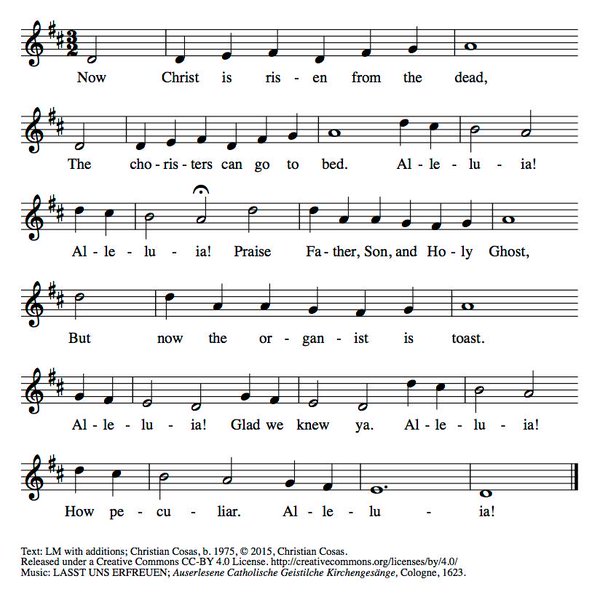
We knew we couldn’t do sombre and Lenten for long. Or rather, we’ve never been good at being anything but jocund as Wordsworth’s daffodils come Easter Sunday. Here’s a hymn for all fellow choristers to be sung to the same tune as ‘All Creatures of Our God and King.’

Though fair warning- we don’t actually recommend damaging the organist. They can be awkward and a nuisance and they think they’re in charge, but they do have their uses, especially after you’ve broken the rector with over-singing.

Happy Easter!

Choir