Tag: Advent
Spiced Tea and Cats
We’re steeping a pot of what calls itself Cardamom French Toast Tea, and so far all things are promising. We gather from both grandmothers that Canadians -or perhaps its only our family -deem the correct way to eat this delicacy involves tomato sauce. As we’ve never agreed with this particular doctrine, we’re relieved to find the tea (it’s a black tea at its roots) tends towards cinnamon and maple, no tomatoes involved. It tastes of spice, which is more than welcome; we’ve long been partial to spiced black tea but ran through our Wittards stock some time ago. We’ll make do with other things, but there’s nothing like Wittards Imperial Blend, or Kusmi’s Prince Vladimir with its cloves and vanilla, to take the cold out of a winter afternoon. Cardamom French Toast does not fall short.
We’re seriously tempted this evening to give you the series of limericks about the Marschallin-cat. She’s at our elbow and most insistent that we pay her suitable homage. But there are almost certainly superior writers who have treated much the same theme. Our favourite comes from a collection that purports to be written by cats and begins, unforgettably, why are you screaming?
Why Are You Screaming
(Francesco Marciuliano)
Why are you screaming?
Did I do something wrong?
Why are you crying?
How can I make it right?
Would you like it in a different colour?
Would you like it in a different size?
Would you like it in a different room?
I just wanted to show my love,
I just wanted to express my thanks,
I just wanted to lay a dead mouse on your sheets.
But now you are screaming,
And I don’t know how to make you stop.

Just the Ordinary Thing…
Everything we’ve been saying for weeks about green tea being the perfect compliment to fruit and nuts is realised in tonight’s tea. It’s an almond green tea that would be much too sweet were it herbal. As it is it’s a beautifully balanced cup that tastes a bit like drinking an almond slice. We’re drinking it in leisurely fashion and musing on church and family, because part of them visiting means trying to explain Scottish Episcopalianism to long-term Presbyterians.
There’s no good way of explaining why this is fraught and complicated except to try and describe the service from the ‘other side’ of the pews, as it were.
No one is thinking very hard about the clockwork and how it fits together because we’re all doing six different things at once. The thurifer’s censing the choir, who are trying not to asphyxiate because they are trying to sing, and while all of that is happening the priest is preparing the altar for communion and the congregation is anticipating the moment the thurifer turns on them so they remember to bow, and so it goes on. And because it’s Christmas there are half a dozen furbelows that have been added to make sure everyone knows it’s Christmas (because the midnight service mightn’t give that away), which means we’re all guessing. The choir are trying not to melt the folders and the organist (who only has half the asperges and that in a completely different setting to the one his choir is canting) is approximating how long to improvise for and watching the communion queue to see whether to deploy the emergency communion hymn, and there’s always going to be a surplus of wafers ‘just in case’ because it’s one of those occasions when you anticipate the 500.
The point is, none of us knows what we’re doing, not really, and it doesn’t really matter. We’ll still try and explain, because that’s part of giving them welcome, and we’d hate for them to feel all adrift somewhere that’s made us so at home. Also, we know the service book isn’t exactly expansive in its communication. We’ll do our best, but S. J. Forrest still says it best in his critique of services, and we’re seriously tempted to let him have the last word.
What’s The Use?
by S.J. Forrest
(transcribed by Father James Siemens, AF)
‘Oh just the usual thing you know; the BCP all through,
Just pure and unadulterated 1662;
A minimum of wise interpolations from the Missal,
The Kyrie in Greek, the proper Collects and Epistles,
The Secret and the Canon and the Dominus Vobiscum,
(Three aves and a salve at the end would amiss come);
To the “militant” and “trudle” there is little need to cling,
But apart from these exceptions, just the ordinary thing.’
‘Oh, just the usual thing you know; we’re C of E of course,
But beautify the service from a mediaeval source,
With various processions, and in case you shouldn’t know,
There are tunicled assistants who will tell you where to go;
And should you in bewilderment liturgically falter,
Just make a little circumambulation of the altar.
The blessing, like a bishop, you majestically sing;
But apart from these exceptions, just the ordinary thing.’
‘Oh, just the usual thing you know; but very up to date,
Our basis is the liturgy of 1928,
With lots of local colouring and topical appeal,
And much high-hearted happiness, to make the service real;
Our thoughts on high to sun and sky, to trees and birds and brooks,
Our altar nearly hidden in a library of books;
The Nunc Dimittis, finally “God Save The Queen” we sing;
But, apart from these exceptions, just the ordinary thing.’
‘Oh, just the usual thing you know, we trust that you’ll be able
To mingle with the reredos and stand behind the Table;
(For clergymen who celebrate and face the congregation,
Must pass a stringent glamour-test before their ordination!)
Patristic ceremonial; economy of gesture,
Though balanced by a certain superfluity of vesture;
With lots of flanking presbyters all gathered in a ring,
But, apart from these exceptions, just the ordinary thing.’
Levity from the Choir
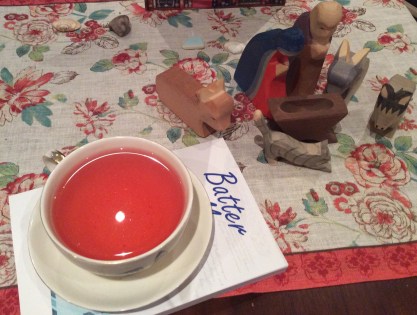
Six o’clock this evening found us drinking Sleigh Ride tea with our academic daughter on the eve of her departure as it were, and talking Christmas traditions. We have family coming soon, and that means shortbread and thumbprint cookies. It being the fourth Sunday in Advent also means that the angels get added to the Nativity unfolding on the coffee table. If that sounds illogical, it probably is. We’ve cribbed the pattern of building the scene from a former minister and have done our best to replicate it, and can’t remember what he did except that everything seemed to end up at the crib by Christmas Eve bar Christ and the Kings. But we’re mostly Anglican, and it’s a tradition, and that naturally means it’s set in stone for the next thousand years at least. On which note by the by, as the annual tradition of the candlelit service looms ever nearer, we feel the need to issue the following friendly reminder;

The Benevolent Choirs Act, issued alongside the 1970 liturgy, means that we in the choir stalls don’t have this problem, being gifted instead with tall candles in glass casing. There is no flimsy cardboard or spindly half-spent candles; these sit stolidly on shelves that make balancing one’s music awkward. Also, because there is no Music Folders Protection Act, the folders are still prone to melt if held too close to the candles by preoccupied choristers.
We’re dwelling on candles this evening because bizarrely it was revealed this morning that today’s Advent candle was being lit for Mary. Having never realised that the symbolism of the candles changed with the church year this was a surprise; we’ve always supposed the Gaudete Sunday candle is pink as much because it’s a Marian colour as because it’s nodding towards it’s mirror Sunday in Lent, Rose Sunday. Mind you, the calendar also says today is Laetare Sunday, so called because one sings the introit ‘Rejoice O Jerusalem,’ whereas in fact we sang the Advent Prose, which is gorgeous but sounds more like the wail of people anticipating the Apocalypse than a shout of jubilation, so perhaps we shouldn’t be surprised. Good Presbyterians of the kind we grew up with, of course, have none of these problems because good Presbyterians don’t give the days Romish names like Gaudete Sunday and they let the candles stand for nice things like peace, hope and joy. They’ve probably never heard of the Advent Prose (the ones we grew up with certainly hadn’t) either. We are not good Presbyterians. We gave up sometime after acquiring our first rosary. Great-Grandmother Grace is spinning in her grave, and the fact that we’ve since allied ourselves with the Scottish Episcopacy probably hasn’t slowed her down all that much.
We should, here, give you a Marian poem in the name of thematic relevance, but we’re afraid to look for one as the vast majority are almost certainly doomed to be soppy. Instead have a bit of ecclesiastical levity. Mine might be spiky people who give Latinate names to Sundays and look dangerously over the precipice at Rome all too often, but we do know better than to take ourselves too seriously.
Hilarity, or Hymnody
(Unknown) -to be sung to ‘Aurelia’
Our church is mighty spikey
with smells and bells and chants,
And Palestrina masses
that vex the Protestants.
O happy ones and holy
who fall upon their knees
For solemn Benediction
And mid-week Rosaries.
Though with a scornful wonder
men see our clergy, dressed
In rich brocaded vestments
as slowly they process;
Yet saints their watch are keeping
lest souls be set alight
Not by the Holy Ghost, but
by incense taking flight.
Now we on earth have union
with Lambeth, not with Rome,
Although the wags and cynics
may question our true home;
But folk masses and bingo
can’t possibly depose
The works of Byrd and Tallis,
or Cranmer’s stately prose.
(Here shall the organist modulate)
So let the organ thunder,
sound fanfares “en chamade;”
Rejoice! For we are treading
where many saints have trod;
Let peals ring from the spire,
sing descants to high C,
Just don’t let your elation
Disrupt the liturgy.
An August Midnight
Among the scents we actively recoil from in drinks, coconut is one of them, or so it emerged this morning when we opened the tin with this day’s tea. We’ve never liked coconut but we can sometimes bear it in things if it isn’t the main ingredient. This isn’t true of tea, possibly because no drink on earth should smell of suncream. In this particular instance, we’re immensely grateful that the tea doesn’t taste as it smells, but that might be because we were afraid of leaving it to steep. We’ve never really been curious to find out what suncream tastes like, you understand.
All told though, and if you can get past -or indeed have no issue with -the smell of coconut, it’s a nice tea, smooth, creamy and reminiscent of those flavoured custard creams sold briefly by Lidl (the coconut variety, naturally). We used to buy them in the summer and eat them out in the garden. With that in mind, here’s a poem we’ve long associated with summer writings and the act of creation -though we now suspect that for years we misunderstood the title. No matter, the day’s almost run out here in Scotland, and goodness knows Miss Marschallin-cat would be grievously offended if we didn’t consider her august company.
An August Midnight
Thomas Hardy
I
A shaded lamp and a waving blind,
And the beat of a clock from a distant floor:
On this scene enter–winged, horned, and spined –
A longlegs, a moth, and a dumbledore;
While ‘mid my page there idly stands
A sleepy fly, that rubs its hands . . .
II
Thus meet we five, in this still place,
At this point of time, at this point in space.
– My guests parade my new-penned ink,
Or bang at the lamp-glass, whirl, and sink.
“God’s humblest, they!” I muse. Yet why?
They know Earth-secrets that know not I.
City of the Scarlet Gown
We unveiled Irish Breakfast Tea this morning, and there really isn’t anything we can say about that except to express our profuse gratitude at finally opening something that will wake us up over breakfast. We love the variety of leaf teas this Advent Calendar displays but we’re desperately short of black tea and we’ve put off buying it expressly because we’re confronted by a calendar full of the stuff.
Thus, sufficiently awake and free of cotton-wool for brains when we looked up from hunting for Christmas cards -minimal luck, the selection was worse than sparse so late in the month -it was to help show St. Andrews off to visitors. Even on grey December days it’s easy to boast about. We had been traipsing through the Castle and were wending towards the cathedral in three o’clock twilight, and the sky was the loveliest wash of orange and grey whenit came home to us again how lucky we’ve been these last seven years. Part of it is the lifestyle of the people, and part of it’s the smallness of the town, and not a little of this is because of the sea and the fact that its in our blood even though we, like Coleridge hale from the city and cloisters dim. But there’s something more than that, an inarticulable something that we can’t seem to express. We alighted at Leuchars station one May -just to visit -and knew in our bones we’d come home. Andrew Lang says this best, so we’ll let him have the last word.
Almae Matres
Andrew Lang
Batter My Heart
Tonight, after a day spent attempting to get organised for Christmas (when and how did it get to be December 13?) we’re drinking Caramel Roibos tea. It’s smooth, rich and roughly the way we imagine liquid gold to taste. Win fact this is our second pot; we made the first with breakfast. It’s not really a breakfast tea though, and we don’t just mean that it only half diminished the feeling our brain was over-stuffed with cotton wool, or even that we felt extravagant drinking it (though we did). It’s a tea meant to be savoured though, drunk slowly and unaccompanied by anything that might interfere with the flavour of the tea.
It’s St. Lucy’s Day today, and by rights I should offer you John Donne’s thoughts on that occasion. In Scotland though, that particular poem is really best read on the shortest day of the year, and that’s still a little way away, so we’re guarding it jealously. Instead, have another of his and a favourite of ours, ‘Batter My Heart. And because it happens that it’s been strikingly adapted by John Adams into an aria, we’re going to give you that too; it captures the raw urgency of the speaker and deserves to be better known.
Here then, as sung by Gerald Finley, is ‘Batter My Heart’ from Doctor Atomic and Donne’s Holy Sonnet.
Holy Sonnets; Batter My Heart, Three-Person’d God
John Donne
Hot Chocolate Tea and Mist like Incense
In the course of sampling a tea labeled ‘Hot Chocolate’ we’ve put our finger on why we take exception to chocolate in tea; it is disconcerting to drink something that smells of one thing and tastes of another. Hot Chocolate tea in particular is neither fish nor fowl. It has black tea notes, so is long in the mouth like any weighty black tea, but it smells of chocolate. It doesn’t actually taste of chocolate though, more of cinnamon and vanilla, maybe of sugar too. Most disconcertingly that undefinable thing, ‘milk essence’ is back, which leaves the whole thing tasting vaguely creamy. Now it may be that adding milk to ‘Hot Chocolate’ tea would help it, some teas work that way. Equally, milk might crush the spices and the vanilla, which opinion we tend towards. Either way, if we have this for breakfast tomorrow (and we could,as it’s very definitely a black tea whatever else it is), we’re going to feel excessively decadent -Signora Neroni comes to mind, or possibly a misguided E. M. Forster heroine.
By rights we should give you another Scots poem this evening, just to prove that this piece of green and pleasant land has in fact produced poets who understand both metre and rhyme. We were going to too, and then we went rootling around on the internet for a scrap of something that had come up in a sermon months ago and were so delighted that our haphazard googling yielded results that you’re getting that instead. It’s neither May, nor Ascensiontide, nor even a Thursday, but that doesn’t diminish the loveliness of the poem. Besides, it’s Gaudete Sunday today, the Advent Sunday when we can relax liturgical disciplines a bit. If the priests can wear rose, we think we can disregard the calendar and look backwards to Ascension in the name of good writing. We’ll chalk up on a roster somewhere though that we owe you one piece of good Scottish poetry.
Ascension Thursday
Saunders Lewis (translated from the Welsh)
What is happening this May morning on the hillside?
See there, the gold of the broom and the laburnum
And the bright surplice of the thorn’s shoulder
And the intent emerald of the grass and the still calves;
See the candelabra of the chestnut tree alight
The bushes kneel and the mute beech, like a nun,
The cuckoo’s two notes above the bright hush of the stream
And the form of the mist that curls from the censer of the
meadows.
Come out, you men, from the council houses
Before the rabbits run, come with the weasel to see
The elevation of the unblemished host from the earth,
The Father kiss the Son in the white dew.
Green Tea and the Silvery Tay
There are some things that will always work well in tea. Cornflowers are one, and fruit -nearly all of it -seems to be another. We were reminded of this tonight, coming back from the university carol service to a pot of what the calendar simply calls ‘passionfruit green tea.’
The great blessing of fruit in tea is that while it increases in flavour, it never oversteeps, even if the tea does. Hence we could leave the leaves of Orange Oolong in the pot for as long as we liked, and it never went bitter. That’s not strictly true of green tea, but we had had the kind of day that left us disinclined to savour our tea over-long, so that was a non-issue.
Standing in the queue for the carol service this evening, we were told all about a poem penned to St Andrews that isn’t the famous Andrew Lang one.It was written by Robert Crawford for the installation of the new principal and we had grand plans to share it, but seemingly it can’t be found for all the tea in China, so here instead is a poem by another Scottish poet, William Topaz McGonagall. He’s best known for ‘The Bridge of the Silvery Tay’ -at least, for the first four lines. Less well known is that the Tay Bridge Disaster goes on ad at quite some length. The thing about McGonagall’s poetry -well one of many things -is that there are patterns to it, so in former years the Poetry and Cake Society used to play Guess the Rhyme at it’s Christmas party. We gave up on the (in)famous Tay Bridge poem because after a while we all knew it too well.
It wasn’t the only poem he wrote on the subject of the Tay though, and as Tayside isn’t so many miles as the crow flies from us, here’s ‘A Descriptive Poem of the Silvery Tay.’ We’re very sorry. If it’s any consolation, you could always play Guess the Rhyme.
A Descriptive Poem of the Silvery Tay
William Topaz McGonagall
Beautiful silvery Tay,
With your landscapes, so lovely and gay,
Along each side of your waters, to Perth all the way;
No other river in the world has got scenery more fine,
Only I am told the beautiful Rhine,
Near to Wormit Bay, it seems very fine,
Where the Railway Bridge is towering above its waters sublime,
And the beautiful ship Mars,
With her Juvenile Tars,
Both lively and gay,
Does carelessly lie
By night and by day,
In the beautiful Bay
Of the silvery Tay.
Beautiful, beautiful! silvery Tay,
Thy scenery is enchanting on a fine summer day,
Near by Balmerino it is beautiful to behold,
When the trees are in full bloom and the cornfields seems like gold –
And nature’s face seems gay,
And the lambkins they do play,
And the humming bee is on the wing,
It is enough to make one sing,
While they carelessly do stray,
Along the beautiful banks of the silvery Tay,
Beautiful silvery Tay, rolling smoothly on your way,
Near by Newport, as clear as the day,
Thy scenery around is charming I’ll be bound…
And would make the heart of any one feel light and gay on a fine summer day,
To view the beautiful scenery along the banks of the silvery Tay.
In a Bath Teashop
Have you ever heard it say that the better the tea-leaf the better the tea? Forever Nuts is a herbal tea that takes this idea to it’s logical conclusion; the constituent parts of it are so big as to actually be awkward to extract from the sample tin onto a teaspoon. That’s its greatest fault though -if you don’t mind drinking tea that is pink.

It doesn’t taste of pink, you understand, there’s beetroot in it and that dyes it pink. Mind you, it doesn’t taste of beetroot either. In fact it tastes mostly of apple, cinnamon, almonds and what we’re tolerably sure is another nut that the ingredients neglected to specify. It being another of our previous attempts to replace the Crumble Tea, when it cropped up in the calendar today it was a bit like stumbling over an old friend.
It’s especially welcome after a day spent drinking Twinings breakfast tea. (We did warn you we could be snobbish about tea.) It’s not that there’s anything wrong with Twinings; if we have to have a bag tea their our default when we can’t get Red Rose, and we can’t at the moment, because we’re in Scotland. It’s just that if you live on nothing but leaf tea -and good leaf tea at that -for long enough, it’s a wrench going back. Well we think so. The fact that we never learned to take Twinings Breakfast Tea without milk probably doesn’t help either.
If at this point you’re wondering how teabags ever came to feature today, given that we’re clearly fussy on the point of tea, we spent a large portion of today from sunset onwards in tearooms visiting with people. If that sounds like on of those quirks of time worthy of Austen -when a morning lasted until you sat down to your afternoon meal -it’s only because this is Scotland and twilight falls at 3. If anything we were observing tea precipitately. Tea of course, was most quotidian, but as proof it needn’t be that way, here is a poem by John Benjamin. We preface this by saying that whenever we read ‘In a Bath Teashop’ we think of Bath wet-cobbled and rainy. It’s not that it rained the whole time we visited -it didn’t – it’s that nothing elevates a bath tearoom so much as ducking into one to escape a sudden gout of rain when without an umbrella.
In a Bath Teashop
John Betjeman
Let us not speak, for the love we bear one another—
Let us hold hands and look.”
She such a very ordinary little woman;
He such a thumping crook;
But both, for a moment, little lower than the angels
In the teashop’s ingle-nook.