An Oldie but Goodie

Just as we were getting used to these ubiquitous yellow tea packets…it turns out the teas are colour coded! This in light of today’s revealing of a black tea in a navy blue packet. Oh, we could sing!

We love a good black tea. Herbal teas are fine when options are limited; we even have one or two we particularly like. We wouldn’t turn up our noses at green or robins either. Whites and Oolongs are lovely for late afternoon and evening, but for a good, old-fashioned afternoon tea with biscuits we favour a black tea. That this one says it’s Breakfast Blend on the tin has deterred us not a jot from sitting down to a pot at gone three of a December afternoon.

This is a lovely breakfast tea with Ceylon notes that add delicate, subtle flavour. It’s worth noting though that we’re among those people who, de facto, take black tea with milk, which will necessarily alter it’s taste. But in this instance we hardly think the effect was adverse. It’s a classic tea and its classic for a reason.

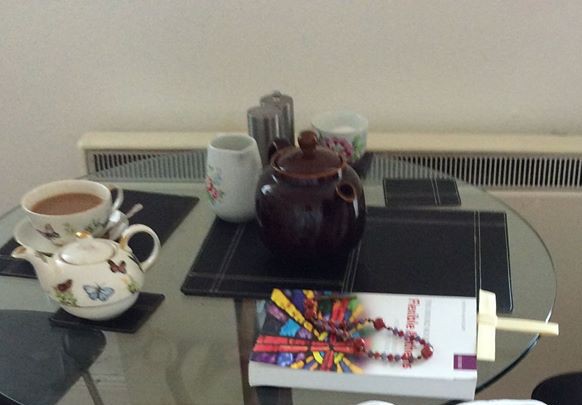
 To go with it, here’s a classic poem. To early for Hardy, you say? Never say we! It wouldn’t be Chorister At Home does Advent and Tea without a healthy dose of Hardy! Besides, we mentioned this one yesterday. So settle down to a cup of your favourite tea, luxuriate in it while it steeps, and have a read. See if you find this Hardy and yesterday’s Lawrence as metrically similar as we do.

The Voice 
Thomas Hardy

Woman much missed, how you call to me, call to me,
Saying that now you are not as you were
When you had changed from the one who was all to me,
But as at first, when our day was fair.

Can it be you that I hear? Let me view you, then,
Standing as when I drew near to the town
Where you would wait for me: yes, as I knew you then,
Even to the original air-blue gown!

Or is it only the breeze, in its listlessness
Travelling across the wet mead to me here,
You being ever dissolved to wan wistlessness,
Heard no more again far or near?

Thus I; faltering forward,
Leaves around me falling,
Wind oozing thin through the thorn from norward,
And the woman calling.
I remember, I remember

A nice, relaxing tea today. It’s called Apple Cider, and not only have we had it before, we own a whole tin of the stuff. It’s a nice herbal blend that is supposed to channel mulled apple cider. (The non-alcoholic kind, for reference.)

Now, although we own a tin of this tea, we’ve never actually run out because lovely as this is – the apple and the cinnamon are very much present in the taste – it’s just too sweet to be herbal. Cf yesterday’s post about the herbal tea of choice and how it ,too, needed some kind of underlying tea blend for emphasis. This isn’t about imbalance so much though as emphasis. Ever added lemon to Earl Grey? Or maybe you’ve added milk to a tea with chocolate in? Some things simply help to bring out existing tastes, and we get the sense that this would taste even more like mulled cider with a green tea underneath. Or maybe we’re just nostalgic for Mom’s Apple Pie, the green tea that stole our hearts and was apple crumble in a cup. It was a glorious thing, universe, and no aspiring tisane, however good, can hold a candle to it.

In the spirit of waxing nostalgic, then, here’s a poem that revels in it. It’s by D. H. Lawrence but it uses a metre we’ve only ever before seen in Hardy. Now, the internet assures us that it uses a popular hymn metre, alternating tochees and iambics, and that would make sense; haven’t we said before you can sing any Hardy to any hymn tune? Well, we’ve tried with Lawrence and his nostalgia and it defies a range of beloved hymn melodies. In fact, the poem we think it most echoes is Woman Much Missed, which is just about the one Thomas Hardy piece you’d be hard pressed to sing. But go on, pour out your tea, have a read, and then a wee sing. Did we miss a hymn tune that works? Does it do better as a nursery rhyme? We’d love to hear what you think!

Piano
D.H. Lawrence

Softly, in the dusk, a woman is singing to me;
Taking me back down the vista of years, till I see
A child sitting under the piano, in the boom of the tingling strings
And pressing the small, poised feet of a mother who smiles as she sings.

In spite of myself, the insidious mastery of song
Betrays me back, till the heart of me weeps to belong
To the old Sunday evenings at home, with winter outside
And hymns in the cosy parlour, the tinkling piano our guide.

So now it is vain for the singer to burst into clamour
With the great black piano appasionato. The glamour
Of childish days is upon me, my manhood is cast
Down in the floor of remembrance, I weep like a child for the past.

S

Advent I: Tis the Season

It’s that time of year again; another Advent season brings another month of tea and poetry. This year Advent is sponsored by Freezing Rain R Us, which has got the market cornered on making Canada look an awful lot like Christmas, and feeling like it, too.

It even got into this morning’s liturgy, as the assistant priest’s particularly Canadian cadence translated ‘deliver us from sudden death’ to ‘deliver us from sodden death.’ It’s not what he meant, and it’s probably just about the one thing not listed in the prayer for everything ever that is the Great Litany, but we appreciate the sentiment. Freezing rain, snow and subzero weather; deliver us from sodden death indeed.

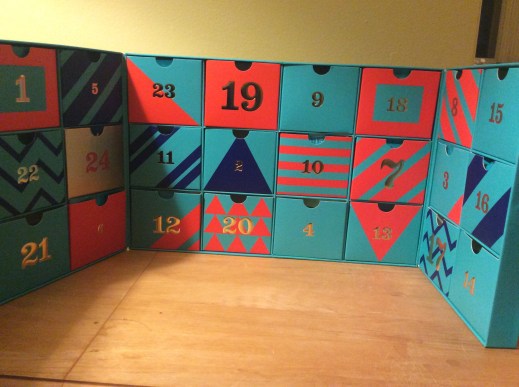
It’s also the perfect weather for tea. Cue the calendar.

img_3749

This year it’s even larger than previous lives have rendered it, and the boxes include not only supersized portions of tea but also gift cards. Today’s was $5 off any robois we happened to purchase between now and Christmas. Since this calendar has got us well stocked on tea into next Advent, the likelihood of me capitalising on this bit of generosity seems unlikely. But it’s a nice thought, calendar.

On to the tea, though Today’s selection is whimsically called Gingerbread Blondie, which makes it sound like some kind of traybake. And if you too made the mental leap to the sort of tea one Harmony Kendal, vampiric nuisance of Buffy  and lately the spin-off Angel the Series, might drink, you’re in good company. If not, no bother.

It’s a herbal infusion, and the ingredients promise apple, pineapple, mango, candied ginger and vanilla in some cocktail or other. Our first cup was nothing but ginger, and scent of vanilla. The second cup was nothing but pineapple, with lingering notes of ginger. It’s a problem we often have with these tisanes; they’re weak to start and then they’re overly sweet on the second cup. Pineapple probably shouldn’t be hot (we don’t care for it on gammon or pizza, either), and it definitely shouldn’t be floating around without the body of a caffeinated tea under it. Green, ideally, but an oolong or even a white might work here. It just needs something to get all the flavours in alignment instead of fighting for dominance like so many cats.

And speaking of, here’s a wee gem of a Christmas poem to start off the month. We’re skipping ahead a little bit with this one – it’s not technically Christmas yet, much less New Year’s – but it’s just such fun. Have a read and see if you, too, don’t come away singing this reworked carol for cats.

We Wish for the Family Goldfish
From Christmas Carols for Cats by John and Julie Hope, 2010

We wish for the family goldfish
Why in bowl and not in our dish?
We wish for the family goldfish
To bring us good cheer!

Of longing we sing, for food to appear;
We wish for the family goldfish to bring us good cheer!

We long for the hamster squeaking
Along to his house we’re sneaking
We long for the hamster squeaking
A snack we revere.

In wonder we sing, why live food is here!
We wish for the hamster squeaking, a snack we revere.

We’re sick of the budgie chirping
Let’s eat him and all be burping,
We’re sick of the budgie chirping
Each day of the year.

The food that can talk we do not hold dear
We’re sick of the budgie chirping each day of the year!

Expecting something longer and grander?

img_3711

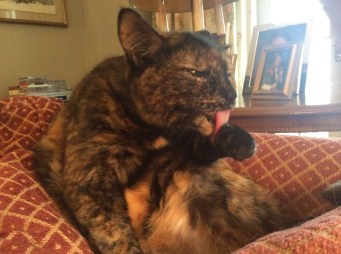
Not all that glisters is gold, and we have a whole 23 days of poetry to get through. We’ll get there. Until tomorrow, a holy Advent from us, the Dawlish Dachshunds and Miss Marschallin cat. Who does not, by the way, wish for the family goldfish. Though we suspect she dreams of evicting the dachshunds. Shame it doesn’t scan as well.

Doubt, Tea and Christmas Eve

In homage to an old Glasgow haunt of ours, we’re drinking today’s tea in what they would call ‘Russian style.’ That is, loose leaved and less the tea infuser. Also, whatever the technical term si for drinking a cup of tea while a cat waltzes around one’s space, not just lap, but back, shoulders, desk, keyboard…there’s a technical term for that, yeah?

Anyway, the tea itself is called Fireside Mocha, and we really hoped we’d misread Firside Matcha. No such luck. Question; if your fruit based infusion lacks tea leaves but does have coffee grounds, in what way is it not flavoured coffee?

This year’s attempt to convert us to the taste of coffee went about as well as anyone whose old hat at this tea-and-a-poem blog of ours would expect after three odd years of it.  There’s grimacing, noises of distress and quoting of Nancy Mitford. Specifically that old saw, ‘Aren’t I grown up Fanny? I drink tea and almost like coffee.’ It’s one of Don’t Tell Alfred‘s truly funny moments, with the caveat that we still don’t like coffee. Not even almost. And we absolutely, unconditionally, definitely do not want the stuff in our tea. Got it, universe? If we want coffee – which event is doubtful – we’ll have coffee. If we want tea, we’ll make tea. And if we want a fruit concoction steeped in hot water, we’ll have a fruit flavoured tisane and thank you to leave coffee grounds well out of the mix.

Anyone still unclear on the Gospel of Tea as preached by us, raise your hand, post a note, or otherwise reach out to us. We solemnly promise not to victimise any lovers of coffee.

To go with a tea of dubious merit, here’s a Christmas poem with doubt at it’s thematic centre. We don’t know enough Betjeman, and obviously neither does the internet, since it’s convinced we’ve misspelled his name. What we have read though, we’ve always found interesting. He shares Hardy’s trick for elevating the mundane and weaving it in to a sacred space.

There’s probably something interesting to be said about the fact that two of the best Christmas poems going are rooted in the wavering faith of these two poets. Something about the frailty of humanity and our impermanence, or something. But it’s late, much too late for theology. So here’s the poem instead, and if you happen to have any more brainwaves about doubt, Advent, mundanity and the poetic, you know where to reach us. Or you could just get in touch about tea. We’re really good with both.

Either way, a happy Christms from Canada, from us, the Dawlish Dachshunds, and Miss Marschallin.

Christmas 

John Betjeman

The bells of waiting Advent ring,
The Tortoise stove is lit again
And lamp-oil light across the night
Has caught the streaks of winter rain
In many a stained-glass window sheen
From Crimson Lake to Hookers Green.The holly in the windy hedge
And round the Manor House the yew
Will soon be stripped to deck the ledge,
The altar, font and arch and pew,
So that the villagers can say
‘The church looks nice’ on Christmas Day.

Provincial Public Houses blaze,
Corporation tramcars clang,
On lighted tenements I gaze,
Where paper decorations hang,
And bunting in the red Town Hall
Says ‘Merry Christmas to you all’.

And London shops on Christmas Eve
Are strung with silver bells and flowers
As hurrying clerks the City leave
To pigeon-haunted classic towers,
And marbled clouds go scudding by
The many-steepled London sky.

And girls in slacks remember Dad,
And oafish louts remember Mum,
And sleepless children’s hearts are glad.
And Christmas-morning bells say ‘Come!’
Even to shining ones who dwell
Safe in the Dorchester Hotel.

And is it true,
This most tremendous tale of all,
Seen in a stained-glass window’s hue,
A Baby in an ox’s stall ?
The Maker of the stars and sea
Become a Child on earth for me ?

And is it true ? For if it is,
No loving fingers tying strings
Around those tissued fripperies,
The sweet and silly Christmas things,
Bath salts and inexpensive scent
And hideous tie so kindly meant,

No love that in a family dwells,
No carolling in frosty air,
Nor all the steeple-shaking bells
Can with this single Truth compare –
That God was man in Palestine
And lives today in Bread and Wine.

Advent IV: Music and Favourite Things

In addition to the tea Advent Calendar, we keep going about four old-fashioned calendars with doors. At this point we must know what’s behind each individual door, but we still enjoy opening them. Today’s tea was a bit like that. It’s a black tea with candy cane pieces called Santa’s Secret. We knew it featured somewhere in the calendar, but not where and when.

It’s a good black tea. We’ve used it before now as a breakfast tea stand in. And after a day running between musical functions, we needed it. There was church in the morning, and then a singing lesson, The Messiah afterwards, where we were good and resisted the muscle-memory impulse to sing the choruses. We were less good at tonight’s Nine Lessons and Carols, where we defected to the descant at Hark the Herald. On the other hand, the alto next to us was having no qualms about singing the harmony line to every verse ever, so it wasn’t just us.

For a tea that’s familiar and predictable, here’s a poem to match. It wouldn’t be Advent if we didn’t give The Darkling Thrush an airing. And besides, there’s still no one who writes winter in England like Hardy. Unless we’re missing someone, in which case, please send material our way.

The Darkling Thrush

Thomas Hardy

I leant upon a coppice gate
      When Frost was spectre-grey,
And Winter’s dregs made desolate
      The weakening eye of day.
The tangled bine-stems scored the sky
      Like strings of broken lyres,
And all mankind that haunted nigh
      Had sought their household fires.
The land’s sharp features seemed to be
      The Century’s corpse outleant,
His crypt the cloudy canopy,
      The wind his death-lament.
The ancient pulse of germ and birth
      Was shrunken hard and dry,
And every spirit upon earth
      Seemed fervourless as I.
At once a voice arose among
      The bleak twigs overhead
In a full-hearted evensong
      Of joy illimited;
An aged thrush, frail, gaunt, and small,
      In blast-beruffled plume,
Had chosen thus to fling his soul
      Upon the growing gloom.
So little cause for carolings
      Of such ecstatic sound
Was written on terrestrial things
      Afar or nigh around,
That I could think there trembled through
      His happy good-night air
Some blessed Hope, whereof he knew
      And I was unaware.

In keeping with the Hardy, here’s a bit of Holst to go with it that ought to be better known than it is. It’s Hardy-adjacent, but on the other hand, we’re tolerably sure that of all Egon Heath’s many moods, winter was one of them.

And because it’s still Advent, specifically Rorate Sunday, we’ll leave you with the Advent Prose. We would sing them on a loop through the season, if we could, but apparently that’s considered odd. So here’s a choir to do that instead.

Red Tea and Autumn Leaves

‘Don’t make it too red’ is one of those phrases you’ll sometimes heard passed between tea-drinkers when you’re making up milked tea. We’re guilty of doing exactly that, having more of a tendency to wave a milk jug in the vicinity of a teacup than to pour out from it. But tonight’s tea is red and it’s not remotely our fault.

Tulsi Tranquility features a number of red ingredients from rosehip to red currants, raspberries and strawberries. All it really tastes of are the currants, and it smells of cloves, though the ingredients assure us none feature. Personally, we have doubts. Anyway, it’s a tangy, tart tea that runs deceptively deep red very early on.

We drank it by hunting down a poem, which was mostly achieved tonight by putting rather particular combinations of words into the search engine in an effort to coax out something specific. So while tonight’s poem is thematically unlikely, we’re that pleased that we found it that you’re getting it anyway. Besides, it features the deep red of Canadian autumn. Consider it a tribute to the tea. Well, to the red tea and the fact that nowhere on earth does autumn like Canada.

Falling Leaves and Early Snow 

Kenneth Rexroth

In the years to come they will say,
“They fell like the leaves
In the autumn of nineteen thirty-nine.”
November has come to the forest,
To the meadows where we picked the cyclamen.
The year fades with the white frost
On the brown sedge in the hazy meadows,
Where the deer tracks were black in the morning.
Ice forms in the shadows;
Disheveled maples hang over the water;
Deep gold sunlight glistens on the shrunken stream.
Somnolent trout move through pillars of brown and gold.
The yellow maple leaves eddy above them,
The glittering leaves of the cottonwood,
The olive, velvety alder leaves,
The scarlet dogwood leaves,
Most poignant of all.
In the afternoon thin blades of cloud
Move over the mountains;
The storm clouds follow them;
Fine rain falls without wind.
The forest is filled with wet resonant silence.
When the rain pauses the clouds
Cling to the cliffs and the waterfalls.
In the evening the wind changes;
Snow falls in the sunset.
We stand in the snowy twilight
And watch the moon rise in a breach of cloud.
Between the black pines lie narrow bands of moonlight,
Glimmering with floating snow.
An owl cries in the sifting darkness.
The moon has a sheen like a glacier.

Why are You Screaming?

The Christmas cards finally got sent off today. They’ll be late of course – our fault for somehow losing track of where we were in the season, notwithstanding the short days. Also on the docket; the re-taping of the furniture. Why? Because Miss Marschallin has a taste for masticating the sofas, chairs, footstools and anything else masquerading as a scratching post. We don’t care, but apparently other people do. So double-sided tape it is.

‘It will be easy,’ said the woman at the till. ‘Very self explanatory,’ said the woman at the till. We are forced to conclude that the woman at the till has never had the pleasure of battling for upwards of half an hour with the application of double-sided tape to her furniture.

The instructions claimed that you apply it and press it down, and then peel off the protective coating once it’s all nicely flat. Well, we tried. Peeled the tape off the step. Got it beautifully flat. Peeled off the protective coating, and lifted off the tape with it. Reapplied the tape, tried again. Gave up on that strand of tape and chose a fresh one. This nonsense went round and round in a fashion strongly evocative of a closed causal loop. This isn’t unreasonable, since 15 minutes in we were ready to conclude that double-sided tape was at least as science-fiction worthy and ill-advised as time travel.

At some point we peeled off half-a-dozen protective strips successfully and lull ourselves into thinking we’d triumphed. All the while the cat paraded around the room, searching out weaknesses, assessing the chair corners we missed for maximum scratching potential. Honestly, why would any sane cat owner bother?

Needless to say, when we afterwards got around to tea, it was earned. Today it was Buddha’s Blend, which has cropped up in the Advent Calendar before. We said then that it doesn’t taste the way it smells, and we stand by that. It smells light and floral. It tastes of a tanin-heavy green tea. A bit bitter, but we’d left it to steep overlong because we were still recovering from The Battle of The Double-Sided Tape (victory to us but by a narrow margin). It’s a lovely, flavoured green tea, and if you can catch it before it turns sharp, there’s a sweetness to it that is pleasant.

There are probably lots of meditative poems out there. We think Robert Frost even has one on Christmas Cards. But we’re still traumatised by the tape. Really. It was a bloody battle. The Dachshunds – traitors – fought on the side of the tape. They wanted to eat the tape.  So here’s a gem from the anthology I could Pee on This, and other Poems Written By Cats. Miss Marschallin isn’t much for dead animals, but swap them out for a malevolence of tape (that’s definitely the collective noun, by the by) and this writer, too, has had had their share of tape-induced trauma. We have every confidence.

Why are You Screaming? 

Francesco Marciulano

Why are you screaming?
What did I do wrong?
Why are you crying?
How can I make it right?
Would you like it in a different color? Would you like it in a different size? Would you like it in a different room? I just wanted to show my love
I just wanted to express my thanks I just wanted to put a dead mouse
on your sheets
But now you are screaming
And I don’t know how to make you stop

St Andrews Bay

Talking of teas that take after traybakes, today’s is called Caramel Shortbread. This comes on the heels of yesterday’s Mulled Wine, and achieves a slightly better result. The tea is herbal, and the overwhelming taste is of caramel. For those keeping track at home, nuts, raisins, and sultanas don’t diffuse well in tea. One thing this does do, though is establish very well the biscuity taste that a good caramel shortbread has.

The best caramel shortbread, by the by, doesn’t have a shortbread base. It’s much better with a biscuit base; it crumbles less and balances the sweetness better. The tea tastes of this sort of biscuit. It’s not rich and buttery like a shortbread. We’re experts on this, you understand, since Millionaire’s Shortbread, which was the posh name for this traybake over in Britain, was our traybake of choice. We used to order it from the cafe we frequented in the years before peppermint squares. About this time of year we’d go in and order a slice, and a pot of tea. The tea would arrive in a teapot that defied the laws of physics and distributed the tea anywhere but in the cup, and was accompanied by a pot of hot water. That one had a workable spout.

In light of all that, here’s Andrew Lang on St. Andrews Bay. It’s not the obvious poem of his, or even one we know terribly well. But for an accurate description of a wintry sea, look no further.

St Andrews Bay 

Andrew Lang

NIGHT

Ah, listen through the music, from the shore,
The ‘melancholy long-withdrawing roar’;
Beneath the Minster, and the windy caves,
The wide North Ocean, marshalling his waves
Even so forlorn–in worlds beyond our ken –
May sigh the seas that are not heard of men;
Even so forlorn, prophetic of man’s fate,
Sounded the cold sea-wave disconsolate,
When none but God might hear the boding tone,
As God shall hear the long lament alone,
When all is done, when all the tale is told,
And the gray sea-wave echoes as of old!

MORNING.

This was the burden of the Night,
The saying of the sea,
But lo! the hours have brought the light,
The laughter of the waves, the flight
Of dipping sea-birds, foamy white,
That are so glad to be!
‘Forget!’ the happy creatures cry,
‘Forget Night’s monotone,
With us be glad in sea and sky,
The days are thine, the days that fly,
The days God gives to know him by,
And not the Night alone!’

Mulled Wine and Minced Pies; their Oddities and Risks

Yesterday’s tea confused us. Today’s…well, today’s is odd. It’s called Mulled Wine Oolong, and incontrovertibly it tastes of mulled wine. Specifically of mulled wine if you took out the alcohol content. The bizarre thing here is that it tastes not at all of oolong. This is strange less because it’s a tea (though there’s that too) but because oolong is such a pungent sort of tea. You ferment the leaves to make an oolong, so it always has something of a smoky taste. Smoky isn’t quite the right word, but it’s late and the right word for that particular flavour eludes us. The point is, it should be ideally suited for something calling itself Mulled Wine Tea. You’d expect the underlying notes here to be the musk of the oolong. Instead the spices and candied fruit overwhelm it, which says a lot about the strength of the flavouring, because a normal fruit blend won’t undercut an oolong. We drink them all the time; orange oolong, oolong with raspberry, with lemon and citrus.

That’s not to say Mulled Wine Oolong is a bad tea. As we say, it’s an eerily effective rendition of mulled wine. Drink it with a mince pie and enjoy yourself. Just don’t expect it to taste like tea.

We’re thinking of mince pies as a companion piece here not a little because we miss them over in Canada. We can’t buy them for love or money this side of the water, whereas we used to be spoiled for selection. We never actually went out of our way to buy them, but they always seemed to be on hand at Christmas receptions or as sweets after supper – maybe a friend passed them round over afternoon tea. We keep meaning to make them, but since we can’t find the mince over here either, and making it up from scratch is an alarming amount of effort, that has so far come to nothing.

We did look, but found no literature on the mince pie. Personally, we blame Oliver Cromwell, who famously declared them – and Christmas – illegal back when he was running England. The country then, like good, absent-minded Englishers, forgot to reinstate both as legal thereafter. So it’s really very daring, the buying and selling of mince pies. This may explain the total lack of them in Canada, what with our track record of historically declining to offend Britain.

Instead, here’s a poem on something called Christmas Plum Cake. We make this a plum pudding, but if anyone has different ideas, do write in. You can get hold of plum pudding in Canada, incidentally. It was a staple of Christmases in Guelph, growing up, where only our grandfather ate it. Here’s hoping you have more appetite for the poem.

To Mrs K____, on Sending Me an English Plum Cake

Helen Maria WIlliams

What crowding thoughts around me wake,
What marvels in a Christmas-cake!
Ah say, what strange enchantment dwells
Enclosed within its odorous cells?
Is there no small magician bound
Encrusted in its snowy round?
For magic surely lurks in this,
A cake that tells of vanished bliss;
A cake that conjures up to view
The early scenes, when life was new;
When memory knew no sorrows past,
And hope believed in joys that last! —
Mysterious cake, whose folds contain
Life’s calendar of bliss and pain;
That speaks of friends for ever fled,
And wakes the tears I love to shed.
Oft shall I breathe her cherished name
From whose fair hand the offering came:
For she recalls the artless smile
Of nymphs that deck my native isle;
Of beauty that we love to trace,
Allied with tender, modest grace;
Of those who, while abroad they roam,
Retain each charm that gladdens home,
And whose dear friendships can impart
A Christmas banquet for the heart!

Tea, Poetry and Little Perplexities

Mother’s Little Helper, today’s tea election for day 18, has us confused on several levels. It manages to taste both of nothing and everything at once, to start with. In fact, it tasted so thoroughly of nothing that we went hunting for the ingredients. It’s supposed to feature camomile, hibiscus, valerian, lemongrass and several other soporifics, but the hibiscus is dominating. And it’s mostly dominating the colour of the tea, which is beetroot pink. It doesn’t say, but we suspect cornflowers of featuring too; the little blue flowers are particularly distinctive.

Atypically, not even the camomile comes through with its dusty, dry-hay taste. We brewed it in a mug, which is also atypical for us, so it may be that we misjudged the brewing time on this one.  The other point of confusion stems from the kosher declaration on the tea. We understand what makes kosher salt distinctive – but tea? We thought we knew our Levitical law, but we’ve obviously forgotten the pertinent verse. If anyone wants to write in with an explanation, please do.

Tea aside though, we’ve always loved the light-play of winter, if not the cold that comes with it. Scotland used to give us what we called ‘three o’clock light’ – a particular shade as the sun was setting early. But there are other variations too; the waning of it across stained glass as it grows ever more opaque, the gold of it coming up late in the morning and blossoming across the sky. Here’s a poem on a similar theme. And to add to our ever-growing list that things we don’t understand, you’ll find an accented ‘all trade’ at the end of the first stanza. Normally we can talk metrical stresses with the best of them, but this one has us baffled. How do you lengthen the vowel on a short word? Or even on an already long A? We welcome insights.

Pied Beauty 

Gerrard Manly Hopkins

Glory be to God for dappled things –
   For skies of couple-colour as a brinded cow;
      For rose-moles all in stipple upon trout that swim;
Fresh-firecoal chestnut-falls; finches’ wings;
   Landscape plotted and pieced – fold, fallow, and plough;
      And áll trádes, their gear and tackle and trim.
All things counter, original, spare, strange;
   Whatever is fickle, freckled (who knows how?)
      With swift, slow; sweet, sour; adazzle, dim;
He fathers-forth whose beauty is past change:
                                Praise him.