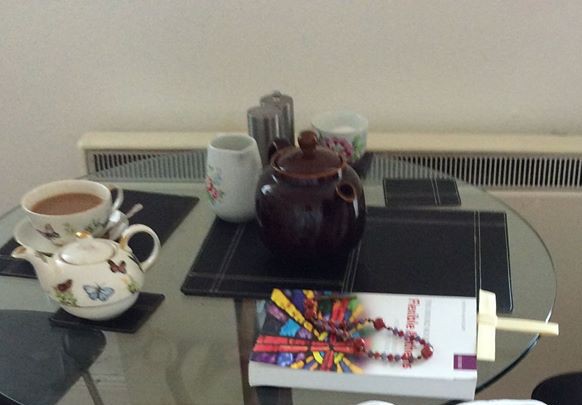
For Little Things

It’s one of those chameleon teas today. It is billed as one thing and tastes like another. It’s got a nice, straightforward name; Peanut Butter Cup. Does what it says on the tin, you think? You’d be wrong.

Now, we’re always a bit odd about chocolate teas, so maybe our guard went up to start with. Maybe it went doubly up because tea shouldn’t be the kind of thing that can trigger anaphylaxis.

But for all that, this is a lovely tea. Except for the minor detail that it tastes like neither chocolate nor peanut butter. We’re prepared to say it tastes a bit like roasted chestnuts. There’s a nuttiness in the tea certainly. But from the flavour of it, we think that comes more, bizarre as this sounds, from the use of dark chocolate in the tea. The cocoa brings out subtler notes in the leaves that come across as faintly roasted.

It’s almost like a smoked tea, like Lapsung. But not quite, because it doesn’t get in your nose the same way. Whatever it is, it’s very nice. What it’s not is a peanut butter cup. And that’s absolutely fine. We love a peanut butter cup, we love this tea, and we accept that one of these things is not like the other.

But we got another opportunity to do a bit of tea sampling today, because a friend surprised us with a tea parcel.

We know, it’s Christmas and that’s what friends do. But this friend is way out in Australia and up to her eyes in managing children’s choir recitals and dogs and more choir recitals and Christmas and even more choir stuff and the dog again. And did we mention choirs? So we weren’t expecting a long-distance  ‘thinking of you’ type anything because we’ve been there and done the headless chicken routine, and something has to give.

Not, apparently, our tea. So, we had the delightful chance to sit down with tea named Jane Austen and enjoy that when we finally, finally got to the end of today’s workload.

It was billed as a rose tea, smelled like Turkish delight, and tasted like a rose garden. Okay, it tasted like a rose garden if rose gardens cultivated really high-quality Assam. We’re ear-marking this tea supplier as someone we want to return to and not just because of the literary names.

Now, on this basis, we thought about finding you one of Jane Austen’s poems. She wrote them, and they do exist. They’re sort of hen’s teeth on the internet, though. So, instead, we dug up a poem by the other literary great behind the tea parcel, L.M. Montgomery.   

We almost posted her piece about harbours but that would involve an explanation and we’ve wittered quite enough tonight. We’ll tell you about The Great Harbour Adventure tomorrow. Remind us. Until then, here’s a tribute to unexpected mementos of long-distance friendships.

For The Little Things
L.M. Montgomery

Last night I looked across the hills
And through an arch of darkling pine
Low-swung against a limpid west
I saw a young moon shine.

And as I gazed there blew a wind,
Loosed where the sylvan shadows stir,
Bringing delight to soul and sense
The breath of dying fir.

This morn I saw a dancing host
Of poppies in a garden way,
And straight my heart was mirth-possessed
And I was glad as they.

I heard a song across the sea
As sweet and faint as echoes are,
And glimpsed a poignant happiness
No care of earth might mar.

Dear God, our life is beautiful
In every splendid gift it brings,
But most I thank Thee humbly for
The joy of little things.

As If They Bear Gifts to My People

Sleigh bells ring…Well no, they don’t but tonight’s tea is Sleigh Ride.

This is one of the Advent standards, and we remember it back when it was a new Crumble Tea aspirant. It’s not as good as Crumble Tea. Nothing will ever be as good as Crumble Tea except the original.

But for what it is, this blend of cinnamon, apples, hibiscus and beetroot is a good herbal blend. A bit astringent, a bit sweet, and shockingly pink. Crucially, the pinkness is only surface deep. You drink it and think Robert Frost, not gelatinous confectionary. Thank God.

Though speaking of, we haven’t had a single green tea this Advent. That’s bizarre. There’s always at least one. But with four days to go, we’ve had several blacks, many herbals and two oolongs. It’s a bizarre way to split the calendar – isn’t green tea supposed to be the latest health kick?

Look, we don’t know either. That’s not how or why we drink tea. But we’re sure that was a thing for five minutes at some point in time. So, we’re taking bets; Green teas from here on out or not a one?

All this talking of old but good teas led us to dig up a truly old poem. No, seriously. Think Alliterative Half Metre and the sixth century, or thereabouts. Don’t worry. We took all the declensions out before you got it. Apparently declining Old English isn’t everyone’s idea of fun. Just ours.

Wulf and Eadwacer

It’s as if someone should give a gift to my people—
They will kill him if he comes to the troop.
It is otherwise for us.

Wulf is on an island, I on another.
Fast is that island, surrounded by fen.
The men on the island are murderous and cruel;
They will kill him if he comes to the troop.

It is otherwise for us.
I felt far-wandering hopes for my Wulf,
As I sat weeping in the rainy weather,
When the bold warrior’s arms embraced me—
It was sweet to me, yet I also despised it.

Wulf, my Wulf! My wanting you
Has made me sick—your seldom coming,
My mourning heart, not lack of meat.
Do you hear, Eadwacer? A wolf bears away
Our wretched cub to the woods.
One can easily split what was never united,
The song of the two of us.

We quibble with lots of this translation, if you want to know. We can do that because we translated this for a university assignment and came through with astonishingly high marks. We also went on to write a pretty comprehensive essay on the linguistic nuances of just how bizarre this little Old English thing is.

For instance, Wulf may not be anyone’s name. It might be a moniker. Or it might be the kind of thing you call anyone of a certain station, like lieutenant. The wretched cub is almost never a cub – every other version we’ve seen refers to a child. But it’s not a terrible translation choice because we all agree that the play on Wulf/wolf is deliberate.

But the last lines stand out here. Most translations go almost Biblical, and you get renderings like ‘What was never joined together cannot be unjoined.’

Oh, and they quibble over who the ‘He’ of that first bit is, too. Extensively. Volubly. Not always in ways that are terribly interesting.

But that’s quite enough of that. We forgot how much of this we remembered until we started lecturing at you. See you tomorrow under actreo. You don’t know ‘The Wife’s Lament?’ Not to worry, we won’t do that to you again. We’ll come back with something nice and more obviously English. Promise.

THe Camels of Trebizond and Elsewhere

Today’s tea was an absolutely lovely black tea called Brown Sugar Bourbon. We should probably preface this with the caveat that we know nothing about bourbon, so can’t speak to that side of the favour.

But the use of brown sugar was ingenious. Brown Sugar Bourbon isn’t showy like Glitter and Gold. It doesn’t sparkle or anything like that. But it does feature a beautifully dark brown sugar to lightly flavour the tea.

As far as we can tell, there’s nothing else there. Like we say, we’re not experts on Bourbon and won’t pretend to be. But what we could detect was a rich and complex semi-sweet black tea that we would happily buy more of.

In the past, we’ve grumbled about some of the flavoured black teas as being too sweet – typically green tea works better to balance the sweeter flavours like apple or maple out. But because dark muscovado sugar has more in it than undiluted sweetness, this particular combination works.

It’s a lovely way to dress up a breakfast table or a therapeutic way to end the afternoon. In this instance, it was the later. We have had an absolutely unrelenting day. The poor dachshunds still aren’t speaking to us because we took exception to some over-exuberant barking five hours ago. But it was the straw that broke this camel’s back.

The Camel
Wislawa Szymborska with translation by Joanna Trzeciek

Don’t tell a camel about need and want.

Look at the big lips
pursed
in perpetual kiss,
the dangerous lashes
of a born coquette.

The camel is an animal
grateful for less.

It keeps to itself
the hidden spring choked with grass,
the sharpest thorn
on the sweetest stalk.

When a voice was heard crying in the wilderness,

when God spoke
from the burning bush,

the camel was the only animal
to answer back.

Dune on stilts,
it leans into the long horizon,
bloodhounding

the secret caches of watermelon

brought forth like manna
from the sand.

It will bear no false gods
before it:
not the trader
who cinches its hump
with rope,
nor the tourist.

It has a clear sense of its place in the world:

after water and watermelon,
heat and light,
silence and science,

it is the last great hope.

What’s fascinating about this poem to us is the symbolism it gives the camel. The only other place we’ve seen them used to represent hope and faith is in Rose Macaulay’s The Towers of Trebizond, and we thought that was a one-off. So, our question to you; Is there a whole academic sub-culture of camel symbolism we’ve missed out on? And if so, where is it and how can we read it?

Also, if you haven’t read The Towers of Trebizond, haste ye to a library. We don’t recommend it to just anyone, but it has the best opening sentence of all time, and if you like tea and poetry, it’s a safe bet you’ll enjoy Macaulay’s prose.  

In Need of (Tea) and Music

We aren’t wild about herbal teas, and David’s herbals can be particularly hit and miss. Silent Night, tonight’s Advent Tea, is an exception.

The copy on the website for David’s Tea bills this one as full of spice, citrus and refreshing. It turns out it’s right on all counts. It’s a lovely blend of orange with Christmas spices that creates a tea that tastes incredibly seasonal. We give them bonus points for pulling it off without marshmallows, artificial flavour or anything unlawfully saccharine.

The orange gives this tea real zest. You feel it refreshing you as you drink it, which sounds unlikely but isn’t us over-egging anything.

After a weekend spent rushing around like the proverbial headless chicken, this was the perfect way to cap a late Sunday evening.

Okay, part of the running around involved The Messiah, which was lovely and also extremely seasonal. We quibbled with some of the alto ornaments in ‘O Thou That Tellest’ but recognize that since alto isn’t our line we can’t really do anything about that. They were perfectly good ornaments, by the way. They were just very out of left field.

Ditto some of the decorations in ‘I Know That My Redeemer Liveth.’ This one we get to have opinions on for the twofold reason that we sing soprano and specifically, can sing this aria. What we hadn’t appreciated until this afternoon was that we apparently had a set of standard ornaments so deeply embedded in our musical psyche we expected everyone to use them. Ah well.

Here’s a poem in keeping with the musical theme of the day. We think it’s as refreshing as Silent Night tea, but will let you have the last word.

I Am In Need of Music
Elizabeth Bishop

I am in need of music that would flow
Over my fretful, feeling fingertips,
Over my bitter-tainted, trembling lips,
With melody, deep, clear, and liquid-slow.
Oh, for the healing swaying, old and low,
Of some song sung to rest the tired dead,
A song to fall like water on my head,
And over quivering limbs, dream flushed to glow!

There is a magic made by melody:
A spell of rest, and quiet breath, and cool
Heart, that sinks through fading colours deep
To the subaqueous stillness of the sea,
And floats forever in a moon-green pool,
Held in the arms of rhythm and of sleep.

I Had A Dove

We had Chai S’Mores tonight. This is a chai base with marshmallow and several other sweet things woven in.

It’s another good example of how to brew a sweet teat that won’t choke anyone on the all-consuming taste of jam. The spice inherent in chai keeps it from cloying. But the presence of marshmallow adds a touch of extra sweetness.

It’s one of those teas that might work well with milk. We didn’t try it that way because it was an exceptionally long evening, and candidly we didn’t have the energy to experiment with tea.

We poured this out after a whack of guests left and the tidy-up was done. It was the first spare moment we got all day.

Not quite true. There was a half-hour earlier where we were reading Less Than Angels. Somewhere in there, Deirdre Swan reads a poem by Christina Rosetti. Our cunning plan was to crib the poem from Pym for you. Can we remember it? Can we never. And can we be bothered sifting through the last 30 pages of Less Than Angles? Ask us again tomorrow, yeah?

Until then, enjoy Keats. He also crops up in Pym, as the pet subject of an American Academic named Ned.

The Sweet Dove Died
John Keats

I had a dove and the sweet dove died;
And I have thought it died of grieving.
O, what could it grieve for? Its feet were tied,
With a silken thread of my own hand’s weaving;

Sweet little red feet! why should you die –
Why should you leave me, sweet bird! why?
You lived alone in the forest-tree,
Why, pretty thing, could you not live with me?
I kissed you oft and gave you white peas;
Why not live sweetly, as in the green trees?

There’s a whole essay to be had on the aptness of this epigram for the Pym novel of the same title. But not tonight. It’s late and the weekend isn’t nearly over. But watch this space. We have plans re Pym.

We Still Haven’t Forgiven The Jam Tea

Today’s tea, Pommegrateful, is one of David’s many Pink Teas. These are teas that pour out pink and taste alarmingly pink.

Usually when this happens there’s hibiscus in the tea somewhere. There’s definitely hibiscus in this tea. But there’s also the eponymous pomegranate.

The result is an incredibly sweet tea that probably makes a much better iced tea than it does a hot one. Every year we get this one out of the calendar we observe that we’d like to try it that way. Just not in -8 weather conditions.

We got distracted with other writing tonight, so that gave this a time not only to steep but to cool. And while it’s not cold, we can confirm it’s a much better tepid tea than a hot one. Some fruit teas shouldn’t be hot, and this is one of those.

It’s also an interesting exercise in how to make a sweet tea that isn’t hideous. We know, we know, we’re still going on about jam-tea from two days ago. But it was appalling. Pomegrateful isn’t.

It walks the tightrope between overly-sweet and cloying, and pleasantly tart. Just as you think it’s tiptoed over the line, the hibiscus under the surface cuts through the pomegranate and sugar of it all.

And no, maybe they shouldn’t be allowed to run with these dreadful puns for names. But you know, it doesn’t taste like jam. And we’re going to keep coming back to that until kingdom come, because truly that was dire.

Tonight’s poem is a gift from another writer-friend. Remember we said we got distracted with other writing? Some of that was for her.

There’s some greyness to the poem, but then, that’s Advent too. And you’ve got to remember, we are chronically allergic to anything too sweet.

Desolation is a Delicate Thing
Elinor Wylie

Sorrow lay upon my breast more heavily than winter clay
Lying ponderable upon the unmoving bosom of the dead;
Yet it was dissolved like a thin snowfall; it was softly withered away;
Presently like a single drop of dew it had trembled and fled.

This sorrow, which seemed heavier than a shovelful of loam,
Was gone like water, like a web of delicate frost;
It was silent and vanishing like smoke; it was scattered like foam;
Though my mind should desire to preserve it, nevertheless it is lost.

This sorrow was not like sorrow; it was shining and brief;

Even as I waked and was aware of its going, it was past and gone;
It was not earth; it was no more than a light leaf,
Or a snowflake in spring, which perishes upon stone.

This sorrow was small and vulnerable and short-lived;
It was neither earth nor stone; it was silver snow
Fallen from heaven, perhaps; it has not survived
An hour of the sun; it is sad it should be so.

This sorrow, which I believed a gravestone over my heart,
Is gone like a cloud; it eluded me as I woke;
Its crystal dust is suddenly broken and blown apart;
It was not my heart; it was this poor sorrow alone which broke.

In Which We Discuss Nice Normal Things Like Golden Geese

The discontented grumblings of a blogger will out, apparently, because after all that stuff the other night about overly sweet faux jam we got Christmas Morning Tea this morning.

Christmas Morning Tea is a nice, sane, no-nonsense black tea with vanilla flavour. We couldn’t for the life of us tell you how this is Christmassy, but candidly, we don’t care. It doesn’t taste like jam. Huzzah! Would it be more Christmassy with cloves in? Of course it would.

Do we care? Not a jot.

We can drink it without awful gagging noises, no tea was poured down the sink in vexation, it’s a banner day for the Chorister at Home and the menagerie.

Doubly so, because we have discovered Muriel Spark wrote poetry. We like to think we’re if not Muriel Spark experts than decently cogent on the subject of her writing. We can even name some of her plays and tell you how The Girls of Slender Means opens.

(We can tell you the last sentence of The Prime of Miss Jean Brodie, too, but so can anyone who claims to like Spark, so that’s no great thing.)

We did not know she wrote poetry.

So, obviously, what with writing about nothing but tea and poetry all Advent we set out to find some of her poems. It took some digging. Turns out Muriel Spark’s poetry is rivalling Tenessee Williams for Best Kept Poetic Secret of the Century. The thing of it is, we’d all know it a heck of a lot better if they’d both never written a novel or a play worth talking about.

With that in mind, here’s a quintissencially Muriel Spark poem by the woman who wrote the most horrifyingly gothic tea scene ever. You can find it in Memento Mori, if you are wondering. You’ll never look at a Victorian tea service the same way again. But before you set off to do that, here’s that poem.

The Goose
Muriel Spark

Do you want to know why I am alive today?
I will tell you.
Early on, during the food-shortage,
Some of us were miraculously presented
Each with a goose that laid a golden egg.
Myself, I killed the cackling thing and I ate it.
Alas, many and many of the other recipients
Died of gold-dust poisoning.

You’re laughing, aren’t you? Even while experiencing visceral horror. That’s Spark’s signature. Darkly, comedically brilliant.   

We Despair of Jelly Dougnuts

More dancing tonight. The Dawlish Dachshunds currently aren’t speaking with or to us because it was our Christmas Party and we got home late. No, not the one on Saturday, a different one. Do keep up. Lots of Scottish Dance here on Dawlish and it’s all wrapping up for the holidays.

We had live music and food afterwards…Actually, Rockingham Napier, charmer of WRENS is speaking to us. This is because he is as incorrigeable a flirt as his namesake and despite courting the Marschallin Cat, has yet to figure out how one holds a grudge. But anyway, Buffy isn’t speaking to us and Miss Marschallin is offended. Very.

So, anyway, because the animals that don’t flirt with us are shunning us, we’re drinking our tea for the evening. It’s called Jelly Doughnut, and it tastes like drinking jam.

We’ve always wondered what that would be like, you know? Back when we studied Eugene Onegin Penguin thoughtfully footnoted a line about passing the jam around. We went looking thinking it would be a lesson on Russian tea prep. Cue the world’s most useless footnote; Jam is a preservative that comes in flavours Raspberry, Strawberry, Blueberry, etc. Really? Really, Penguin?

If we were doing the Penguin debrief on this tea, we would now tell you that this tea tastes specifically like the preservative Raspberry Jam. You can make it by…But we like to be more helpful than Penguin.

What we are driving at here is that this is a ridiculously sweet tea. There’s some kind of confectionary thing in the mix – you know those pink things that aren’t sprinkles but you still decorate cakes with? They’re in here, cheerfully dissolving. So is some kind of currant and apple.

It’s much, much too sweet. Unless you have a sweet tooth, in which case you won’t have any qualms drinking faux jam.

It may also be our fault. We tipped the tin into our quilted cats mug. We only let it steep for about ninety seconds and that was enough to strip the enamel off our teeth. So, if you fancy it, use moderate amounts of tea and pour out immediately. Do not let stand.

On the other hand, it gave us the perfect poem for tonight. Enjoy!

Faithful Jelly Doughnut
Dennis Lee

Far across the ocean,
Far across the sea,
A faithful jelly donut
Is waiting just for me.

Its sugar shines with longing,
Its jelly glows with tears;
My donut has been waiting there
For twenty-seven years.

O faithful jelly donut,
I beg you; don’t despair!
My teeth are in Toronto, but
My heart is with you there.

And I will cross the ocean,
And I will cross the sea,
And I will crush you to my lips;
And make you one with me.

Unless you too cannot stand jelly doughnuts, in which case the fictive Rupert Giles will gladly have your share. He can certainly have ours!

Camomile Lawns

Today’s tea is Calming Camomile. Investigation reveals David spells this the Canadian way, and you know, fair play. But it’s late and we’ve read too much Mary Wesley. It looks wrong if we deviate from British English. Apologies.

Candidly, we aren’t camomile lovers. Unless you stick the stuff in a fictive Camomile Lawn way off in Cornwall and leave us to read about it. That’s quite nice. As a tea, it’s not a flavour that does a lot for us. When we want something soothing, we drink lavender.

So, when we say this one is a decent camomile tea, we aren’t damning with the faint praise we could be. Someone went to extravagant lengths to dress it up with apple and a few other ingredients. Nothing you can do about the awful camomile smell, but at least it tastes more of apples than hay.

On the other hand, we still have other things we prefer when we want something soothing. Like sticking on a video of Orchards of County Armagh and watching the dancers. We’re odd like that.

Just to prove it, here’s an unlikely poem to go with today’s sleepy time tea offering.

Flowers
Wendy Cope

Some men never think of it.
You did. You’d come along
And say you’d nearly brought me flowers
But something had gone wrong.

The shop was closed. Or you had doubts-
The sort that minds like ours
Dream up incessantly. You thought
I might not want your flowers.

It made me smile and hug you then.
Now I can only smile.
But, look, the flowers you nearly brought
Have lasted all this while.

Why ‘Flowers’? Because we had to write all kinds of gloop for a work assignment today and this was the perfect anecdote. Also, there’s tremendous debate about whether the speaker is being sincere or cynical. Feel free to write in and take sides. We know where we come down.

Nor All That Glisters Gold

Another old favourite today. We ended up brewing it several times. Glitter and Gold is a black tea that supposedly sparkles when you pour it out. We’ve never made that happen.

It’s something to do with the sugar crystals in it, or something. Anyway, the composition has clearly changed a bit, because it used to include little gold balls of what we presume was a variation on hundreds and thousands.

That wasn’t in the tin, so apparently whatever causes the crystalline effect has changed. It hasn’t affected the taste. It’s still a light, sparkling (meraphorically) black tea with a hint of spice.

We associate it with Cambridge, because that’s where a friend introduced us to it. We drank nothing else for the whole of the visit. This was back when David’s Tea still shipped to Britain. After that we stocked up in Toronto and brought a whacking great load of tea across the border. That was when Toronto still had stores you could walk into.

As it happens, we have the perfect poem to go with Glitter and Gold with its sparkling gold confectionary balls. It was a Poetry and Cake staple.

Ode on the Death of a Favourite Cat Drowned in a Bowl of Goldfishes
Thomas Grey

Twas on a lofty vase’s side,
Where China’s gayest art had dyed
The azure flowers that blow;
Demurest of the tabby kind,
The pensive Selima, reclined,
Gazed on the lake below.

Her conscious tail her joy declared;
The fair round face, the snowy beard,
The velvet of her paws,
Her coat, that with the tortoise vies,
Her ears of jet, and emerald eyes,
She saw; and purred applause.

Still had she gazed; but ’midst the tide
Two angel forms were seen to glide,
The genii of the stream;
Their scaly armour’s Tyrian hue
Through richest purple to the view
Betrayed a golden gleam.

The hapless nymph with wonder saw;
A whisker first and then a claw,
With many an ardent wish,
She stretched in vain to reach the prize.
What female heart can gold despise?
What cat’s averse to fish?

Presumptuous maid! with looks intent
Again she stretch’d, again she bent,
Nor knew the gulf between.
(Malignant Fate sat by, and smiled)
The slippery verge her feet beguiled,
She tumbled headlong in.

Eight times emerging from the flood
She mewed to every watery god,
Some speedy aid to send.
No dolphin came, no Nereid stirred;
Nor cruel Tom, nor Susan heard;
A Favourite has no friend!

From hence, ye beauties, undeceived,
Know, one false step is ne’er retrieved,
And be with caution bold.
Not all that tempts your wandering eyes
And heedless hearts, is lawful prize;
Nor all that glisters, gold.

Apologies cat lovers! We know a few of you read along. It’s not Miss Marschallin’s favourite poem, either, nor ours. But we saw the name on the tea tin and the first thing we thought of was that final line by Gray. It’s was too perfect to leave lying there.