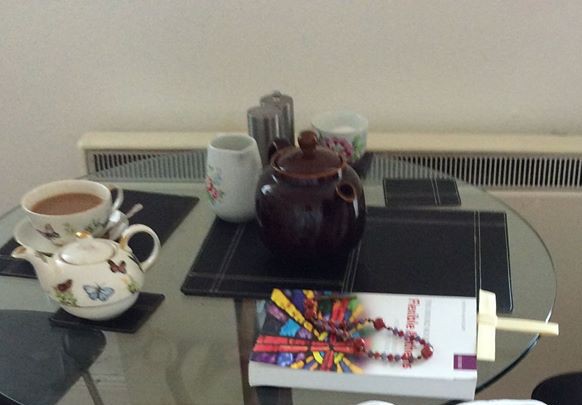
Milk Oolong for Not-Quite Milkwood

The Advent door gave us one of our favourite teas for Gaudete Sunday.

It’s a kind of milk oolong. Rich, creamy, and as the name suggests, a bit milky. We never drink it with milk, though we know people who do and enjoy it. Oolong leaves ferment though. It’s part of what gives oolong its distinctive flavour. And we can’t square that taste with milk.

Still, it was the ideal way to relax our Advent discipline of a Sunday afternoon. We thought it would go well with a bit of ‘Under Milk Wood.’ A friend reminded us it existed, and it used to be a staple of the Poetry and Cake Society, which has more than a little to do with this series of blogs existing.

But pulling out an excerpt of ‘Under Milk Wood’ at no notice is tricky. So, instead, here’s another poem by the same author.

The Almanac of Time
Dylan Thomas

The almanac of time, hangs in the brain;
The seasons numbered, by the inward sun,
The winter years, move in the pit of man;
His graph is measured as the page of pain
Shifts to the redwombed pen.

The calendar of age hangs in the heart,
A lover’s thought tears down the dated sheet,
The inch of time’s protracted to a foot
By youth and age, the mortal state and thought
Ageing both day and night.

The word of time lies on the chaptered bone,
The seed of time is sheltered in the loin:
The grains of life must seethe beneath the sun,
The syllables be said and said again:
Time shall belong to man.

We’ve been to Wales and seen Dylan Thomas’s boathouse. We’ve also seen the place where supposedly he did lots of his writing. It was admittedly spoiling for rain at the time, because it was Wales. That whole day was a bit wet and a bit improvised, because nothing went to plan. But it was fun and the company was good. We think of this now every time we read Thomas.

Dancing Days

Today’s tea was Forever Frosty.

We aren’t sure if it’s supposed to replace Forever Nuts but hope it is. It has a lot of those same flavours but is a superior tea. It’s less sweet, less pink and has a long-in-the-mouth flavour that rounds out the taste.

The ingredients claim it features marshmallow. We can’t taste it, but we did get hints of orange and cloves. Somewhat bizarrely it smells of, but doesn’t taste like pine needles. We’re not complaining so much as observing. It’s a lovely smell and pairs handily with a good herbal tea. But it’s monumentally bizarre.

We’re late on the whole blog thing tonight because it was the Scottish Country Dance Christmas Dance. It was our first monthly dance since covid. We’ve been going to weekly sessions for over a year now, but have been cantering up to the  montly balls.

This one was lots of fun. We can tell we’re where we should be in the intermediate class because in a program rife with corner- and ladies’ chains, we barely registered them. In fact, looking over the selection this afternoon we wrote the lot off as easy. Well, except that one dance with a one-person poussette. Candidly, I think the whole society is pretending that dance never happened. This is why no one dances the old dances.

As is tradition when the blog coincides with the Christmas dance, we eked out a Pat Batt poem for you. She dances Scottish and she has a rare eye for observations. Enjoy ‘The Intermediate Class.’

The Intermediate Class
Pat Batt ©2000

Well now I’m Intermediate –
My feet are doing nicely –
The brain still finds it hard to cope
And work things out precisely.

I sometimes feel that I’m a pawn
In a giant game of chess –
But the pattern’s getting clearer
And the chaos getting less.
I’ve mastered chain progression,
I can do a nifty Knot –
But the Rondel and Espangnole,
I admit they’re not so hot.

So – here you find me in the set
And I am number two.
I’m O.K. for the first few bars –
I’ve nothing much to do.
I’ve stepped up very nicely
(It’s lovely to be dancing!)
But – someone’s coming up the set –
Oh, should I be advancing?
Ah no, it’s just a set and turn
And balance in a line –
My confidence comes flooding back
And now I’m doing fine!

I’ve come in for the Allemande
(Arm over on bar one!)
Now I can do it properly
I’m finding it such fun!
I’ve done 8 slip steps to the left
And 8 back to the right,
I’ve turned, and now I’m casting
And the end is now in sight.
I’ve remembered all the proper things
That I’ve been taught to do –
And the nicest thing about it is
My teacher’s happy too!

We contest the bit about the Rondel and Espagnol. Not only do we dance them ably, but the Espagnol is one of our favourite formations. Now Set-to-Partner-Set-to-Corner…And don’t start us on Diamond Poussettes. Awful, awful things.

Blast Beruffled Plume

Today’s David’s Tea is a wonderful selection. It’s called Salted Caramel Oolong. We always say we have yet to meet an oolong we don’t like, and this is a textbook example of why that’s true.

Oolongs are wonderfully flexible teas. You can mix them with fruit or sweets or leave them alone and you always get a rich combination of tastes. Salted Caramel Oolong is a bit sweet, and it’s long in the mouth. It’s an extravagant desert tea or afternoon tea. There’s enough caffeine to get you through the afternoon but not too much to keep you wide awake.

We drank ours while writing about bird symbolism today. 2000 words of it. It’s been one of our better topics.

That makes our poetry selection tonight apt. Here’s one of our favourite poems in the English language to go with our favourite oolong. It happens to be about a bird. But it’s about so much more than that, too.

The Darkling Thrush
Thomas Hardy

I leant upon a coppice gate
When Frost was spectre-grey,
And Winter’s dregs made desolate
The weakening eye of day.
The tangled bine-stems scored the sky
Like strings of broken lyres,
And all mankind that haunted nigh
Had sought their household fires.

The land’s sharp features seemed to be
The Century’s corpse outleant,
His crypt the cloudy canopy,
The wind his death-lament.
The ancient pulse of germ and birth
Was shrunken hard and dry,
And every spirit upon earth
Seemed fervourless as I.

At once a voice arose among
The bleak twigs overhead
In a full-hearted evensong
Of joy illimited;
An aged thrush, frail, gaunt, and small,
In blast-beruffled plume,
Had chosen thus to fling his soul
Upon the growing gloom.

So little cause for carolings
Of such ecstatic sound
Was written on terrestrial things
Afar or nigh around,
That I could think there trembled through
 His happy good-night air
Some blessed Hope, whereof he knew
And I was unaware.

Not that anyone asked, but we could do you a whole Advent of nothing but Thomas Hardy. The man gets damned out of hand for his bleak novels, but for our money, he writes some of the most beautiful poetry there is. And as this one demonstrates, it can be surprisingly hopeful.

About Cats

Tonight’s tea is Mother’s Little Helper.

We always get a kick out of this one because the whole concoction revolves around valerian root. In humans, that makes you sleepy. We never get to have much of it because we open the tin, Miss Maschallin comes nosing, and next thing we know, we are up to our eyes in stoned cat.

The thing about valerian root is that however it works on humans, feline brain chemistry is completely different. It revs them up like nothing on earth. And it stinks to high heaven.

But it’s a really lovely, therapeutic tea if you have, say, spent an evening trying to keep an overactive Dachshund Puppy – let’s call him Rocky – away from the woodpile. And the Christmas tree. And the cat. And…

Tell you what, we’re going to sit down and enjoy our valerian tea, and you can enjoy this lovely poem about cats. Deal?

Pangur Bán
Translation by Seamus Heaney

Pangur Bán and I at work,
Adepts, equals, cat and clerk:
His whole instinct is to hunt,
Mine to free the meaning pent.

More than loud acclaim, I love
Books, silence, thought, my alcove.
Happy for me, Pangur Bán
Child-plays round some mouse’s den.

Truth to tell, just being here,
Housed alone, housed together,
Adds up to its own reward:
Concentration, stealthy art.

Next thing an unwary mouse
Bares his flank: Pangur pounces.
Next thing lines that held and held
Meaning back begin to yield.

All the while, his round bright eye
Fixes on the wall, while I
Focus my less piercing gaze
On the challenge of the page.

With his unsheathed, perfect nails
Pangur springs, exults and kills.
When the longed-for, difficult
Answers come, I too exult.

So it goes. To each his own.
No vying. No vexation.
Taking pleasure, taking pains,
Kindred spirits, veterans.

Day and night, soft purr, soft pad,
Pangur Bán has learned his trade.
Day and night, my own hard work
Solves the cruxes, makes a mark.

So, we can’t translate Old Irish unassisted. But we definitely translated quite a lot of Old English while the Marschallin Cat looked on. We learned soprano descants with her sitting in, too. Very musically snobbish that one, we can tell you.  

The Blind Men And Their Elephants After All

Tonight we drank Organic Orange Spice.  The internet tells us that in another life this was ‘The Spice Is Right.’ We don’t remember it that way, either.

This is one of those bizarre David’s Tea’s that is billed as one thing and tastes like another.

Supposedly, there’s orange in there. See further the name. It also purports to be a blend of green tea and chai.

We are prepared to grant the chai is definitely in there. If there’s any green tea, not only did we not see it, but the taste doesn’t come through. To be fair, no taste comes through except cloves.

Don’t misunderstand. The taste is lovely. It’s cloves-heavy and cloves mean Christmas to us. But we don’t get any orange out of this. In fact, we misread the title as ‘Organic Spice,’ and candidly, that’s more accurate.

Forget what we said about variety. If ever tonight warranted a poem about things that weren’t what they seemed this is it. And we have just the poem.

The Blind Men and the Elephant
John Godfrey-Saxe


It was six men of Indostan
To learning much inclined,
Who went to see the Elephant
(Though all of them were blind),
That each by observation
Might satisfy his mind.

II.
The First approached the Elephant,
And happening to fall
Against his broad and sturdy side,
At once began to bawl:
“God bless me!—but the Elephant
Is very like a wall!”

III.
The Second, feeling of the tusk,
Cried: “Ho!—what have we here
So very round and smooth and sharp?
To me ‘t is mighty clear
This wonder of an Elephant
Is very like a spear!”

IV.
The Third approached the animal,
And happening to take
The squirming trunk within his hands,
Thus boldly up and spake:
“I see,” quoth he, “the Elephant
Is very like a snake!”

V.
The Fourth reached out his eager hand,
And felt about the knee.
“What most this wondrous beast is like
Is mighty plain,” quoth he;
“‘T is clear enough the Elephant
Is very like a tree!”

VI.
The Fifth, who chanced to touch the ear,
Said: “E’en the blindest man
Can tell what this resembles most;
Deny the fact who can,
This marvel of an Elephant
Is very like a fan!”

VII.

The Sixth no sooner had begun
About the beast to grope,
Than, seizing on the swinging tail
That fell within his scope,
“I see,” quoth he, “the Elephant
Is very like a rope!”

VIII.

And so these men of Indostan
Disputed loud and long,
Each in his own opinion
Exceeding stiff and strong,
Though each was partly in the right,
And all were in the wrong!

MORAL.
So, oft in theologic wars
The disputants, I ween,
Rail on in utter ignorance
Of what each other mean,
And prate about an Elephant
Not one of them has seen!

We don’t know what’s going on with the italics, either. It’s bizarre. On the other hand, that’s true of just about everything Godfrey-Saxe writes. Italics are the least of it.

Candy Cane Crush

Today’s tea was Candy Cane Crush.

This is one of David’s weirder tea selections. It’s a lovely tea but not without issues. The biggest one is the titular candy cane. The tea integrates pieces of candy cane, and nice though it is to know the ingredients aren’t entirely artificial, this means you have to scrub all the tea things for hours afterwards.

Why? Because the melting candy cane covers everything, but especially the tea infuser, in residue that doesn’t come off without a fight.

The other issue is one we’ve never parsed. Something about the candy canes stops the tea steeping properly. We aren’t chemists, so aren’t clear on how this works. But you notice it when you pour out; The tea pours through a film of melted sugar. It makes a very sparkly tea, but it also means it never reaches full strength.

Lest you think we didn’t let it sit long enough, the tea sat there in its pot for a full episode of The Archers. That’s 13-minutes of radio to you non-Ambridgites. And it still came out what our father calls ‘winkles tea.’

If you can get past that, it’s got a lovely flavour. A bit sweet, a bit minty, and a bit of caffeine. The tin does say it never gets very strong, so the issue we notice with the steeping strength may be a feature, not a bug.

We’re posting early tonight, because we are about to head off dancing. The Christmas dance is Saturday, and we haven’t decided if we’re going. It seems like a thoroughly good way to catch covid, so we are hedging. That said, we can run to a three-couple set up at the community centre.

Talking about dancing, here’s some Yeats for you.

Sweet Dancer
W.B. Yeats

The girl goes dancing there
On the leaf-sown, new-mown, smooth
Grass plot of the garden;
Escaped from bitter youth,
Escaped out of her crowd,
Or out of her black cloud.
Ah, dancer, ah, sweet dancer!

If strange men come from the house
To lead her away, do not say
That she is happy being crazy;
Lead them gently astray;
Let her finish her dance,
Let her finish her dance.
Ah, dancer, ah, sweet dancer!

Strange Metemorphoses

Tonight we’re drinking Strawberry Rhubarb Parfait, which has the distinction of tasting shockingly pink.

When we lived in hall, there was a pink doughnut-type thing that used to appear regularly as pudding. Retrospectively we think it was some sort of Aussie creation, because the middle was full of jam. We forget the name, but this is always what we think of when we drink Strawberry Rhubarb Parfait by David’s Tea.

It’s astonishingly pink and incredibly sweet. We left it to steep while we mucked about poem-hunting and that was an error, because while not actually cloying, the flavours distinctly flirt with that possibility.

Mind, as long as you have a sweet tooth that shouldn’t be an issue. And the saving grace of this tea is the rhubarb. Even now it pulls it back from the edge of being overly-sweet with a long-in-the-mouth tartness. You don’t notice until you’ve swallowed, and it’s the perfect antidote to all that strawberry and sugar.

It’s one of our favourite teas, and comes at just the right time, because we’ve had a longer than normal day. To lighten the whole thing we went hunting for verses for you by John Godfrey-Saxe. He’s obscure and overlooked. Candidly, if Lemony Snicket hadn’t devoted a whole exegesis to his poem on six men and an elephant, we wouldn’t know him.

Truth be told, ‘The Blind Men and the Elephant’ is probably our favourite Godfrey-Saxe. But we’ve used it here before and we do try to give you variety. So, here’s a playful retelling of Ovid. We’re not at all sure what Ovid would make of it, but it’s Saxe at his irreverent best, which is how we like him.

How the Raven Became Black
John Godfrey Saxe

There’s a clever classic story,
Such as poets used to write,
(You may find the tale in Ovid),
That the Raven once was white.

White as yonder swan a-sailing
At this moment in the moat,
Till the bird, for misbehavior,
Lost, one day, his snowy coat.

‘Raven-white’ was once the saying,
Till an accident, alack!
Spoiled its meaning, and thereafter
It was changed to ‘Raven-black.’

Shall I tell you how it happened
That the change was brought about?
List the story of CORONIS,
And you’ll find the secret out.

Young CORONIS, fairest maiden
Of Thessalia’s girlish train,
Whom Apollo loved and courted,
Loved and courted not in vain,

Flirted with another lover
(So at least the story goes)
And was wont to meet him slyly,
Underneath the blushing rose.

Whereupon the bird of Phoebus,
Who their meetings chanced to view,
Went in haste unto his master,
Went and told him all he knew;

Told him how his dear CORONIS,
False and faithless as could be,
Plainly loved another fellow-
If he doubted, come and see!

Whereupon Apollo, angry
Thus to find himself betrayed,
With his silver bow-and-arrow
Went and shot the wretched maid!

Now when he perceived her dying,
He was stricken to the heart,
And to stop her mortal bleeding,
Tried his famous healing art!

But in vain; the god of Physic
Had no antidote; alack!
He who took her off so deftly
Couldn’t bring the maiden back!

Angry with himself, Apollo,
Yet more angry with his bird,
For a moment stood in silence-
Impotent to speak a word.

Then he turned upon the Raven,
‘Wanton babbler! see thy fate!
Messenger of mine no longer,
Go to Hades with thy prate!

‘Weary Pluto with thy tattle!
Hither, monster, come not back;
And- to match thy disposition-
Henceforth be thy plumage black!’
MORAL
When you’re tempted to make mischief,
It is wisest to refuse;
People are not apt to fancy
Bearers of unwelcome news.
SECOND MORAL
Something of the pitch you handle,
On your fingers will remain;
As the Raven’s tale of darkness
Gave the bird a lasting stain!

That sounds like Ovid, doesn’t it?  All right, it sounds like a thoroughly vexed Classicist’s rendering of Ovid in English. But you can see the Ovidian shape behind the light verse, can’t you?

Hot Chocolate and Houseman

Saving everyone a lot of headaches, today’s tea was Hot Chocolate.

So, there’s no need for the auxiliary tab detailing what’s in the tea this time or how to brew it. This one’s an old favourite and a calendar staple.

We always enjoy a black tea in the calendar, because we can drink it over breakfast instead of remembering to schedule something atypical into the day, like an oolong or rooibos. And this is a lovely decadent black tea designed to taste like hot chocolate. It always feels extravagant as a breakfast tea, but it’s too caffeinated to be an evening drink.

Because it’s chocolate-flavoured, it’s also the rare flavoured black tea we add milk too. It’s lovely without it, but a bit of milk makes it creamier and brings out the chocolate flavour.

Because it’s been in the calendar so long, it’s a tea that is inherently nostalgic, especially of late nights at Kinness Place. We’d sit on the most orange sofa in creation, juggle the lap desk awkwardly with our tea for one and rattle off the blog, often after a train journey somewhere. Usually it was Stirling.

Since that’s the case we thought we’d give you a similarly nostalgic poem. This one is shot through with a bit of the grey and sere, too, but that’s appropriate for Advent.

Tell Me Not Here It Needs Not Saying
A.E. Houseman

Tell me not here, it needs not saying,
What tune the enchantress plays
In aftermaths of soft September
Or under blanching mays,
For she and I were long acquainted
And I knew all her ways.

On russet floors, by waters idle,
The pine lets fall its cone;
The cuckoo shouts all day at nothing
In leafy dells alone;
And traveller’s joy beguiles in autumn
Hearts that have lost their own.

On acres of the seeded grasses
The changing burnish heaves;
Or marshalled under moons of harvest
Stand still all night the sheaves;
Or beeches strip in storms for winter
And stain the wind with leaves.

Possess, as I possessed a season,
The countries I resign,
Where over elmy plains the highway
Would mount the hills and shine,
And full of shade the pillared forest
Would murmur and be mine.

For nature, heartless, witless nature,
Will neither care nor know
What stranger’s feet may find the meadow
And trespass there and go,
Nor ask amid the dews of morning
If they are mine or no.

In Which Time May Or May Not Run Backwards

Today’s tea is called Headache Halo. This is accidentally apt, not that you’d know. So please allow us a minute to tell you about the ridiculous rigamarole involved in this Advent exercise.

Somewhere between the death of Augie Doggie and December 2022, our normal browser, Firefox (fast, reliable, does what it’s told) was deemed unable to run WordPress. So is the browser we long since rejected, Safari. That one made sense; Safari had become unusable at our end for anything except propelling time backwards.

But there’s a rumour we can run WordPress off of Chrome. Please picture us, late on Dec. 1, frantically downloading Chrome on the perfectly usable Firefox browser.

But why the fuss says you. We’re here, so it obviously worked. Well, sort of. The thing is, Chrome is Very Offended it’s not our Default Browser. It’s also slower than a very slow thing. There is treacle being poured into vats of molasses moving on snowbound trains to the frozen tundra that go faster than Chrome.

And while we could probably write the blog on the app, we’re not wild about trying to mcgyver poetry into cogency on there. So here we are, on this ridiculous browser that makes time slip backwards, wth one tab on the blog, one on the poem of the week, and another on the tea of the day.

Why?

Oh, didn’t we mention? This year David and Co have so thoroughly streamlined the enterprise that they have taken all relevant info off the smart gold tins. Steeping times, teaspoon amount, ingredients…Can’t be had without looking at the back of the box and risking discovering what else is in the calendar. Next year it will be so streamlined it won’t even be on the box. There won’t be a box. They’re going to put the ready-steeped tea in one communal teapot that pours a different tea each day. You heard it here first.

So three days in, Headache Halo sounds about right. Sorry, that was only supposed to take a minute, wasn’t it?

Luckily, this is a really lovely tea. It’s a rooibos blend that uses a combination of lavender, mint and willow to help with headaches. Does it work? We aren’t headache prone, so who knows. Alack, alas, we can tell you it will not speed up recalcitrant internet browser. But it may stop you defenestrating your laptop, so it has that going for it.

In all seriousness, we appreciate the blend. Neither mint or lavender on their own are tea flavours we’re wild about, though we’ll take lavender over camomile any day for a sleeping tonic. But the rooibos stops them being overwhelming. The result is a slightly-minty tea with no caffeine that may or may not cure headaches. Feel free to update us on that one. But we definitely recommend it for Mrs. Bennet’s nerves.

Here’s a poem to read over your headache cure-all of choice takes effect.

all nearness pauses, while a star can grow
e. e. cummings

all nearness pauses, while a star can grow

all distance breathes a final dream of bells;
perfectly outlined against afterglow
are all amazing and the peaceful hills

(not where not here but neither’s blue most both)

and history immeasurably is
wealthier by a single sweet day’s death:
as not imagined secrecies comprise

goldenly huge whole the upfloating moon.

Times a strange fellow;
more he gives than takes
(and he takes all)nor any marvel finds
quite disappearance but some keener makes
losing, gaining
—love! if a world ends

more than all worlds begin to(see?) begin

In Which We All Need Levity

Forgive us if today’s blog runs short. We finished rattling off 4500 words for work approximately half an hour ago. A cup of tea later and the sensation is still the way we imagining walking into a brick wall feels.

We did manage to stop for elevenses and try today’s tea, though. We were anxious about it because it was called Sweet Potato Pie and we aren’t wild about sweet potatoes. A good rule of thumb is that if it’s orange and gourd-like, we probably don’t like it. The absolute worst offender on this front is sweed, which we used to think Mrs. Read was over-egging when she condemned it. But then we moved to a British hall of residence. Turns out Miss Read undersold how dire sweed is.

Luckily, Sweet Potato Pie tastes nothing like sweet potato. If it tastes of anything, it’s chestnut. We’re a bit sorry we didn’t ration this black tea out, because we would drink it again. But if you will name your teas after hideous orange gloop…

It’s also a highly restorative tea. It’s probably too caffeinated for anyone who doesn’t want much caffeine past mid-morning, but it suited us fine. It got us through the 4500 obligatory words for work.

Even so, after all of that, we need some levity. Here’s a textbook example of light verse to get you through your evening.

Some Rules
Wendy Cope


Stop, if the car is going “clunk”
Or if the sun has made you blind.
Don’t answer e-mails when you’re drunk.

You fire off something fierce. You’re sunk.
It’s irretrievable. It’s signed.
You feel your spirits going “clunk.”

Don’t hide your face with too much gunk,
Especially if it’s old and lined.
Don’t answer e-mails when you’re drunk.

Don’t live with thirty years of junk—
Those precious things you’ll never find.
Stop, if the car is going “clunk.”

Don’t fall for an amusing hunk,
However rich, unless he’s kind.
Don’t answer e-mails when you’re drunk.

In this respect, I’m like a monk:
I need some rules to bear in mind.
Stop, if the car is going “clunk.”
Don’t answer e-mails when you’re drunk.

We would add ‘Do not take on eleventh-hour projects of over three thousand words to be done by mid-morning Monday on a Thursday.’ But it doesn’t scan.